How is a refrigerant leak found and fixed?
A certified HVAC technician finds the leak with an electronic detector, UV dye or bubble solution, recovers the remaining refrigerant, then repairs the leaking tubing or fitting or replaces the leaking coil. The repaired circuit is pressure-tested with nitrogen, evacuated with a vacuum pump and recharged to the manufacturer's specified amount. Adding refrigerant without finding the leak is not a repair.
Free to ask. Local shops send quotes, and you pay only when you book one.
By Kasra Taheri, Founder, LoclisPublished
Researched and drafted with AI, then checked claim by claim against the sources listed below before it was published. Prices and rules change; the dates beside each source say when it was last checked.
This is a job for a licensed pro in Virginia
This page explains what the work involves, the permits, what a licensed pro does and what drives the cost. It does not give step-by-step instructions, because this work needs a licence, a permit or both, and doing it wrong can injure someone. Before you hire, check the licence on Virginia's DPOR record.
A refrigerant leak is fixed in a set order: a certified technician finds the leak, recovers the refrigerant still in the system, repairs the damaged tubing or fitting or replaces the leaking coil, proves the repair with a nitrogen pressure test, pulls a vacuum, and recharges the system to the manufacturer's specified amount. Every part of that work happens inside the sealed refrigerant circuit, so it is a job for a licensed HVAC pro, not a homeowner.
Why the leak has to be found
A central air conditioner or heat pump does not use up refrigerant. If the charge is low, the system either has a leak or was charged incorrectly when it was installed.[4][1] That is why a recharge on its own does not fix anything. The EPA asks homeowners to have technicians locate and repair leaks instead of "topping off" a leaking system, which also cuts future service calls and repair costs.[6]
Leaks are not inevitable. Major leaks rarely develop in properly installed and regularly maintained units.[6] When one does appear, the job is to find where and why. If you are not sure the system is low at all, start with how to tell if your AC is low on refrigerant.
Where leaks usually start
Knowing the common spots explains why a technician searches where they do. Chemicals in household air, such as hairspray, cleaning supplies and air fresheners, can react with copper coils and eat tiny pinholes in them, a process called formicary corrosion.[1] Vibration can rub a copper line against another part until it wears through, joints that were poorly soldered at installation can weaken over time, and lawn equipment or falling debris can damage the lines at the outdoor unit.[1]
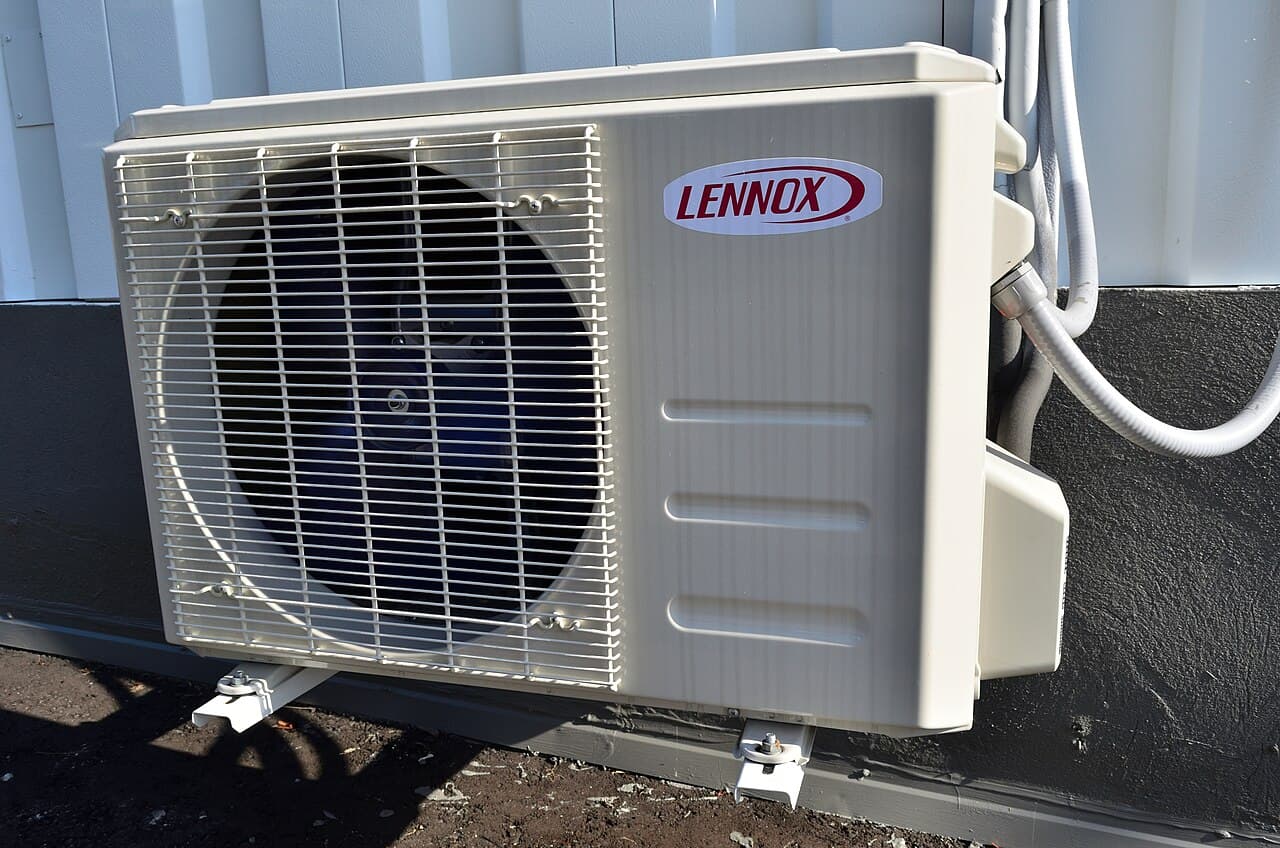
On a ductless mini-split, the technician also checks the flare fittings where the refrigerant lines connect the outdoor unit to the indoor units, and in some cases tightening a fitting is the whole repair.[4]

Finding the leak
Technicians use three main tools, often more than one on the same call. An electronic leak detector, often called a sniffer, senses refrigerant in the air near a leak.[2][1] UV dye added to the system circulates with the refrigerant, escapes at the leak and glows under an ultraviolet light.[2] A soap bubble solution brushed or sprayed on the copper lines and joints shows the exact pinhole or crack.[1]
Small leaks are hard to find with bubbles alone,[3] and pinpointing a leak can take time,[4] especially when it sits inside an indoor coil behind panels. You can save some of that time by telling the technician what you have noticed: when cooling dropped off, any ice, and whether you have seen an oily stain or residue at a fitting or valve, or a hissing sound near the refrigerant lines.[3]
Recovering the refrigerant
Before the circuit is opened, the technician recovers the remaining refrigerant with a recovery machine into a certified recovery cylinder.[1] Under Section 608 of the Clean Air Act, EPA regulations prohibit intentionally venting refrigerant while servicing, repairing or disposing of air-conditioning equipment.[7]
On equipment holding more than five pounds of refrigerant, technicians must evacuate it to set vacuum levels when they open it for service or repair.[8] When a leak keeps them from reaching those levels, they must isolate the leaking parts where possible, evacuate the parts that do not leak to the normal level, and take the leaking parts as low as they can go without contaminating the refrigerant, never above 0 psig.[8] Recovered refrigerant can go back into the same system or another system owned by the same person; if it changes hands, it must be reclaimed by an EPA-certified reclaimer.[8]
Repairing the leak
The repair depends on where the leak is and how much of the part is damaged. For a leak in copper tubing, the technician usually cuts out the damaged section and brazes a new piece in its place.[1] When corrosion has spread through an evaporator or condenser coil, the coil itself is replaced.[1][2]
The refrigerant your system uses shapes the options. Under EPA rules, a homeowner can have a faulty component such as a condensing unit or indoor coil replaced with a similar R-410A component.[9] After January 1, 2026, a whole new system must use a lower-GWP refrigerant, and replacing the condensing unit and indoor coil together counts as a new system.[9] For a coil-or-system decision, see whether to replace the whole AC system or just the condenser.
Older systems usually run on R-22. There are no drop-in replacements for R-22 (HCFC-22), so technicians who repair leaks in an R-22 system most often recharge it with HCFC-22.[6] No new HCFC-22 has been made or imported into the United States since January 1, 2020, but used HCFC-22 cleaned to the same specifications as new remains available.[6]
Testing, evacuating and recharging
A repair is not finished until it is proven. The technician pressurizes the refrigerant circuit with dry nitrogen and watches for any loss of pressure, using the test pressure and hold time the equipment manufacturer specifies.[1][2] After the pressure test, the nitrogen is released and a vacuum pump pulls air and moisture out of the circuit.[1][2]
The system is then charged with the type and amount of refrigerant the manufacturer specifies. The refrigerant is weighed as it goes in, and the technician checks superheat and subcooling to confirm the system is running as designed.[1][2] A good invoice says where the leak was, what was repaired, how the repair was tested and how many pounds of which refrigerant went back in.
What not to put in the system
Over-the-counter leak sealants, often sold as "stop leak," are not a substitute for finding and repairing the leak, and manufacturers generally do not recommend them because they can clog the expansion valve and damage the compressor over time.[2][1] Homeowners also cannot legally buy or charge refrigerant for a home system; why a homeowner cannot recharge their own AC explains the rules.
While you wait for the repair
Running the air conditioner with a refrigerant leak can damage the system further, so shut it off until the repair is made.[3] If you see ice on the indoor coil or the refrigerant lines, switch the thermostat from Cool to Off and do not chip at the ice, which can damage the coil.[5] A fan or a portable unit can carry a room for a day or two.
When to call a licensed pro
Call as soon as you suspect a leak: warm air, ice, hissing, or a system that runs all afternoon without reaching the setpoint. Ask whether the company's technicians are Section 608-certified; you can ask a technician to show you the certification card.[6]
In Virginia, no individual may work, or offer to work, as a tradesman in heating, ventilation and air conditioning for the public for pay without a licence, unless working under the supervision of a tradesman licensed in that specialty.[10][11] Check the business on DPOR's License Lookup[12] before work starts. For what the repair is likely to cost, read what fixing a refrigerant leak costs in Virginia.
Getting it fixed
Loclis lists DPOR-licensed HVAC businesses with their licence number and class. Find HVAC businesses in Blacksburg or another town, see refrigerant leak repairs, or browse more HVAC repair answers.
If you think your system is leaking refrigerant, describe what it is doing once and licensed local HVAC businesses quote the repair.
Common questions
- How long does it take to find a refrigerant leak?
- It varies. A large leak at an accessible fitting can turn up quickly, while a small pinhole inside a coil can take a technician much longer and may need more than one method, such as an electronic detector and UV dye. Ask for the diagnostic time to be listed separately on the quote.
- Can a technician just add refrigerant and come back later?
- Adding refrigerant without a repair only buys time, because the new charge leaks out through the same hole. The EPA asks homeowners to have leaks located and repaired instead of topped off. If you agree to a temporary recharge, get the reason and the plan for the repair in writing.
- Is a leak sealant a good idea?
- Manufacturers generally advise against over-the-counter sealants. They are not a substitute for a physical repair, and they can clog the expansion valve and damage the compressor over time. Ask the technician before anything is added to your system.
- Do I need to replace the whole system if the coil leaks?
- Not necessarily. An R-410A system can have a leaking coil or condensing unit replaced with a similar R-410A part. Replacing both the outdoor unit and the indoor coil together counts as a new system, which after January 1, 2026 must use a lower-GWP refrigerant.
- Who is allowed to repair a refrigerant leak in Virginia?
- The work needs an EPA Section 608-certified technician to handle the refrigerant, and in Virginia HVAC work done for the public for pay needs a licensed tradesman or someone working under one. Check the business on DPOR's License Lookup and ask about 608 certification.
Sources
- [1] How to Fix a Refrigerant Leak in Your AC Unit, Carrier. Checked October 27, 2026.
- [2] How to Fix Refrigerant Leak AC Unit Issues: The Ultimate Guide, Bryant Heating & Cooling Systems. Checked October 27, 2026.
- [3] AC Refrigerant Leak Detection and Repair, Trane. Checked October 27, 2026.
- [4] How to Identify and Fix Mini-Split Refrigerant Issues, Trane. Checked October 27, 2026.
- [5] Help! My AC Evaporator Coil Is Frozen, Trane. Checked October 27, 2026.
- [6] Homeowners and Consumers: Frequently Asked Questions, U.S. Environmental Protection Agency. Checked October 27, 2026.
- [7] Stationary Refrigeration - Prohibition on Venting Refrigerants, U.S. Environmental Protection Agency. Checked October 27, 2026.
- [8] Stationary Refrigeration Service Practice Requirements, U.S. Environmental Protection Agency. Checked October 27, 2026.
- [9] Frequent Questions on the Phasedown of Hydrofluorocarbons, U.S. Environmental Protection Agency. Checked October 27, 2026.
- [10] Va. Code § 54.1-1129, Necessity for licensure, Code of Virginia, Virginia General Assembly. Checked October 27, 2026.
- [11] Va. Code § 54.1-1128, Definitions, Code of Virginia, Virginia General Assembly. Checked October 27, 2026.
- [12] License Lookup, Virginia Department of Professional and Occupational Regulation. Checked October 27, 2026.
Want a pro to handle it?
Describe the job once. Licensed local businesses send quotes, and you pay only when you book one.
Get a quote for HVAC Repair