How do I know if my AC is low on refrigerant?
The usual signs are warm or weak air, an AC that runs and runs without reaching the setpoint, ice on the indoor coil or outdoor line, a hissing or bubbling sound, a sticky house and higher bills. A dirty filter or thermostat setting can cause the same symptoms, so none proves a leak. Only a certified technician can confirm the charge.
Free to ask. Local shops send quotes, and you pay only when you book one.
By Kasra Taheri, Founder, LoclisPublished
Researched and drafted with AI, then checked claim by claim against the sources listed below before it was published. Prices and rules change; the dates beside each source say when it was last checked.
This is a job for a licensed pro in Virginia
This page explains what the work involves, the permits, what a licensed pro does and what drives the cost. It does not give step-by-step instructions, because this work needs a licence, a permit or both, and doing it wrong can injure someone. Before you hire, check the licence on Virginia's DPOR record.
You usually find out an AC is low on refrigerant from how it behaves: the air from the vents is not cold, the system runs for hours without reaching the setpoint, ice forms on the indoor coil or the copper line outside, or you hear a hiss near the lines. None of those signs is proof on its own, and only a certified technician with gauges can confirm the charge. What a low charge always tells you is that something is wrong.
Low refrigerant means a leak
Low refrigerant is generally a sign of a leak rather than something an AC simply uses up.[1] A system should not be low on refrigerant unless it has a leak or was charged incorrectly at installation.[6][4] A refrigerant recharge is not part of normal air conditioner or heat pump maintenance.[7] So if a company has "topped you off" before and the problem is back, the leak is still there.
The signs to look for
The signs of a refrigerant leak can also be signs of other problems,[3] so treat them as a reason to look closer, not a diagnosis.
Warm or weak air. The air from the vents feels weak or warm.[1][3]
Long run times. The AC runs constantly but never reaches the temperature set on the thermostat, or its cooling cycles get longer than they used to.[2][1]
Ice. When the charge drops, the evaporator coil cannot absorb heat properly and the moisture on it freezes. You may see ice on the indoor coil, frozen refrigerant lines at the outdoor unit, or puddles of water on the floor as the ice thaws.[2][4]
Hissing or bubbling. A large leak in a refrigerant line can make an audible hissing sound, and a leak in a submerged section can bubble.[2][1] On a ductless mini-split, which normally runs quietly, a whistling or hissing near the indoor or outdoor unit most likely means a refrigerant leak.[6]
A sticky house. Refrigerant helps the system pull moisture from the air, so a leak can leave the house feeling sticky or clammy even with the AC running.[2][3]
Higher bills. A system that is low on refrigerant runs longer to keep up, so the electric bill rises without a rate increase or a heat wave to explain it.[2][3]
Oil at a joint. A leak can leave an oily stain or residue at the fittings and valves.[3] Look, but do not touch or tighten anything on the refrigerant lines.
Look-alikes that need no refrigerant
Several ordinary problems produce the same symptoms, which is why none of them proves a leak.
- The filter. A clogged or dirty air filter can cause reduced airflow, which makes the AC unit work harder and can lead to a frozen evaporator coil.[5]
- The thermostat. If the fan is set to ON, it will blow warm, unconditioned air even when the AC isn't running.[5]
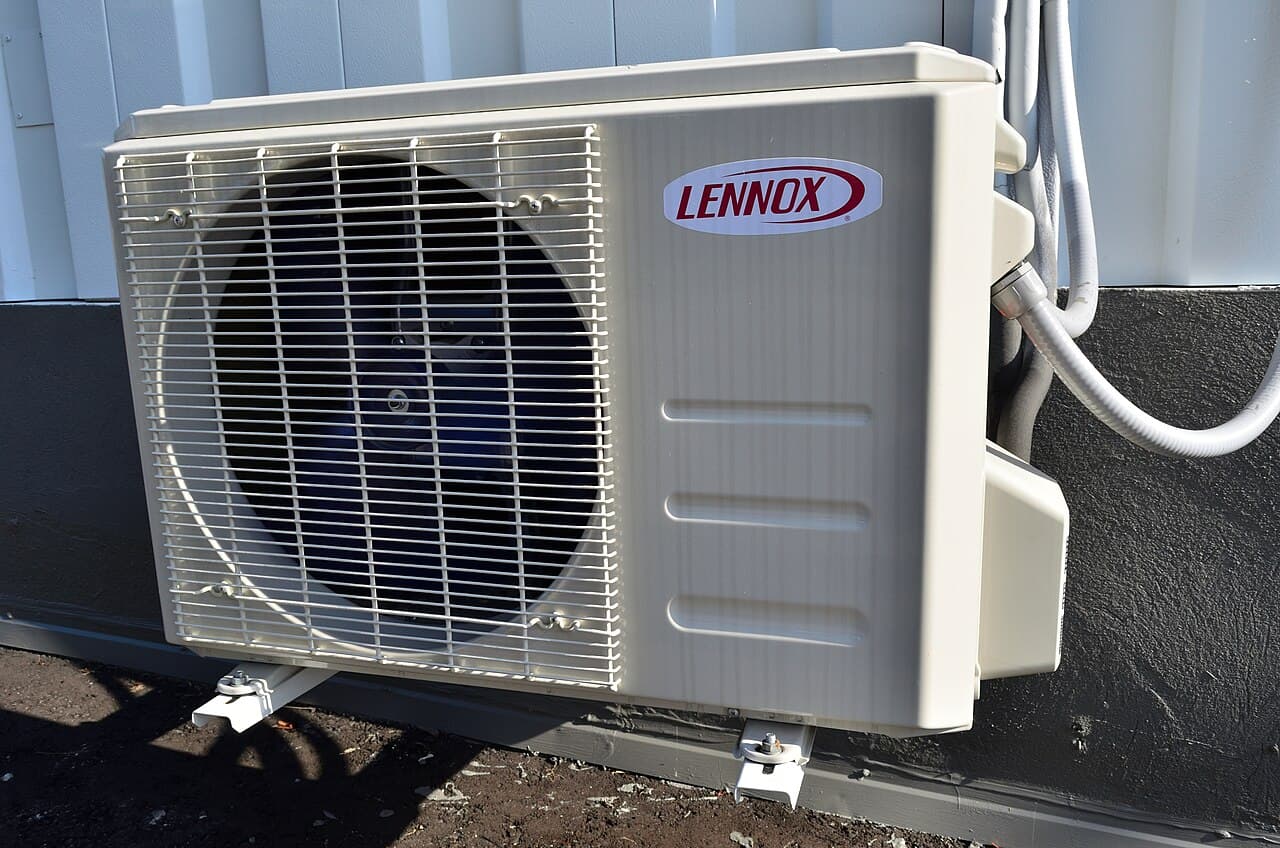
- The outdoor unit. Dirt, grass clippings and other debris on the condenser coil can cut airflow and even shut the system down.[5]
- Mini-split filters. Some mini-split low-refrigerant symptoms can be due to other issues, including needing to clean the mini-split filters.[6]
For the homeowner-safe checks that separate these from a leak, see what to check before calling for AC repair and why an AC runs but does not cool the house.
If you see ice
A frozen coil has several possible causes: restricted airflow from a clogged filter, blocked return vents or a dirty evaporator coil, low refrigerant, or a thermostat problem.[4] Whatever the cause, switch the thermostat from Cool to Off, because running with a frozen coil can cause major damage. Do not chip away at the ice, which can damage the coil.[4]
Ice that keeps coming back after the airflow causes have been ruled out points toward low refrigerant, which only a technician can confirm.
Why only a technician can confirm it
Checking the charge means connecting gauges to the refrigerant circuit, and that is regulated work. Attaching hoses and gauges to an air conditioner is one of the activities that requires EPA Section 608 certification.[9] The charge also has to be right, not just high enough. Too much or too little refrigerant makes a system less efficient, raising energy costs and shortening the life of the equipment.[8]
That is why a technician measures it against the manufacturer's specification, and why ENERGY STAR lists checking the refrigerant level as part of a typical cooling check-up by a contractor.[8]

One useful thing to do before the visit is find out which refrigerant you have. The refrigerant your air conditioner uses is typically listed on the unit's nameplate, which on a central system is usually on the outdoor condenser.[9] An R-22 system changes the repair-or-replace conversation, because no new R-22 has been made or imported since January 1, 2020.[9]
When to call a licensed pro
Call when the symptoms remain after the simple causes above are ruled out, and call right away for ice that returns, hissing or an oily stain on the lines. Turn the system off while you wait. Running the air conditioner with a refrigerant leak can damage the system further,[3] and a leak left alone can end in compressor failure.[2]
In Virginia, no individual may work, or offer to work, as a tradesman in heating, ventilation and air conditioning for the public for pay without a licence, unless working under the supervision of a tradesman licensed in that specialty.[10][11] Check the business on DPOR's License Lookup[12] and ask about Section 608 certification. To know what happens next, read how a refrigerant leak is found and fixed and what fixing a refrigerant leak costs in Virginia.
Getting it checked
Loclis lists DPOR-licensed HVAC businesses with their licence number and class. Find HVAC businesses in Blacksburg, see refrigerant leak repairs, or browse more HVAC repair answers.
If your AC shows these signs, describe what it is doing once and licensed local HVAC businesses quote the diagnosis and repair.
Common questions
- Can an AC lose refrigerant over time without a leak?
- No. The refrigerant circuit is sealed and the system does not use refrigerant up. If the charge is low, either there is a leak or the system was charged incorrectly when it was installed. A technician should find out which before adding any.
- Does ice on the AC lines always mean low refrigerant?
- Not always. A clogged filter, blocked return vents, a dirty evaporator coil or a thermostat problem can freeze the coil too. Turn the system off, do not chip at the ice, and call a technician if the ice comes back.
- Can I check the refrigerant level myself with gauges?
- No. Attaching hoses and gauges to the system is one of the activities that requires EPA Section 608 certification. A certified technician checks the charge against the manufacturer's specification, which matters because too much refrigerant hurts efficiency as well as too little.
- Is it safe to keep running my AC if it might be low on refrigerant?
- It is better not to. Running with a leak can damage the system further, and a leak left alone can end in compressor failure. Turn it off and use fans until a technician has looked at it.
- How do I find out what refrigerant my AC uses?
- It is typically listed on the nameplate, which on a central system is usually on the outdoor condenser. Tell the technician which you have when you book.
Sources
- [1] Why Is My AC Blowing Hot Air? Troubleshooting and Fixes, Bryant Heating & Cooling Systems. Checked October 27, 2026.
- [2] How to Fix a Refrigerant Leak in Your AC Unit, Carrier. Checked October 27, 2026.
- [3] AC Refrigerant Leak Detection and Repair, Trane. Checked October 27, 2026.
- [4] Help! My AC Evaporator Coil Is Frozen, Trane. Checked October 27, 2026.
- [5] AC Not Blowing Cold Air, Trane. Checked October 27, 2026.
- [6] How to Identify and Fix Mini-Split Refrigerant Issues, Trane. Checked October 27, 2026.
- [7] AC Refrigerant Recharge Pricing Guide, Trane. Checked October 27, 2026.
- [8] Maintenance Checklist, ENERGY STAR, U.S. Environmental Protection Agency. Checked October 27, 2026.
- [9] Homeowners and Consumers: Frequently Asked Questions, U.S. Environmental Protection Agency. Checked October 27, 2026.
- [10] Va. Code § 54.1-1129, Necessity for licensure, Code of Virginia, Virginia General Assembly. Checked October 27, 2026.
- [11] Va. Code § 54.1-1128, Definitions, Code of Virginia, Virginia General Assembly. Checked October 27, 2026.
- [12] License Lookup, Virginia Department of Professional and Occupational Regulation. Checked October 27, 2026.
Want a pro to handle it?
Describe the job once. Licensed local businesses send quotes, and you pay only when you book one.
Get a quote for HVAC Repair