How do I tell if it's the alternator or the battery?
A battery that is weak usually shows up before the engine starts: slow cranking, clicking, a dead start. A failing alternator usually shows up while you drive: a charging warning light, dimming lights, a car that dies and then will not restart. The only sure answer is a test of both, which many shops can run before you buy anything.
Free to ask. Local shops send quotes, and you pay only when you book one.
By Kasra Taheri, Founder, LoclisPublished
Researched and drafted with AI, then checked claim by claim against the sources listed below before it was published. Prices and rules change; the dates beside each source say when it was last checked.
Step by step
Read when to stop and call a pro, further down this page, before you start.
Step 1: Note when it happens
Write down whether the trouble comes before the engine starts (slow crank, clicking, nothing) or while it runs (warning light, dim lights, stalling).
Step 2: Read the warning light
Check whether the charging system light stays on with the engine running. It also lights when the ignition is on and the engine is off, which is normal.[1]
Step 3: Look at the drive belt
If the light came on while driving, stop somewhere safe, switch the engine off and look at the alternator belt for looseness or breakage.[1]
Step 4: Look at the battery
With the engine off, look for a swollen case, leaks, or corroded, loose cable clamps, and tell the shop what you see.
Step 5: Jump-start only if the manual allows it
If the car will not crank, follow the jump-start procedure in your owner's manual, using a 12-volt booster battery only.[2]
Step 6: Watch what happens after
If the car starts on a jump but dies again soon after the leads come off, the charging system, not just the battery, is a suspect.
Step 7: Get both tested
Ask a shop to test the battery and the charging system before you agree to any part.[4]
Start with when it happens
A weak battery and a failing alternator can look the same from the driver's seat, but the timing usually separates them. A weak battery tends to show up at the moment you start the car: the engine cranks slowly, the starter only clicks, or nothing happens. A failing alternator tends to show up after the engine is running: a charging warning light, headlights that dim at idle, or a car that stalls and will not restart.
Cold weather muddies this. Battery performance degrades in cold conditions and may prevent the engine from starting,[2] so a hard start on a freezing morning does not by itself mean the battery is finished.
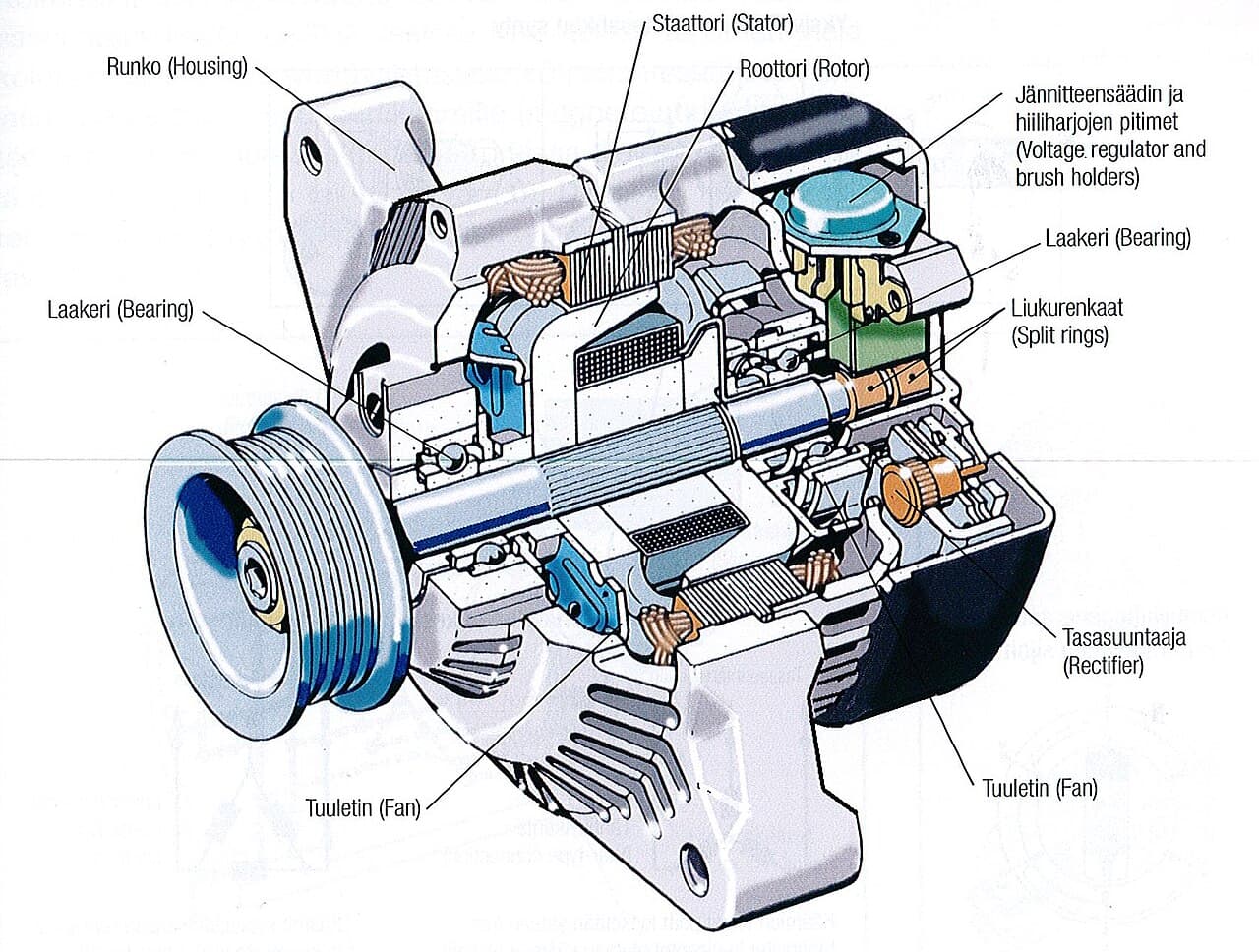
What the warning light tells you
The charging system warning light comes on when there is a problem with the electrical charging system,[1] and it also lights briefly when you turn the ignition on before starting. If it goes out once the engine runs, that is normal. If it stays on, or comes on while you drive, the car has stopped charging properly.
The light is named for the charging system, not the battery. The fault can be the alternator, the belt that turns it, or the wiring between them. Acura's owner's manual says: "If the light comes on while driving, stop and check to see if the alternator belt is loose or broken."[1] Do that only with the engine off. If the engine has been running, some engine components may be hot enough to burn you.[1]
Clues that point to the battery
- The engine cranks slowly or clicks, but the lights and radio work normally while it is running.
- The problem is worst in the cold or after the car has sat for days.
- The case is swollen, leaking or has crusty, loose terminals.
- The car runs fine once started and keeps charging, but fails to start the next morning.
A common pattern is an old battery that has simply lost its capacity to hold a charge. The alternator is fine, but the battery cannot store the energy.
Clues that point to the alternator
- The charging light stays on while the engine runs.
- Headlights and dash lights dim or flicker, especially at idle, and brighten when you rev the engine.
- A whining or grinding noise from the front of the engine that changes with engine speed.
- The car starts with a jump but dies shortly after the leads are removed.
- A new battery that goes flat again within days.
None of these is conclusive alone. A slipping belt can cause the same symptoms as a worn alternator, and a poor ground or loose cable can mimic either part.
If you have to jump the car
If the car will not crank, use the procedure in your owner's manual, because the cable order and connection points differ by vehicle. Use a 12-volt booster battery only.[2] A battery can explode if you do not follow the correct procedure, seriously injuring anyone nearby,[2] so keep all sparks, open flames, and smoking materials away from the battery.[2] Lead-acid batteries may contain up to 18 pounds of lead and about one gallon of corrosive lead-contaminated sulfuric acid,[3] which is a good reason to wear eye protection and not to lean over the battery.
After the engine starts, Honda's owner's manual advice is blunt: "Have your vehicle inspected by a nearby service station or a dealer."[2] A jump that keeps the car running but leaves the warning light on is a sign that the alternator is not recharging the battery.
Getting a real answer
Many shops can test both the battery and the charging system. Ask for both tests before you buy a part. Replacing the battery when the alternator is the fault is a common and avoidable mistake.
In Virginia, you can ask for a written estimate before work that may cost you more than $25.[4] Shops may charge a reasonable fee for the preparation of a written estimate and related diagnostic work,[4] so ask what the test costs and whether that fee is credited to the repair.
Stop and call a pro if
- The charging light comes on while you are driving. The car is running on battery power only and will stop when it is spent. Drive straight to a shop or have it towed.
- The car stalls, loses power steering or dims its lights in traffic. Pull over somewhere safe and call for help rather than trying to restart it repeatedly.
- The battery case is swollen, cracked or leaking. Do not jump or handle it; the sulfuric acid in it is corrosive.[3]
- Smoke, a burning smell or a hot, melted cable. Switch the engine off and call for a tow.
- You cannot tell which part it is. A proper charging-system test settles it before you pay for the wrong part.
Getting help in Virginia
Once you know which part failed, see what an alternator replacement costs and what a new battery costs, or read how long an alternator lasts. Browse automotive repair answers.
When you want a shop to test and quote it, describe the problem once and local shops will respond.
Common questions
- Can a bad alternator kill a new battery?
- It can run a battery flat. The alternator is what recharges the battery while the engine runs, so if it stops charging, any battery, new or old, drains until the car will not start. That is why a replaced battery that goes flat again points to the charging system.
- Does the battery light mean the battery is bad?
- Not necessarily. An Acura owner's manual says the charging system warning light comes on when there is a problem with the electrical charging system. It is a charging system light, so the fault can be the alternator, the belt or the wiring as well as the battery.
- Can I drive with the charging light on?
- Only a short way. With the charging system not working, the car runs on the battery alone and will eventually stop. Switch off what you do not need and drive to a shop, or have the car towed if you are far from one.
- Will a jump start tell me which part is bad?
- It gives a hint, not an answer. A car that starts on a jump but will not run on its own for long suggests the alternator. A car that starts on a jump and keeps running, then will not restart later, suggests a battery that no longer holds a charge.
- Is the test free?
- Often a quick battery check is, but not always. Virginia law lets a repair shop charge a reasonable fee for a written estimate and related diagnostic work, provided it tells you the condition when you ask, so ask what the test costs first.
Sources
- [1] Charging System Warning Light (owner's manual), American Honda Motor Co., Acura owner's manual. Checked October 28, 2026.
- [2] If the Battery Is Dead (HR-V 2024 owner's manual), American Honda Motor Co.. Checked October 28, 2026.
- [3] Used Household Batteries, U.S. Environmental Protection Agency. Checked October 28, 2026.
- [4] Va. Code § 59.1-207.3, Written estimate for repair work required upon request, Code of Virginia, Virginia General Assembly. Checked October 28, 2026.
Want a pro to handle it?
Describe the job once. Licensed local businesses send quotes, and you pay only when you book one.
Get a quote for Automotive