How much does bee removal cost in Virginia?
There is no standard price, so the real number is a written quote. What moves it most: which insect it is, whether it is a swarm in the open or a colony inside a wall, how high and hard to reach it is, whether the wall must be opened and repaired, and whether follow-up visits are included.
Free to ask. Local shops send quotes, and you pay only when you book one.
By Kasra Taheri, Founder, LoclisUpdated
Researched and drafted with AI, then checked claim by claim against the sources listed below before it was published. Prices and rules change; the dates beside each source say when it was last checked.
Step by step
Read when to stop and call a pro, further down this page, before you start.
Step 1: Identify the insect
From a safe distance, work out whether you have honey bees, carpenter bees, yellowjackets or paper wasps, so you know whom to call first.
Step 2: Note where it is
Write down whether it is hanging in the open, in a ground hole, under an eave, or going into a gap in a wall or soffit.
Step 3: Note height and access
Record how high it is and whether it needs a ladder, since overhead and hard-to-reach nests are the ones to hire out.[3]
Step 4: Take photos
Photograph the cluster, nest or entrance from a distance, plus any stains or damaged wood around it.
Step 5: Ask for a written quote
Get the method, the price, what is included and how many return visits are covered, in writing.
Step 6: Check the pesticide licence
Ask any company that will treat the nest for its Virginia pesticide business license and the name of its certified commercial applicator.[5]
Step 7: Settle the repair
Agree who opens and closes the wall, and check that whoever does repair work over $1,000 holds a Virginia contractor licence.[7]
There is no standard price. The same call can be a free swarm pick-up or a day of carpentry. What you will pay comes down to a handful of things you can work out before anyone visits, and the best way to compare is a written quote that spells each of them out.
What drives the price
Which insect. Honey bees, carpenter bees, yellowjackets and paper wasps are different jobs, and often different businesses. A honey bee swarm usually goes to a beekeeper; yellowjackets and paper wasps to a pest control company; carpenter bee holes within reach are often a homeowner job. If you are not sure, see how to tell bees from wasps.
In the open or inside the house. This is the biggest single factor. If a swarm of honey bees is found, Maryland Extension's advice is to call or email a local beekeeper, and most will come and remove the swarm.[1] A colony that has moved into the house is a different job. Few beekeepers will retrieve honey bees nesting in a wall void of a home, and in that case a professional pest control company should be consulted.[1] Either way, the nest usually has to come out of the wall, which means opening it up and closing it again.
Yellowjackets in a wall are a similar step up. Virginia Cooperative Extension says a yellowjacket nest inside the walls of a house may justify the cost of a licensed pest control operator,[2] who has the equipment to reach it.
Height and access. A nest you can see from the ground costs less to deal with than one at the peak of the house or in a chimney chase. Maryland Extension's advice is to hire a pest control company when carpenter bee nests are overhead, awkward to reach, or need a ladder or step stool,[3] and the same logic prices every other nest.
Method. Ask each business how it will do the job: live removal by a beekeeper, or treatment by a pest control company, and in either case whether the nest comes out. The method decides how much of the wall is opened, how many visits are needed, and whether a second contractor is needed for the repair.
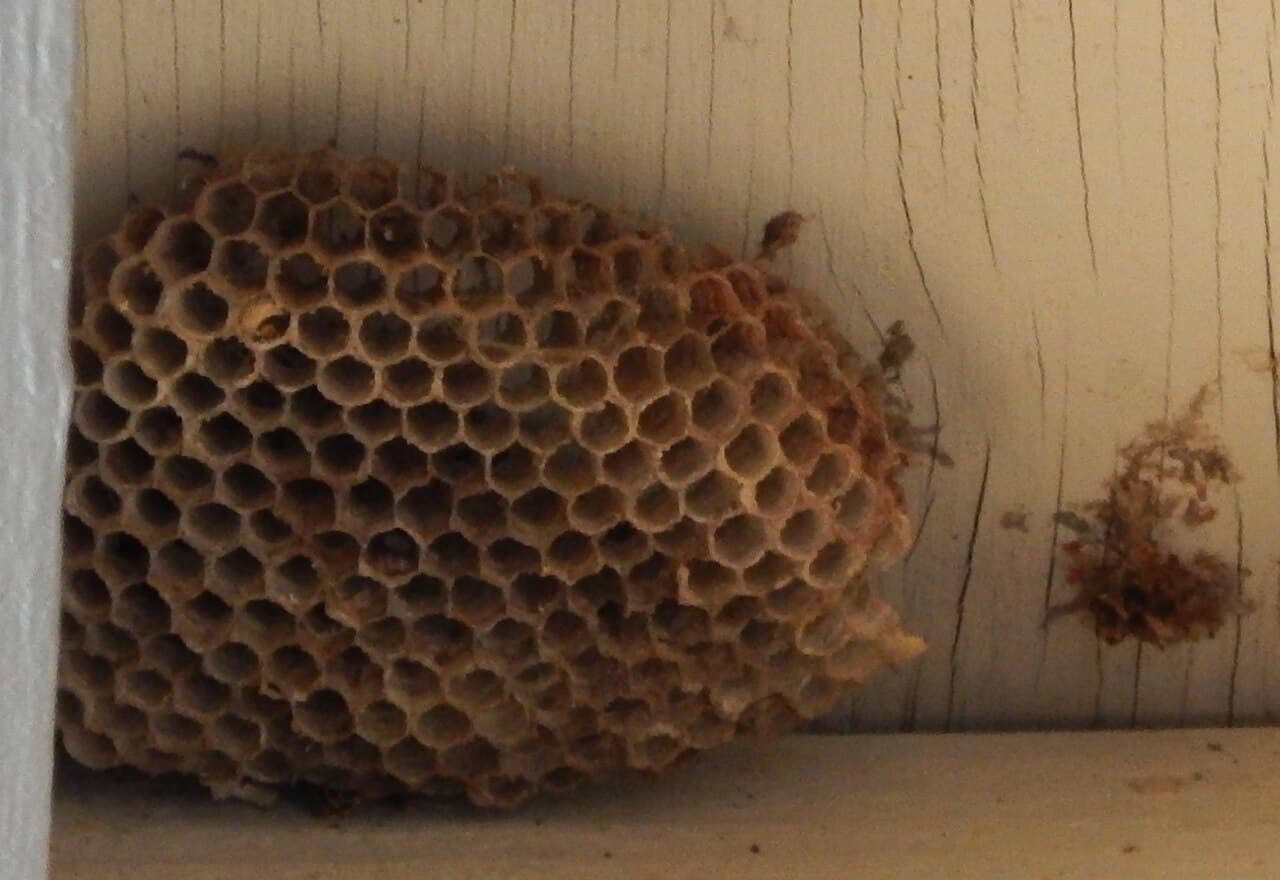
The costs that are easy to miss
- Follow-up visits. A large nest may need to be treated several times.[2] Ask how many visits the price includes.
- Removing the nest or comb. Wall nests should be removed after the yellowjackets are dead when possible, because they can attract other insects or mice.[2] Whether that is done depends on where the nest is, how big it is, how much damage there is, and the cost of the repair.[2] With honey bees the comb matters even more. If honey bees in a wall are killed and the nest is not removed, the wax and honey melt inside the wall, the honey may seep through plaster, the honey and dead bees smell strongly, and the debris attracts other insects and mice.[1]
- Repairing the wall. Siding, trim, drywall and paint after a cut-out are often a separate line or a separate contractor.
- Sealing the entrance. The gap the insects used should be closed so the next swarm or queen does not move in.
Licences that come with the price
Licensed businesses carry costs that an unlicensed one skips, and those protect you.
- Pesticides. In Virginia, no person may apply or recommend a pesticide commercially without a pesticide business license and a certified commercial applicator.[5] To get that license, VDACS requires a certificate of insurance showing at least $100,000 for property damage, $100,000 for injury to or death of one person, and $300,000 per occurrence.[6] Pesticide business licenses expire on March 31 each year,[6] so ask for a current one.
- Repairs. Under the Code, anyone who for a fee undertakes the repair or improvement of a building is a contractor, and a Class C licence covers jobs over $1,000 and under $30,000.[7] If a removal quote includes rebuilding part of a wall for more than $1,000, ask who holds the licence.
Spraying is not always the cheaper fix. Broad spectrum insecticides also kill bees, butterflies and other beneficial insects,[4] and with honey bees in a wall, killing them does not end the job, because the nest still has to come out.[1]
How to get quotes you can compare
Give every business the same description: the insect, where it is, how high, how long it has been there, and photos taken from a distance. Ask each one to put in writing:
- The method: live removal or treatment, and whether the nest or comb is taken out.
- Exactly what is included: nest or comb removal, sealing the entrance, wall repair and paint.
- How many return visits are covered.
- The pesticide business license and applicator, if anything will be sprayed or dusted.
A swarm is the exception to taking your time: call a beekeeper while it is still out in the open. For a swarm, see who removes honey bees without killing them.
Doing it yourself
Carpenter bee holes you can reach from the ground are a reasonable homeowner job with a product labeled for them; see how to get rid of carpenter bees. Most other nests near the house are worth a quote.
Stop and call a pro if
- The insects are going into a wall, soffit, attic or chimney. Do not plug the gap; trapped yellowjackets may chew into the living space.[2]
- The nest is overhead or needs a ladder.
- Anyone in the house is allergic to stings.
- They are honey bees. Call a beekeeper before anyone sprays.
Getting quotes on Loclis
You can browse bee and wasp removal, look up pest control around Blacksburg, or read the other pest control answers. Loclis's own fees are on the pricing page. For the wall, siding or trim repair after a removal, describe the job on Loclis and local businesses can quote.
Common questions
- Is honey bee removal cheaper than extermination?
- For a swarm in the open, call a local beekeeper first; most will come and remove a swarm, and you can ask about any charge up front. For a colony in a wall the comparison is closer than it looks: killing the bees still leaves the wax and honey in the wall, and that nest has to come out either way, so ask every quote whether removing it is included.
- Why does the price jump when the bees are inside a wall?
- Because the job usually becomes carpentry. Getting a nest out of a wall means opening the wall and closing it again, and few beekeepers take on honey bees nesting in a wall void. Ask whether the quote includes closing the wall and painting, or only the removal.
- Do follow-up visits cost extra?
- It depends on the quote. Large yellowjacket nests may need several treatments, so ask how many visits the price covers and what happens if the insects are still active after the last one.
- Can I save money by treating it myself?
- For carpenter bee holes you can reach from the ground, yes; see how to get rid of carpenter bees. For a nest inside a wall, a nest overhead, or honey bees, hiring out is the safer route.
- What should a written quote include?
- The insect and method, the price, what is included (comb or nest removal, sealing the entrance, wall repair, paint), how many return visits are covered, and the company's Virginia pesticide business license if it will apply any pesticide.
Sources
- [1] Honey Bees, University of Maryland Extension. Checked October 27, 2026.
- [2] Yellowjackets in Virginia (ENTO-49), Virginia Cooperative Extension, Virginia Tech. Checked October 26, 2026.
- [3] Carpenter Bees, University of Maryland Extension. Checked October 26, 2026.
- [4] Bees, Hornets and Wasps, Fairfax County Park Authority. Checked October 26, 2026.
- [5] Code of Virginia § 3.2-3924. Annual business license required, Virginia General Assembly, Legislative Information System. Checked October 26, 2026.
- [6] Pesticide Business License, Virginia Department of Agriculture and Consumer Services. Checked October 26, 2026.
- [7] Code of Virginia § 54.1-1100. Definitions (contractors), Virginia General Assembly, Legislative Information System. Checked October 26, 2026.
Want a pro to handle it?
Describe the job once. Licensed local businesses send quotes, and you pay only when you book one.
Get a quote from a local pro