How do I get rid of carpenter bees?
Treat each active hole, then close it and finish the wood. Puff a small amount of a dust or aerosol labeled for carpenter bees into the entrance, leave it open a few days so returning bees carry it through the tunnel, then plug the hole with a glued dowel or wood putty and paint the bare wood. Late summer or early spring is the best time.
Free to ask. Local shops send quotes, and you pay only when you book one.
By Kasra Taheri, Founder, LoclisPublished
Researched and drafted with AI, then checked claim by claim against the sources listed below before it was published. Prices and rules change; the dates beside each source say when it was last checked.
Step by step
Read when to stop and call a pro, further down this page, before you start.
Step 1: Confirm they are carpenter bees
Look for a perfectly round hole about half an inch across in bare or weathered wood, with coarse sawdust below it and large bees with shiny black abdomens nearby.[2]
Step 2: Decide whether to act
One nest in a fence post or shed board is mostly cosmetic; act when tunnels are in siding, trim, decks or wood you care about, or when holes are multiplying year after year.[3]
Step 3: Pick the season
Treat in early spring as the bees become active, or in late summer after the new adults have emerged and before they settle in for winter.[2]
Step 4: Only work what you can reach from the ground
If a hole is overhead or would need a ladder or step stool, leave it for a pest control company.[2]
Step 5: Read the product label
Use a dust or aerosol whose label lists carpenter bees, and follow its directions on amount, protective gear and where it may be used.[2]
Step 6: Treat the hole lightly
Wait until the female has left, then puff a small amount into the entrance; too much repels the bees and they simply drill a new hole nearby.[2]
Step 7: Leave the hole open a few days
Returning bees spread the insecticide through the tunnel, so do not plug it right away.[3]
Step 9: Paint the wood
Fill nail holes and cracks, then paint the treated board and any bare wood around it; painted wood is rarely attacked.[2]
Step 10: Watch next spring
Check the same boards in April and May, when females look for nest sites, and treat any new hole early.[2]
Treat the hole, let the bees carry the treatment in, then plug it and paint the wood. Virginia Cooperative Extension's advice, when control is needed, is to spray an aerosol insecticide into the entrance hole and plug the opening with wood putty.[1] The details below are what make that work: timing, using very little product, waiting before you plug, and finishing the wood so the next bee moves on.
Make sure it is a carpenter bee
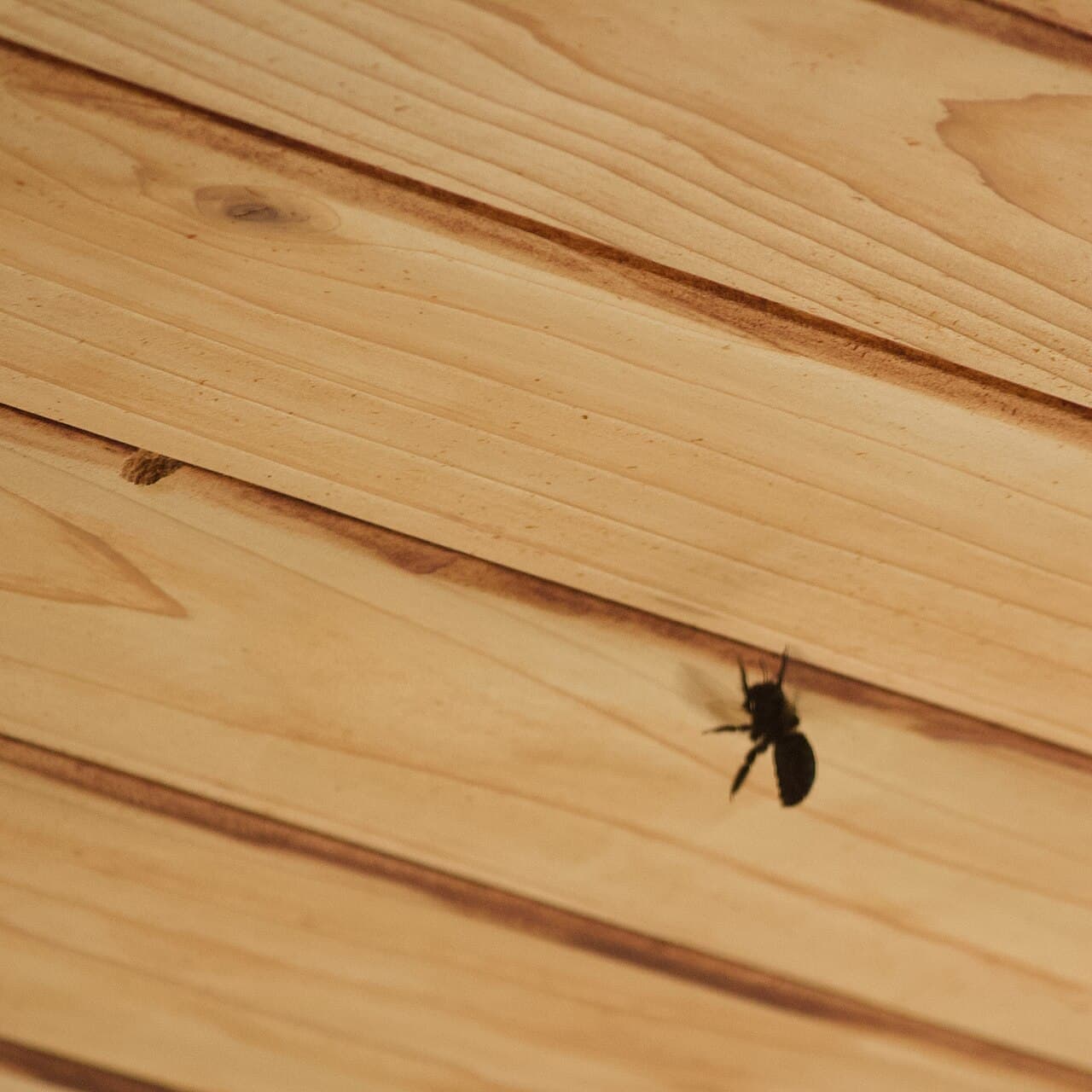
Carpenter bees are large bees, about an inch long, often mistaken for bumble bees.[1][2] The quick tell is the back half: a carpenter bee's abdomen is shiny and black, while a bumble bee's is covered in hair.[1][2] The other giveaway is the wood itself.
- The hole. The female chews a round hole about half an inch across, goes in an inch or two, then turns and tunnels along the grain.[2] It looks drilled.
- Sawdust and stains. Coarse, pale sawdust piles up under the hole, and yellow waste can streak the board below it.
- Where. Bare, weathered or stained wood: fascia, soffits, eaves, siding, deck rails, porch ceilings, fence posts and sheds.
If you are not sure what you are looking at, see how to tell bees from wasps.
Do you need to do anything?
Carpenter bees are native pollinators and are mostly a nuisance. Males hover and dart at people near the nest but have no sting,[2][3] and females can sting but rarely do unless they are handled.[2][3]
The case for acting is the wood. A single nest will not cause structural damage, but tunnels that are reused and lengthened over several years, and many bees working the same boards, can weaken wood.[2] The holes also let moisture in, which speeds up rot,[2][3] and woodpeckers will peck out the young bees and do more damage.[1] A hole or two in a fence post can be left. New holes in trim or siding every spring are worth dealing with.
Timing
The best times to treat are late summer, after the new adults emerge and before they hibernate, or early spring before nest building begins.[2] In practice that means a look in spring as the bees start flying, and another toward the end of summer.
Adult bees overwinter together in existing tunnels,[2][3] so an old hole may not be empty even in the middle of winter. Treat it before you plug it, whatever the season.
Treating the holes
Use a product whose label names carpenter bees, and follow the label on amount and protective gear. Wasp, hornet and bee aerosols sprayed into the holes are effective, and insecticide dusts labeled for carpenter bee control work when small amounts are puffed into the tunnel.[2]
The common mistake is using too much. Chemicals are repellent in large amounts, so the goal is to lightly treat the inside of the entrance.[2] If you overdo it, the bee avoids the tunnel and starts a new one nearby.[2] A short puff is enough. Treating at dusk, or once you have seen the female leave, means fewer bees tumbling out at you.[2][3]
Then wait. Leave the hole open for a few days so the bees contact the insecticide and carry it through the tunnel.[3] The tunnel must be treated before it is plugged, or the bees will chew through the plug.[2]
Plugging and finishing
Once the hole has been quiet for about a week, plug the hole with a piece of wooden dowel coated with carpenter's glue, putty or another sealant.[3] A dowel slightly larger than the hole, tapped in and trimmed flush, gives a neat repair that takes paint.
Finishing the wood is what keeps the problem from returning. Carpenter bees usually will not tunnel into painted wood, and stains and preservatives are less reliable than paint.[3] Fill nail holes and cracks before painting, since those give a bee a head start. For more on prevention, see how to keep carpenter bees from coming back.
Traps
Traps catch searching females but do not clear out bees already in the wood. Most traps are a small wooden box with half-inch holes drilled in the sides and a plastic bottle hung below.[3] Kentucky's entomologists suggest you hang them in early spring from eaves and overhangs at the corners of the house, porch, deck or shed.[3] Stick to the overhangs you can reach standing on the ground, such as a low porch or shed roof edge; a trap that would need a ladder is not worth the climb. Use traps alongside treating and painting rather than instead of them.
Stop and call a pro if
- The holes are overhead, high on the house, or under a roof edge. Maryland Extension's advice is to hire a pest control company when the nests are overhead, awkward to reach, or need a ladder or step stool.[2]
- There are many holes in the same boards, or the wood is soft, split or rotting. That is a carpentry repair as much as a pest job.
- Woodpeckers have torn open long stretches of trim or siding.
- Anyone in the house is allergic to stings.
- The insects are going into a gap in siding or a wall rather than a drilled hole. That is more likely yellowjackets or honey bees, which need a different approach.
Some extension services go further. Penn State Extension's guidance on carpenter bees is blunt: "Chemical pesticide applications should always be performed by an expert."[4] If you would rather not handle insecticide at all, that is a sound reason to hire the job out. If you hire it out in Virginia, check the license: no one in Virginia may apply a pesticide commercially without a pesticide business license and a certified commercial applicator on staff.[5]
Getting help on Loclis
You can browse pest control businesses, see bee and wasp removal, look up pest control around Blacksburg, or read the other pest control answers. If the bees have left trim or siding that needs replacing, describe the repair on Loclis and local businesses can quote.
Common questions
- Will carpenter bees sting me?
- Rarely. The bees that dive at your head near the nest are males, and males have no sting. Females can sting but are docile and usually do so only when handled or trapped against skin.
- Can I just plug the holes without spraying?
- Not on its own. Maryland Extension says tunnels must be treated with a pesticide before they are caulked, or the bees will chew through the plugs and come back out. Winter is no exception: adult carpenter bees spend the winter inside existing tunnels, so an old hole may still have bees in it.
- Do carpenter bee traps work?
- They catch some bees. Kentucky's entomology department describes traps as a wooden box with half-inch holes and a bottle below, hung in early spring from overhangs at the corners of the house, porch, deck or shed. Use only spots you can reach standing on the ground. Traps help reduce drilling but do not treat bees already inside the wood.
- Is carpenter bee damage serious?
- One nest is mostly cosmetic. The damage adds up when the same boards are reused and lengthened year after year, when woodpeckers dig for the larvae, and when water gets into the holes and starts rot. Soft or crumbling trim should be replaced, not just plugged.
- Do I need a licensed company to treat carpenter bees?
- A business that applies pesticides for pay in Virginia needs a pesticide business license and a certified commercial applicator, so ask any company you hire for both. Penn State Extension advises that chemical pesticide applications always be done by an expert, and Maryland Extension advises a pest control company for any nest that is overhead or needs a ladder or step stool. If you do treat a low hole yourself, use a product whose label lists carpenter bees and follow that label.
Sources
- [1] Native and Solitary Bees in Virginia (ENTO-151NP), Virginia Cooperative Extension, Virginia Tech. Checked October 26, 2026.
- [2] Carpenter Bees, University of Maryland Extension. Checked October 26, 2026.
- [3] Carpenter Bees (Entfact 611), University of Kentucky Department of Entomology. Checked October 26, 2026.
- [4] The Eastern Carpenter Bee: Beneficial Pollinator or Unwelcome Houseguest?, Penn State Extension. Checked October 26, 2026.
- [5] Code of Virginia § 3.2-3924. Annual business license required, Virginia General Assembly, Legislative Information System. Checked October 26, 2026.
Want a pro to handle it?
Describe the job once. Licensed local businesses send quotes, and you pay only when you book one.
Get a quote from a local pro