How can I tell bees from wasps?
Look at the body, the food and the nest. Bees are stout and hairy and visit flowers for pollen and nectar. Wasps are smooth, with a narrow waist, and many scavenge meat and sweets. Bees nest in wax comb, wood tunnels or soil; paper wasps, yellowjackets and hornets build nests of paper.
Free to ask. Local shops send quotes, and you pay only when you book one.
By Kasra Taheri, Founder, LoclisUpdated
Researched and drafted with AI, then checked claim by claim against the sources listed below before it was published. Prices and rules change; the dates beside each source say when it was last checked.
Step by step
Read when to stop and call a pro, further down this page, before you start.
Step 1: Keep your distance
Watch from several steps away and do not swat; swatting at stinging insects can alarm them into stinging.[1]
Step 2: Look at the body
A stout, fuzzy body points to a bee; a smooth, mostly hairless body with a pinched waist points to a wasp.[1]
Step 3: Check the abdomen on big black bees
A shiny, hairless black abdomen means a carpenter bee; a fully hairy one means a bumble bee.[2]
Step 8: Check ground holes
Insects flying in and out of a hole in the lawn may be ground-nesting yellowjackets, which defend the nest as a group.[3]
Step 9: Get an ID if unsure
If you still cannot tell, your local Cooperative Extension office can identify a specimen.[6]
Look at three things: the body, what it is eating, and the nest. Fairfax County's Park Authority sums up the body difference: bees have a more robust, hairy body, while wasps are typically hairless, with a slender body and a narrow waist.[1] Pollen and nectar are the main food of bees, while wasps and hornets scavenge, feeding on other insects, food left lying around and decaying fruit.[1] And hornets are a kind of wasp,[1] not a separate group.
Getting the name right matters, because the right response depends on it. Carpenter bees can be treated by a homeowner, a honey bee colony is worth calling a beekeeper for, and a yellowjacket nest in a wall is a job to leave alone.
The bees you are likely to see
- Carpenter bees. Carpenter bees are large bees about an inch long, often mistaken for bumble bees, but their abdomen is shiny and black, while a bumble bee's abdomen is fully covered with hair.[2] Carpenter bees cut a round hole about half an inch across into bare wood and tunnel along it.[2] See how to get rid of carpenter bees.
- Bumble bees. Big, round and fuzzy all over. Bumble bees nest in cavities, sometimes in old rodent nests, around houses, sheds and small barns.[2]
- Honey bees. Smaller and fuzzy, often in large numbers on flowers. Honey bees can nest in the wall void of a house, where they build wax comb.[7] A cluster of thousands hanging from a branch is a swarm; see who removes honey bees without killing them.
- Ground-nesting bees. Andrenid, or mining, bees nest in the soil in spring and may swarm over the ground when people approach, but this is more of a bluff because they rarely sting.[2]
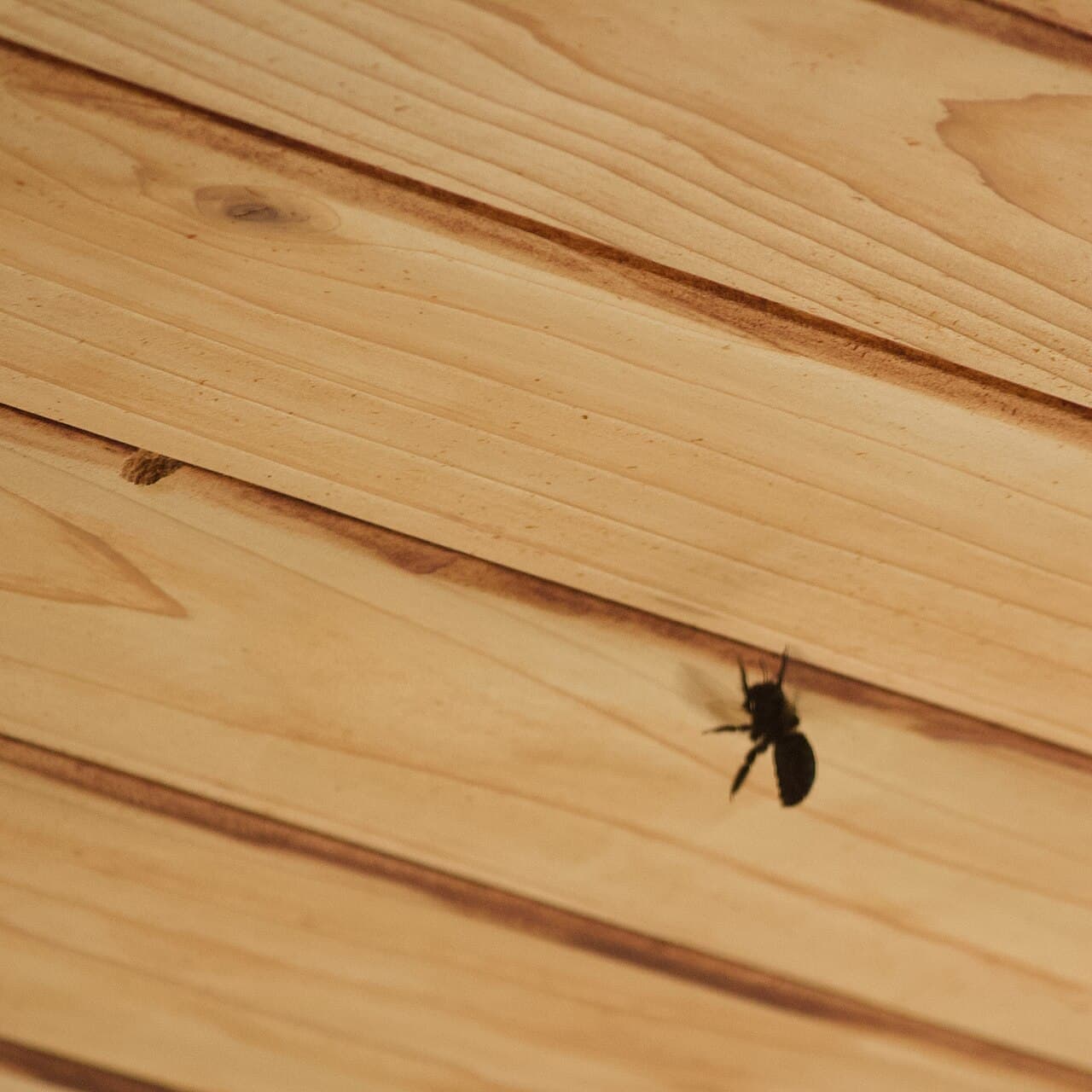
The wasps you are likely to see
- Yellowjackets. Yellowjackets are black and yellow or orangish in bold patterns, typically half an inch to an inch long, with a defined waist and wings folded lengthwise at rest.[3] Ground-nesting yellowjackets nest in the ground, in hollow trees and in the wall voids of buildings, often with more than one entrance hole.[3] They are the ones at your picnic: they scavenge meat and garbage, turn to sugary foods later in the year, and can be nuisance pests from late summer until early autumn, when yellowjacket colonies are at their largest size.[3]
- Paper wasps. Paper wasps are slender, with long legs, a distinct wasp waist, and wings folded narrowly over the back.[4] Many are reddish brown with yellow or dark markings, and the invasive European paper wasp is black and yellow and often mistaken for a yellowjacket.[4]
- Baldfaced aerial yellowjackets. The baldfaced aerial yellowjacket, formerly called the baldfaced hornet, is black with pale markings and a largely white face.[5]
- European hornets. European hornet, about an inch long with drip-like markings on a mostly yellow abdomen, has been known from Virginia since the 1980s.[6]
- Cicada-killers. A big one to know is the eastern cicada-killer, a large solitary wasp about 1.5 to 2 inches long that digs tunnels in soil.[6]
The nest usually settles it
Bees build with wax or bore into wood and soil. Yellowjackets and other social wasps build with paper they make from chewed wood and plant fibres.[3]
- A round hole in bare wood with sawdust below: carpenter bees.
- Wax comb in a wall void, hollow tree or attic: honey bees.
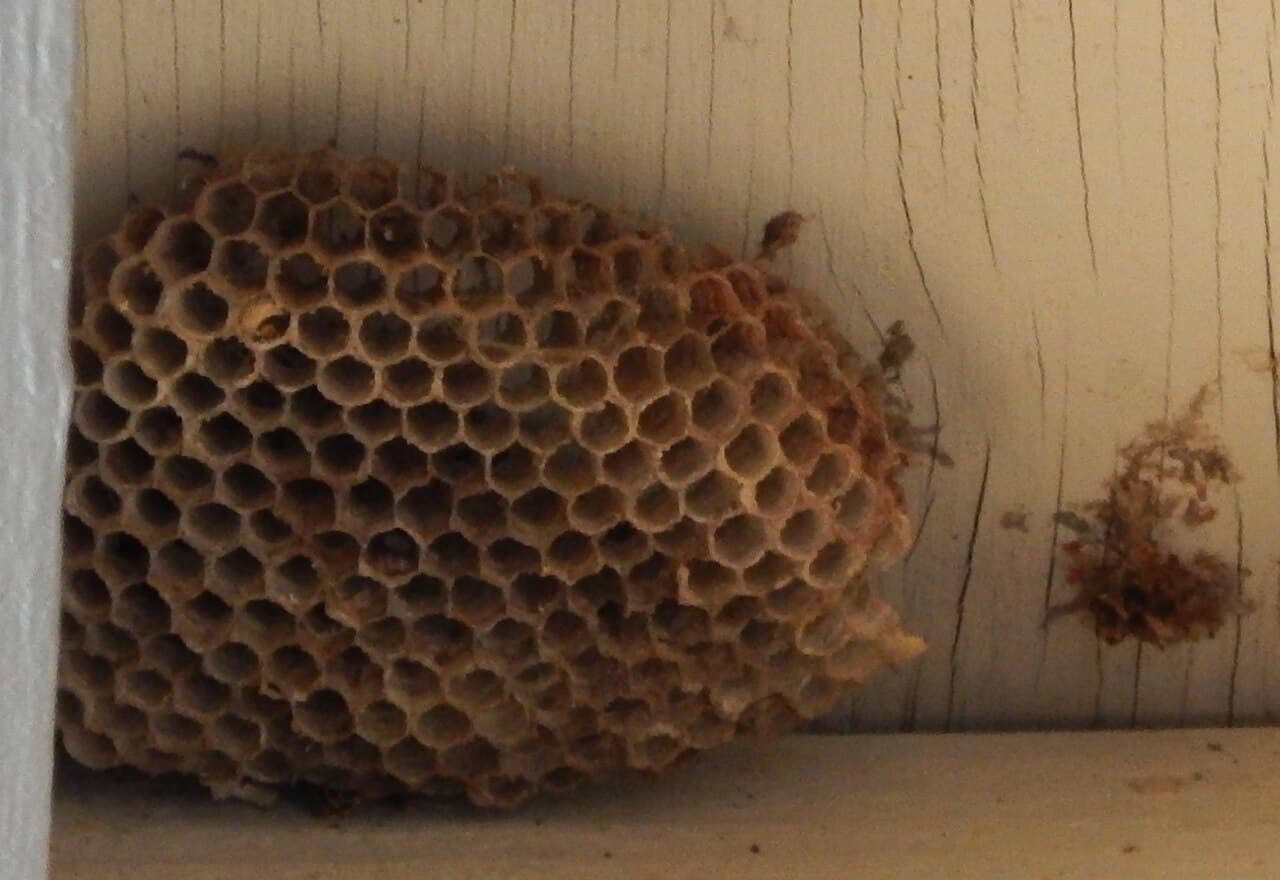
- An open comb of paper cells under an eave or a railing: paper wasps. Their nests are open combs of papery cells hanging from a stalk, with no outer covering, under eaves, behind loose boards and in light fixtures, grills and birdhouses.[4]
- A paper ball hanging in a tree: its nest is an oval paper ball with a protective envelope and a single opening at the bottom, usually hanging from a tree limb.[5] That is the baldfaced aerial yellowjacket.
- A hole in the lawn or a gap in siding with steady traffic: may be yellowjackets, or honey bees if it is a gap in a wall.
Why the difference matters for stings
Solitary bees are the least likely to sting. Mining bees rarely sting, orchard mason bees are very docile and rarely sting, and sweat bees can sting, especially when caught between clothes and sweaty skin, but are otherwise non-aggressive.[2] Social bees are a different matter. Honey bees are not aggressive but will sting to defend themselves, and they live in large colonies,[7] so give a swarm, a nest or a busy entrance plenty of room. Paper wasps do not appear to be particularly aggressive unless they are defending their nest.[4] Unlike honey bees, a paper wasp can sting repeatedly without harming itself.[4] Yellowjackets release an alarm pheromone when they attack, which brings nestmates in to attack as a group.[3] Swatting at stinging insects can make them alarmed and cause them to sting,[1] so step back slowly instead.
About giant hornets: most insects sent to Extension as suspected northern giant hornets have turned out to be European hornets.[6]
Stop and call a pro if
- Insects are going in and out of a gap in your siding, a wall or the attic. Do not plug it: Virginia Cooperative Extension warns that yellowjackets may chew a new way out into the house, and a nest inside a wall may justify the cost of a licensed pest control operator.[3] If they are honey bees, call a beekeeper.
- The nest is large, high up, or next to a door or play area.
- Anyone in the house is allergic to stings, or someone has been stung many times.
- You find wax comb or a large cluster of honey bees. Call a beekeeper before anyone sprays.
Getting help on Loclis
You can browse bee and wasp removal, look up pest control around Blacksburg, or read the other pest control answers. If a nest has left damage to siding, trim or a wall that needs fixing afterwards, describe the repair on Loclis.
Common questions
- Is a yellowjacket a bee?
- No. Yellowjackets are social wasps, sometimes called meat bees because they scavenge meat. They are smooth, boldly striped black and yellow, and nest in paper nests in the ground, in walls or in shrubs.
- Are hornets different from wasps?
- Hornets are a kind of wasp. In Virginia the insect most people call a hornet is often the baldfaced aerial yellowjacket, with its white face and oval paper nest in a tree, or the European hornet, a large wasp with drip-like markings on a yellow abdomen.
- Do bees or wasps sting more than once?
- Wasps can. Virginia Cooperative Extension notes that, unlike honey bees, a paper wasp can sting repeatedly without harming itself, and each female yellowjacket can give multiple painful stings.
- I have bees going into a hole in my lawn. What are they?
- In early spring they are often mining bees, solitary bees that rarely sting and are active for only a few weeks. Later in summer, a steady stream in and out of one hole is more likely ground-nesting yellowjackets, which defend the nest and should be handled with care.
- Could it be a murder hornet?
- Very unlikely. The northern giant hornet has only been found in a small area of Washington state and British Columbia. Virginia Cooperative Extension says most suspected specimens it receives are European hornets.
Sources
- [1] Bees, Hornets and Wasps, Fairfax County Park Authority. Checked October 26, 2026.
- [2] Native and Solitary Bees in Virginia (ENTO-151NP), Virginia Cooperative Extension, Virginia Tech. Checked October 26, 2026.
- [3] Yellowjackets in Virginia (ENTO-49), Virginia Cooperative Extension, Virginia Tech. Checked October 26, 2026.
- [4] Paper Wasps (ENTO-435), Virginia Cooperative Extension, Virginia Tech. Checked October 26, 2026.
- [5] Baldfaced Aerial Yellowjacket (3006-1449), Virginia Cooperative Extension, Virginia Tech. Checked October 26, 2026.
- [6] Large Invasive Hornets (ENTO-592), Virginia Cooperative Extension, Virginia Tech. Checked October 26, 2026.
- [7] Honey Bees, University of Maryland Extension. Checked October 27, 2026.
Want a pro to handle it?
Describe the job once. Licensed local businesses send quotes, and you pay only when you book one.
Get a quote from a local pro