Who removes honey bees in Virginia without killing them?
Beekeepers. A swarm hanging on a branch or fence is usually collected by a local beekeeper, so call one the same day; a local beekeeping association is a good place to start. A colony already inside a wall is harder, since few beekeepers take those on: ask for one who removes bees from buildings, and line up a licensed contractor for the wall.
Free to ask. Local shops send quotes, and you pay only when you book one.
By Kasra Taheri, Founder, LoclisUpdated
Researched and drafted with AI, then checked claim by claim against the sources listed below before it was published. Prices and rules change; the dates beside each source say when it was last checked.
Step by step
Read when to stop and call a pro, further down this page, before you start.
Step 1: Confirm they are honey bees
Look for fuzzy, orangish-brown bees about half an inch long, either in a hanging cluster or streaming in and out of one gap.[3]
Step 2: Do not spray
Keep people and pets back and leave the bees alone; spraying kills bees a beekeeper could have rehomed.
Step 3: Work out swarm or colony
A cluster on a branch, post or wall that appeared suddenly is usually a swarm; bees using the same gap day after day are a colony living inside.
Step 4: Call quickly for a swarm
Contact a local beekeeper the same day, while the bees are still in the open; most will come and remove a swarm.[3]
Step 5: Find a beekeeper
Start with your local beekeeping association; the VDACS beekeeper list is mostly pollination rentals, but a few entries collect swarms.[1]
Step 6: Describe the job
Give the height, what the bees are on or in, how long they have been there and photos taken from a safe distance.
Step 7: Ask how they will do it
For a wall colony, ask whether they will open the wall, whether all the comb and honey will come out, and who closes the wall.
Step 8: Settle who repairs the wall
Agree in writing who closes up siding, trim or drywall, and check that whoever does repair work over $1,000 holds a Virginia contractor licence.[6]
Step 9: Seal the entrance afterwards
Once the bees and comb are gone, have the old entrance gap closed so new insects are less likely to move into the same space.
Beekeepers are the people who remove honey bees alive, and a swarm out in the open is the job they are most likely to take. If a swarm of honey bees is found, Maryland Extension's advice is to call or email a local beekeeper, and most will come and remove the swarm.[3] Bees that have already moved into a wall are harder to place. Few beekeepers will retrieve honey bees nesting in a wall void of a home, and in that case Maryland Extension says a professional pest control company should be consulted.[3] So the earlier you call, the better your chance of a live removal.
Honey bees are worth the effort: VDACS notes that the value of honey bees as pollinators far exceeds their honey production.[2]
First, is it a swarm or a colony?
The answer decides who you call and how fast. Start by making sure they are honey bees at all. Honey bees are about half to five-eighths of an inch long, orangish-brown and fuzzy, and live in large colonies.[3]
A swarm is a dense cluster of bees that appears suddenly on a branch, fence post, shrub or the side of a building. It is a group of bees on the move, looking for a new home, and it is the easy case.
A colony is bees that have moved in: a steady stream flying in and out of one gap in siding, a soffit, a chimney chase or a hollow tree, day after day. Behind that gap is wax comb, young bees and honey.
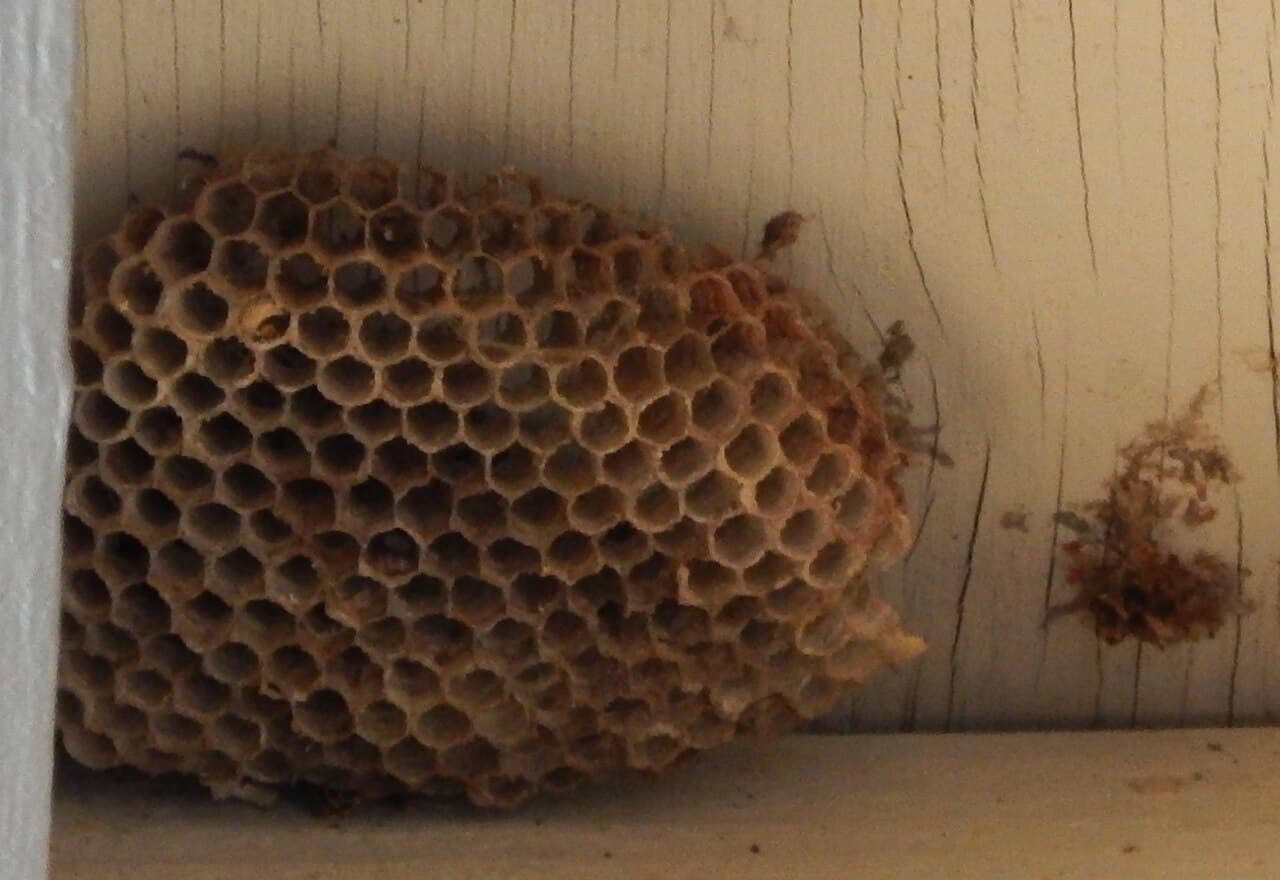
If you are not sure what you have, see how to tell bees from wasps. Yellowjackets also nest in wall voids,[7] and beekeepers generally do not take those. Nor do they usually take paper wasps, which build nests of open hexagonal paper cells with no papery covering, usually in a protected spot such as under eaves,[8] like the empty one below.
Who to call for a swarm
Call a beekeeper the same day, while the bees are still in the open. Places to look:
- Your local beekeeping association. Ask whether any members collect swarms near you.
- The VDACS beekeeper list. The Virginia Department of Agriculture and Consumer Services publishes a directory that lists beekeepers by region.[1] It is built for farmers: VDACS describes it as a resource for Virginians who need bees or have bees to rent for pollination,[2] and at least one listing asks for 2008 contracts. A few beekeepers on it do mention swarms. One entry reads "Swarms captured, Colonies removed from buildings", and another says "Would love to collect any swarms".[1] Treat it as a list of names to try, not a swarm service.
Tell whoever you call how high the swarm is and what it is on. A swarm on a low branch is a quick job. One high in a tree or on a roof may not be worth a ladder, and a beekeeper may advise leaving it.
Who to call for bees in a wall
An established colony is real work, and not every beekeeper does it. Ask specifically for someone who removes colonies from buildings, and expect them to want to see it first.
A live removal from a wall usually means opening the siding, trim or drywall to reach the comb, taking out the comb and bees, and moving them into a hive. Virginia's beekeeping law requires beekeepers to keep bees in hives with movable frames, apart from short periods,[4] so the bees end up in a proper hive, not a box in a garage.
Getting the comb out matters whoever does the job. If the bees are killed and the nest is left in the wall, the wax and honey melt, the honey may seep through plaster walls, the honey and dead bees give off a strong odor, and the debris attracts other insects and mice.[3] A pest control company that treats a wall colony should still have a plan for the nest.
Licences to check
Live removal brings two kinds of work, and Virginia regulates both.
- Pesticides. If a company proposes to treat the bees, it must be licensed: no person may apply or recommend a pesticide commercially without a pesticide business license and a certified commercial applicator on staff.[5] A beekeeper doing a live removal without chemicals is not spraying anything, but ask what they plan to use.
- Wall repair. Anyone who for a fee undertakes the repair or improvement of a building is a contractor under the Code,[6] and a Class C contractor licence covers jobs over $1,000 and under $30,000.[6] If the beekeeper's price includes rebuilding siding or drywall for more than $1,000, ask who holds the licence, or hire a licensed contractor for the repair yourself.
The state's beekeeping office is part of VDACS, which runs an apiary inspection program that promotes the science of beekeeping and regulates the movement of honey bees into the state and the sale of bees, queens and used equipment.[2] Its contact is 804-786-3515 or vabees@vdacs.virginia.gov.[2]
What to agree before work starts
- Whether all the comb and honey will be taken out of the wall.
- Who opens the wall, who closes it, and whether paint or trim is included.
- Whether a return visit is included to collect stragglers.
- How the entrance will be closed so another swarm is less likely to move in.
Get it in writing, with the price.
Stop and call a pro if
- Someone in the house is allergic to stings or has been stung many times.
- Bees are inside the living space, not just in the wall.
- The colony is high on the house, in a chimney or under the roof.
- The insects turn out to be yellowjackets or hornets. Do not plug a wall entrance yourself; Virginia Cooperative Extension warns that trapped yellowjackets may chew through into the house.[7]
Getting help on Loclis
You can browse bee and wasp removal, look up pest control around Blacksburg, see what bee removal costs in Virginia, or read the other pest control answers. Once the bees are out, describe the wall or siding repair on Loclis and licensed local businesses can quote.
Common questions
- Will a beekeeper take a swarm for free?
- Ask when you call. Most local beekeepers will come and remove a swarm, and whether they charge is up to them. Removing an established colony from a wall is a different job that few beekeepers take on, so get a written price for it before work starts.
- Will the swarm leave on its own?
- It may, but you do not control where it goes, and the next stop could be your wall or attic. Bees in a wall are a much harder job to find someone for than bees on a branch, which is why it pays to call a beekeeper while the swarm is still in the open.
- Can a pest control company remove honey bees alive?
- Some work with beekeepers or do live removals; others treat the colony with insecticide. Ask which they do. Any company applying pesticides for pay in Virginia needs a pesticide business license and a certified commercial applicator.
- Who do I call at the state?
- VDACS runs the state's apiary inspection program, which promotes beekeeping and regulates the movement and sale of honey bees in Virginia. Its beekeeping contact is 804-786-3515 or vabees@vdacs.virginia.gov. For a swarm on your property, a local beekeeper or beekeeping association is the quicker call.
- What if they are not honey bees?
- Beekeepers generally take only honey bees. Yellowjackets in a wall, paper wasps under an eave and carpenter bees in trim are pest control or homeowner jobs. If you are not sure what you have, see how to tell bees from wasps.
Sources
- [1] Beekeeper List, Virginia Department of Agriculture and Consumer Services. Checked October 26, 2026.
- [2] Beekeeping and Apiary Inspection, Virginia Department of Agriculture and Consumer Services. Checked October 26, 2026.
- [3] Honey Bees, University of Maryland Extension. Checked October 27, 2026.
- [4] Code of Virginia, Title 3.2, Chapter 44. Beekeeping, Virginia General Assembly, Legislative Information System. Checked October 26, 2026.
- [5] Code of Virginia § 3.2-3924. Annual business license required, Virginia General Assembly, Legislative Information System. Checked October 26, 2026.
- [6] Code of Virginia § 54.1-1100. Definitions (contractors), Virginia General Assembly, Legislative Information System. Checked October 26, 2026.
- [7] Yellowjackets in Virginia (ENTO-49), Virginia Cooperative Extension, Virginia Tech. Checked October 26, 2026.
- [8] Paper Wasps (ENTO-435NP), Virginia Cooperative Extension, Virginia Tech. Checked October 26, 2026.
Want a pro to handle it?
Describe the job once. Licensed local businesses send quotes, and you pay only when you book one.
Get a quote from a local pro