How much does brick repointing cost in Virginia?
There is no standard or official price for brick repointing in Virginia; the number is whatever a written quote says. It is mostly hand labour, so the price moves with how many feet of joint need work, whether it is scattered or one area, how high the wall is, how hard the old mortar is to match, and whether bricks need replacing.
Free to ask. Local shops send quotes, and you pay only when you book one.
By Kasra Taheri, Founder, LoclisPublished
Researched and drafted with AI, then checked claim by claim against the sources listed below before it was published. Prices and rules change; the dates beside each source say when it was last checked.
Step by step
Read when to stop and call a pro, further down this page, before you start.
Step 1: Mark the bad areas
Walk the house with a pencil and phone, photograph every patch of crumbling or missing mortar, and note which walls they are on.
Step 2: Estimate the share of each wall
For each wall, judge roughly what share of the joints is failing, since a wall that is a quarter to half bad may be cheaper to repoint whole.[1]
Step 3: Note height and access
Write down which areas are reachable from the ground and which need ladders, a lift or scaffolding, plus any decks, plantings or slopes in the way.
Step 5: Ask for unit prices
Ask each company for a written quote with a base price and a price per linear foot of repointing, so extra or less work is priced in advance.[1]
Step 6: Ask how they will match and remove
Ask what mortar type they will use, how they will match colour and sand, and whether they rake out by hand or with dust-controlled grinders.[2]
Step 7: Ask for a test panel
On a large job, ask for a small sample area in an out-of-the-way spot before the full job, and agree it in writing as the standard for the rest.[1]
Step 8: Compare three written quotes
Get at least three written quotes for the same described work and treat one far below the others with caution.[6]
Why repointing costs what it does
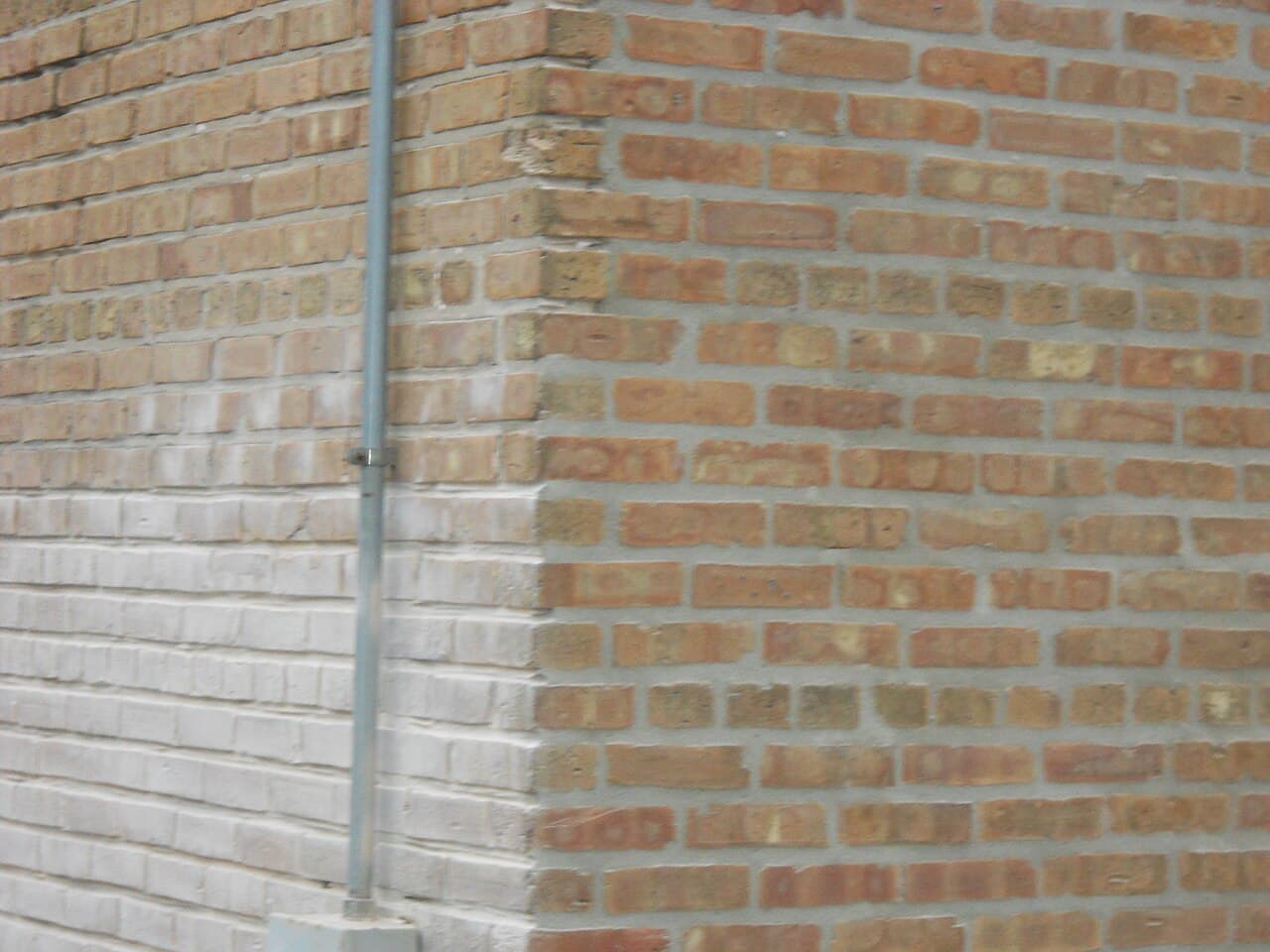
The National Park Service's repointing guidance says: "Repointing is both expensive and time consuming due to the extent of handwork and special materials required."[1] Nearly all of the price is a skilled person's time, raking out old mortar joint by joint and packing in new.
What moves the price
How much joint, and how scattered it is. Many masons price by the linear foot of joint. Scattered patches cost more per foot: the guidance notes that one linear foot of pointing in five different spots will be more expensive than five contiguous linear feet.[1] It also says that if 25 to 50 percent or more of a wall needs repointing, doing the whole wall may cost less than spot repointing.[1]
Height and access. Joints you can reach from the ground usually cost the least. Second-storey walls, gables and chimneys need ladders, lifts or scaffolding, and repointing everything at once can also make more sense when the wall needs expensive scaffolding.[1]
Matching the old mortar. A house built with soft, old brick needs a soft, matched mortar, and matching takes time. On a property of special historic significance, the Park Service says a mortar analysis by a qualified laboratory can be useful by providing information on the original ingredients,[1] which adds a cost on larger or older jobs. A sample panel to check colour and texture is normal, and a 3 foot by 3 foot area is usually enough for brickwork.[1]
How the old mortar comes out. Hand raking with a chisel is slow. Grinders are faster but have to be used carefully on brick, and for handheld grinders used to remove mortar, OSHA's silica rule for construction lists a grinder fitted with a commercial shroud and a dust collection system[2] as the control for workers. Ask which method a quote assumes.
What else turns up. Cracked or spalled bricks that need replacing, cleaning, rusted lintels over windows, or a leak behind the wall are separate items. A crack that points to movement in the structure may need an engineer before any mason can price the repair; see why brick walls crack.
Historic districts. Some Virginia localities review masonry work on houses in their historic districts. Martinsville's historic district guidelines, for example, list masonry, including re-pointing, among the exterior changes its Architectural Review Board covers, and say mortar joints should keep their original profile, width, color and style.[3] They also say a Certificate of Appropriateness must be obtained from the ARB before building permits are issued.[3] If your house is in a local district, ask your city or county what it requires; review time and matched materials both add to the cost.
Licences, contracts and deposits
In Virginia, a Class C contractor's licence covers construction, removal, repair or improvement jobs with a single contract over $1,000 and under $30,000.[4] The Board for Contractors' masonry specialty covers brick, block and stone work and includes tuck pointing, sand blasting, mortar washing and parging;[5] general contracting and home improvement licences can also cover the work.
Virginia's Board for Contractors advises homeowners to get at least three written bids or estimates[6] and notes that Virginia law requires all licensed contractors to provide a written contract for residential work.[6] For payment, it suggests an initial deposit of no more than 10% of the total price or $1,000, whichever is less,[6] and adds: "Never pay cash."[6]
Making quotes comparable
The Park Service recommends contracts with a base bid plus unit prices[1] for each kind of work. For a house, that means asking every company to quote the same areas, state a price per linear foot for anything beyond them, name the mortar type and how it will be matched, say whether joints will be raked by hand or ground, and list what is not included. Ask for photos of comparable jobs and the addresses of a couple you can drive past. The question of who to hire is covered in mason or general contractor.
Doing part of it yourself
Low joints on a house with modern brick are within reach for a careful homeowner, and the cost is mostly mortar, a chisel, a hammer and a pointing trowel. See how to repoint old brick mortar. A mason's price is mostly the height, the matching and the volume you are not doing yourself.
Stop and call a pro if
- The work is on a chimney, a gable or any wall above what you can reach from the ground.
- Bricks are cracked through, bulging, leaning or loose, not just the mortar.
- The house is in a local historic district and the work needs review.
- Water is getting inside, and you do not yet know where from.
Getting quotes on Loclis
On Loclis you describe the brick repair once and licensed local businesses quote it. A business that needs to see the wall first can offer an estimate visit, and a paid visit's fee comes off the price of the work. Loclis's own fees are on the pricing page. You can also browse concrete and masonry services, look up masonry and hardscaping businesses around Blacksburg, or read the other exterior answers.
Common questions
- Is repointing priced by the square foot or the linear foot?
- Masons price it in different ways: by the linear foot of joint, by the square foot of wall, or by the day. Unit prices per linear foot of joint are the easiest to compare, because they let you see what happens to the total if the mason finds more or less failed mortar than expected.
- Why is one quote so much higher than another?
- They are often quoting different work: hand raking versus grinding, a matched lime mortar versus a standard bag mix, ground-level work versus scaffolding, or spot repointing versus whole walls. Put the quotes side by side and ask each company to fill the gaps in writing.
- Is it cheaper to repoint the whole wall?
- Sometimes. The National Park Service's guidance says spot repointing is preferable, but once a quarter to half or more of a wall needs work, or the wall needs scaffolding anyway, doing the whole wall may cost less overall.
- Can I save money by doing some of it myself?
- Low, easy-to-reach joints on a house with modern brick are a reasonable DIY job, and you mostly pay for mortar and a few hand tools. Leave chimneys, high walls and anything with cracked or bulging brick to a mason, and tell the mason in writing which areas you are doing yourself.
- What does Loclis charge?
- Businesses on Loclis quote the job themselves. Loclis's own fees are listed on the pricing page.
Sources
- [1] Preservation Brief 2: Repointing Mortar Joints in Historic Masonry Buildings, National Park Service, U.S. Department of the Interior. Checked October 26, 2026.
- [2] 29 CFR 1926.1153, Respirable crystalline silica (construction), Occupational Safety and Health Administration, U.S. Department of Labor. Checked October 26, 2026.
- [3] Historic District Guidelines (updated August 2021), City of Martinsville, Virginia. Checked October 26, 2026.
- [4] Va. Code § 54.1-1100, Definitions (Contractors), Code of Virginia, Virginia General Assembly. Checked October 26, 2026.
- [5] 18VAC50-22-30, Definitions of specialty services (Board for Contractors Regulations), Virginia Administrative Code, Virginia General Assembly. Checked October 26, 2026.
- [6] What You Should Know Before You Hire a Contractor, Virginia Board for Contractors, DPOR. Checked October 26, 2026.
Want a pro to handle it?
Describe the job once. Licensed local businesses send quotes, and you pay only when you book one.
Get a quote for Roofing