How much do common heat pump repairs cost in Virginia?
Virginia has no set price list: each licensed HVAC business sets its own, and a bill is usually a service call fee plus parts and labor. Trane's general estimates, not specific to Virginia (August 2024, updated February 2026), run from $100-$400 for a capacitor and $200-$700 for a fan motor to $900-$2900 for a compressor. Refrigerant type, age, warranty and after-hours calls move the total.
Free to ask. Local shops send quotes, and you pay only when you book one.
By Kasra Taheri, Founder, LoclisUpdated
Researched and drafted with AI, then checked claim by claim against the sources listed below before it was published. Prices and rules change; the dates beside each source say when it was last checked.
This is a job for a licensed pro in Virginia
This page explains what the work involves, the permits, what a licensed pro does and what drives the cost. It does not give step-by-step instructions, because this work needs a licence, a permit or both, and doing it wrong can injure someone. Before you hire, check the licence on Virginia's DPOR record.
There is no Virginia price list for heat pump repair. Each licensed HVAC business sets its own rates, and a bill is usually a service call fee plus the part and the labor to fit it. Trane's general estimates, in a guide published in August 2024 and last updated in February 2026, run from $100-$400 for a capacitor and $200-$700 for a fan motor to $900-$2900 for a compressor and $1,000-$5,000+ for an evaporator coil[1]. Get a written quote before any large repair.
What makes up the bill
Most repair bills have three parts: the visit, the time and the part.
The visit. In a guide Trane published in August 2024 and last updated in February 2026, it put the service call fee at $50-200 and the typical hourly rate at between $75 and $150[1]. The same guide says some companies apply the service fee toward the repair if you hire them to fix the problem[1], so ask about that when you book.
The timing. A heat pump that quits on a cold Saturday night costs more to fix then than on a Tuesday morning. Trane notes that businesses with 24/7 service charge more outside normal hours: "Emergency rates can be as much as double to triple the regular hourly rate."[1] If the house can stay safely warm on emergency or backup heat, waiting for regular hours can save money.
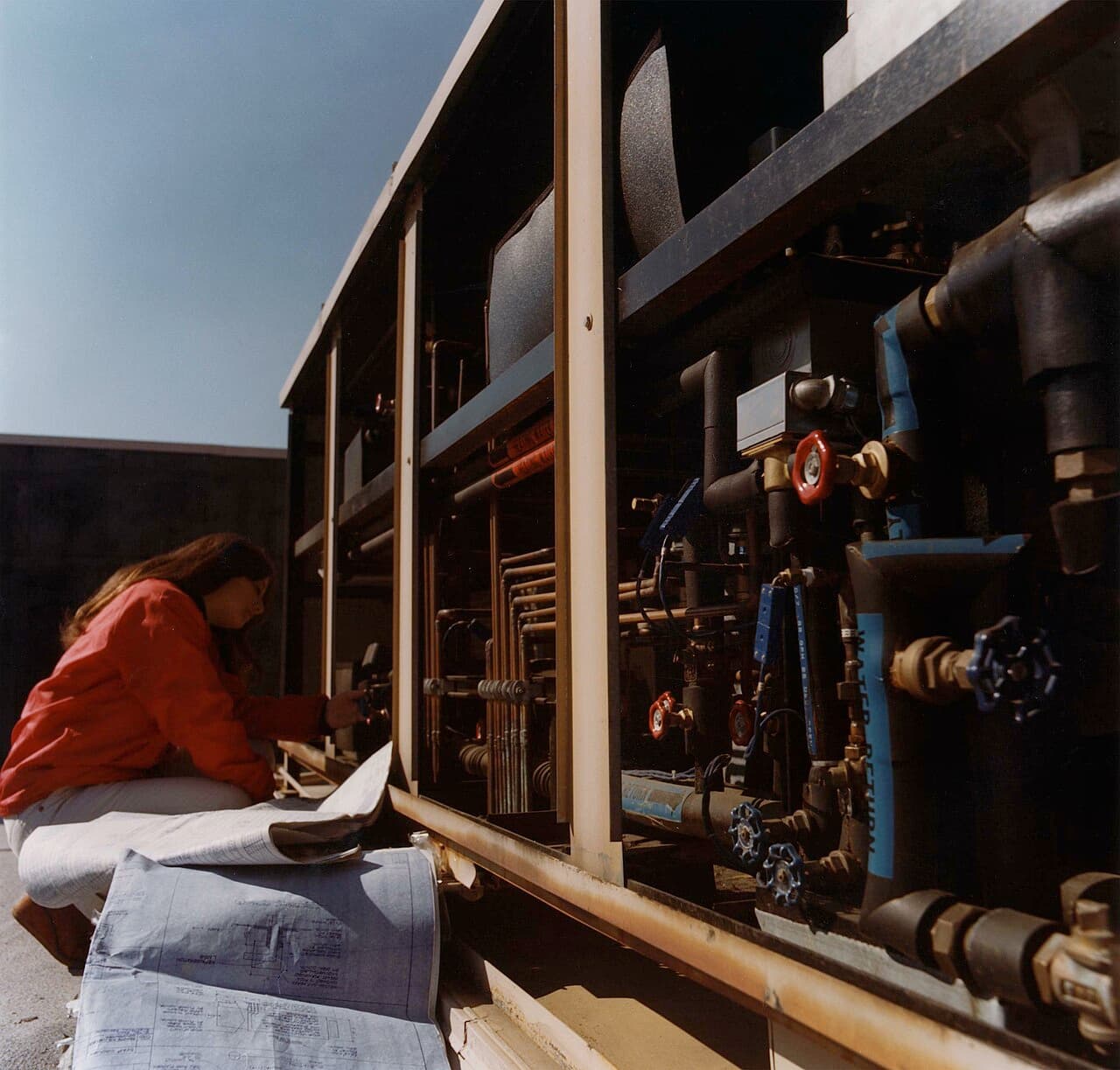
The part. Many repairs mean swapping a failed part for a new one, so the part's price and the time to fit it drive most of the total. What you see on a typical repair visit explains how the technician finds it.
Typical costs by part
The same Trane guide, last updated in February 2026, gives these estimates for the average cost of a repair by the part replaced:[1]
- Capacitor: $100-$400
- Circuit board: $75-$600
- Fuses and relays: $75-$290
- Thermostat: $90-$600
- Condensate drain tube: $100-$195
- Condensate pump: $100-$165
- Drain pan: $150-$350
- Expansion valve: $100-$700
- Fan motor: $200-$700
- Defrost control board: $200-$650
- Reversing valve: $400-$700
- Compressor: $900-$2900
- Condenser coil: $1,000-$4,000+
- Evaporator coil: $1,000-$5,000+
- Refrigerant lines: $1,500-$3,000+
These figures are not Virginia quotes. Use them to judge whether a quote is in the normal range, not as a price to hold a business to. Your cost also depends on whether you have a traditional split system heat pump or a ductless mini-split[1].
Refrigerant: the hardest number to pin down
The cost of a refrigerant recharge varies with the type of refrigerant, R-22 or R-410A, and how much the system needs[1]. The type matters more than people expect.
Older systems often run on R-22 (HCFC-22). As of January 1, 2020, no new HCFC-22 is made or imported into the United States, though used HCFC-22 cleaned to the same specifications as new remains available[4]. There are no "drop in" replacements for it, so technicians repairing a leak will most often continue to charge HCFC-22 into the system[4]. Be wary of anyone offering a cheap substitute: R-22a, which has been falsely marketed as HCFC-22 or a replacement for it, is a hydrocarbon blend that includes flammable substances such as propane and butane[4].
Refrigerant is also never a homeowner purchase. Under federal rules, technicians who maintain, service, repair, or dispose of equipment that could release ozone depleting refrigerants into the atmosphere must be certified[5], and refrigerant for stationary appliances is only sold to certified technicians or the companies that employ them[4]. A quote for refrigerant should name the type and the amount, and say whether the leak itself is being found and fixed.
What pushes the price up or down
- Age. Finding compatible parts and refrigerant for an older unit may be harder, which makes the repair cost more[1], and an older unit is more likely to have several worn parts at once.
- Warranty. A manufacturer's warranty may cover certain parts, but unless you have an extended warranty or a separate labor warranty with the installer, you may pay full price for labor[1].
- A maintenance plan. Some HVAC maintenance plans include discounts on replacement parts and diagnostics[1].
- Where you live. Travel time and how many businesses serve your area both affect rates, so prices in a rural county and a large metro area can differ[1].
When a repair stops making sense
Two rules of thumb help with a big quote. Trane's "$5,000 rule": multiply the age of the equipment by the estimated repair cost, and if the number is over $5,000, a new system probably makes more financial sense[2]. A 12-year-old heat pump needing a $900 compressor comes to $10,800 on that test. Carrier suggests considering replacement sooner if repair costs approach 50% of the value of a new system[3]. Neither rule is binding; a newer unit with parts still under warranty can be worth fixing even for a large part. See how old is too old for a heat pump and how much a new heat pump costs in Virginia.
Virginia rules that shape the quote
Licensing. Virginia law says no person may engage in, or offer to engage in, contracting work unless licensed under the contractor chapter of the Code[7]. The smallest class, Class C, covers a single contract or project over $1,000 but less than $30,000, or a total of less than $250,000 of such work in any 12-month period, and the Board for Contractors requires a master tradesman licence as a condition of licensing an HVAC contractor[6].
Written contracts. Virginia's Board for Contractors requires a legible written contract for residential contracting, though it excludes those who engage in routine maintenance or service contracts[8]. For a larger repair the contract must cover, among other things, when work is to begin and the estimated completion date, the total cost, the payment schedule including the down payment, and the contractor's name, address, license number, class of license, and classifications or specialty services[8].
Permits. The Uniform Statewide Building Code requires a permit to be obtained before installations or alterations involving mechanical systems begin, though for emergency equipment replacement the application is due by the end of the first working day after the work starts[9]. It lists, among ordinary repairs that need no permit application in houses, "Replacement of mechanical appliances provided such equipment is not fueled by gas or oil"[9]. An owner can still ask for a permit, and the building official decides what other repair work is minor and ordinary[9], so ask the contractor whether your job needs one and who will pull it.
What to ask for in a written quote
- The diagnosis in plain words, and the reading or test that showed it.
- The part being replaced, with its price and whether it is a manufacturer part.
- Labor, either as a fixed price or an hourly rate with an estimate of hours.
- For refrigerant, the type, the amount and how the leak will be found and repaired.
- Whether the service call fee comes off the repair price.
- What warranty the business gives on the part and on its labor.
When to call a licensed pro
Every repair on this page is licensed work. Under Virginia law no individual may work as a tradesman unless licensed, unless working under the supervision of a tradesman licensed in that specialty[10]. Check any business on DPOR's License Lookup[11] before you agree to a price.
For more, browse HVAC repair answers, see heat pump services, or find licensed HVAC businesses in Blacksburg.
Describe the problem once and licensed local HVAC businesses send you quotes to compare.
Common questions
- Is the service call fee extra on top of the repair?
- It depends on the business. Trane's guide notes that some companies apply the service fee toward the repair if you hire them to fix the problem, and that most will tell you the fee over the phone. Ask before you book, and ask whether it changes on evenings, weekends or holidays.
- Why is refrigerant so expensive on my older heat pump?
- Older systems often use R-22, and no new R-22 has been made or imported into the United States since January 1, 2020. Repairs rely on reclaimed supply, and a recharge's cost varies with the refrigerant type and how much the system needs. The refrigerant type is usually printed on the outdoor unit's nameplate.
- Can I buy refrigerant and have it added myself to save money?
- No. Federal rules sell refrigerant for home systems only to certified technicians or the companies that employ them, and recharging needs Section 608 certification. Steer clear of R-22a, a flammable hydrocarbon blend that has been falsely marketed as an R-22 replacement.
- Does a heat pump repair need a permit in Virginia?
- It depends on the job. The Uniform Statewide Building Code requires a permit for installations or alterations involving mechanical systems, but in houses it exempts replacing a mechanical appliance that is not fueled by gas or oil, and other repair work the local building official deems minor and ordinary. In an emergency, equipment replacement can start first, with the application due by the end of the first working day after. Ask the contractor whether your job needs a permit and who will pull it.
- Will my warranty cover the repair?
- A manufacturer's warranty may cover certain parts, but labor is often billed in full unless you have an extended or labor warranty from the installer. Have the model and serial number ready, and ask the technician to check coverage before the part is ordered.
Sources
- [1] Average Heat Pump Repair Cost, Trane. Checked October 26, 2026.
- [2] Warning Signs That It's Time to Replace Your HVAC, Trane. Checked October 26, 2026.
- [3] How Long Do HVAC Systems Last?, Carrier. Checked October 26, 2026.
- [4] Homeowners and Consumers: Frequently Asked Questions, U.S. Environmental Protection Agency. Checked October 26, 2026.
- [5] Section 608 Technician Certification, U.S. Environmental Protection Agency. Checked October 26, 2026.
- [6] Va. Code § 54.1-1100, Definitions, Code of Virginia, Virginia General Assembly. Checked October 26, 2026.
- [7] Va. Code § 54.1-1103, Necessity for license, Code of Virginia, Virginia General Assembly. Checked October 27, 2026.
- [8] 18VAC50-22-260, Filing of charges; prohibited acts, Virginia Administrative Code, Virginia General Assembly. Checked October 26, 2026.
- [9] 13VAC5-63-80, Section 108 Application for permit, Virginia Administrative Code, Virginia General Assembly. Checked October 26, 2026.
- [10] Va. Code § 54.1-1129, Necessity for licensure, Code of Virginia, Virginia General Assembly. Checked October 26, 2026.
- [11] License Lookup, Virginia Department of Professional and Occupational Regulation. Checked October 26, 2026.
Want a pro to handle it?
Describe the job once. Licensed local businesses send quotes, and you pay only when you book one.
Get a quote for HVAC Repair