How much does a heat pump cost in Virginia?
It depends on the house, but a manufacturer's own guide gives a starting point. When we checked on October 26, 2026, Trane's 2026 national cost guide put its installed standard heat pumps at $8,313 to $15,608 and its cold-climate heat pumps at $7,983 to $17,012. Sizing, ductwork, backup heat, electrical work and the permit move a Virginia quote up or down.
Free to ask. Local shops send quotes, and you pay only when you book one.
By Kasra Taheri, Founder, LoclisUpdated
Researched and drafted with AI, then checked claim by claim against the sources listed below before it was published. Prices and rules change; the dates beside each source say when it was last checked.
This is a job for a licensed pro in Virginia
This page explains what the work involves, the permits, what a licensed pro does and what drives the cost. It does not give step-by-step instructions, because this work needs a licence, a permit or both, and doing it wrong can injure someone. Before you hire, check the licence on Virginia's DPOR record.
There is no single Virginia price for a heat pump, because the house sets most of the cost. Trane's dated 2026 national prices, below, give a starting point, but they are national figures, not local ones. Your real number comes from written quotes after a licensed contractor has looked at your house.
What one manufacturer's 2026 prices look like
When we checked on October 26, 2026, Trane's 2026 national cost guide listed these installed price ranges for its heat pumps:[1]
- standard heat pumps (the guide's Heat Pumps tab): $8,313 to $10,289 for its single-stage line, $9,921 to $12,648 for multi-stage and $12,778 to $15,608 for variable-speed[1]
- low-profile heat pumps: $7,369 to $11,739 across its three lines ($7,400 to $8,910, $7,369 to $11,339 and $7,612 to $11,739)[1]
- cold-climate heat pumps: $7,983 to $9,374 up to $10,193 to $17,012, depending on the line[1]
- air handlers, the indoor unit, listed separately at $5,172 to $8,742[1]
Read those as a starting point, not a Virginia quote. Trane says its heat pump ranges include product and labor costs and the basic accessories and services its dealer provides, before tax.[1] Trane adds that they are based on national averages, do not include accessories such as a thermostat, and do not include required accessories or installation requirements.[1] Other brands price differently, and a job that replaces both the outdoor unit and the indoor air handler costs more than either line alone.
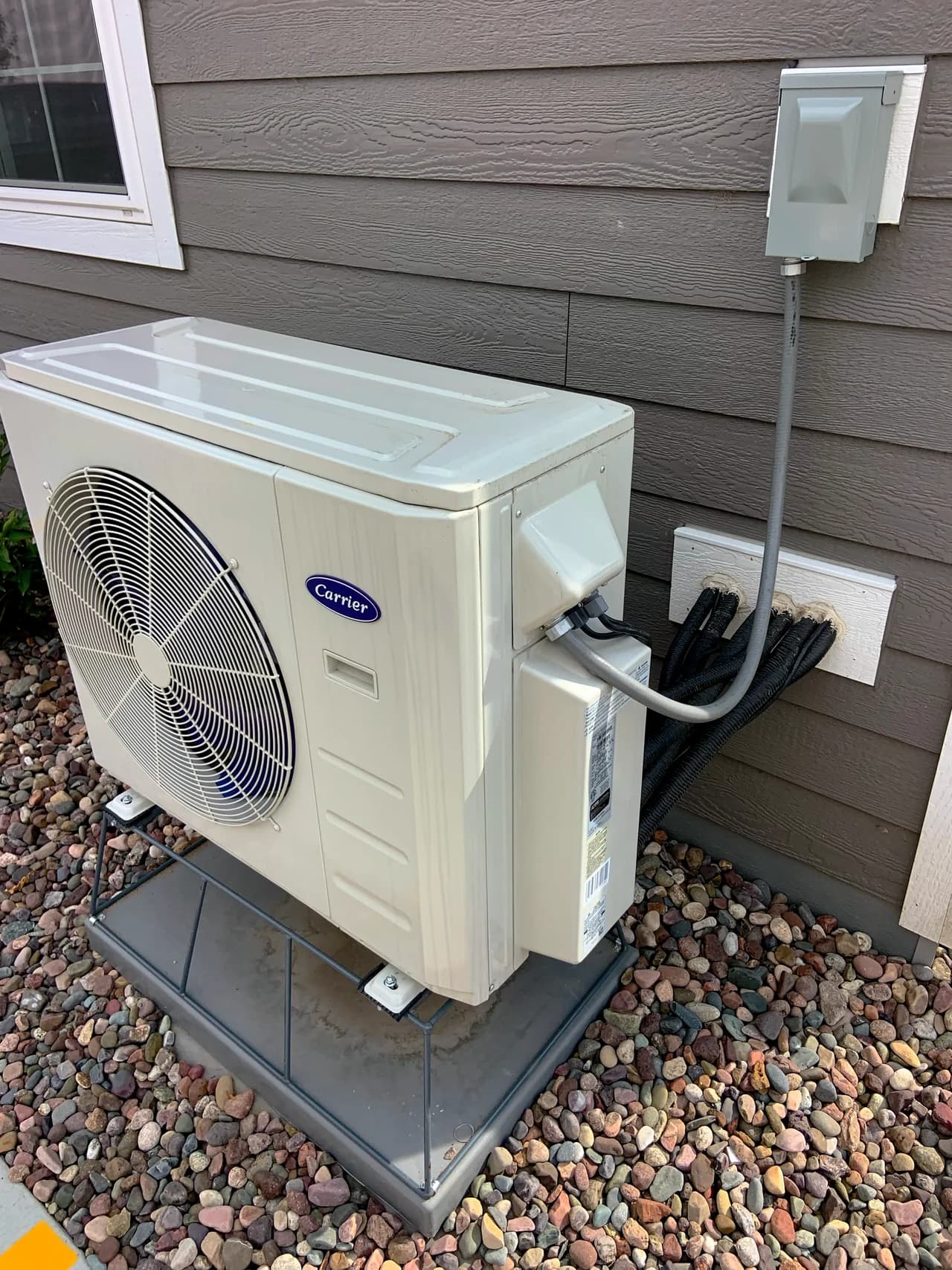
What drives the price
According to Trane, costs vary with geography, climate, home size, system size, home configuration, existing ductwork and selected features.[1] In practice, these are the lines that move a quote.
Staging. Single-stage units are either on and running at 100%, or off,[1] while variable-speed units can run from 30% to 100% of capacity.[1] Trane describes variable-speed units as its pricier option, giving precise temperature and humidity control.[1]
Size. Capacity should come from your house, not from the old unit's label. ENERGY STAR says the contractor should verify the size with a "Manual J" calculation of how much heating and cooling the house needs.[2] A correctly sized heat pump is sometimes smaller, and cheaper, than the system it replaces.
Cold-climate rating and backup heat. In the mountains or the colder parts of the Piedmont, a cold-climate model or a larger backup heat package may be worth paying for. If you already have a relatively new gas furnace, keeping it and adding a heat pump creates a dual-fuel system for a modest extra cost over an AC system,[2] according to ENERGY STAR.
Ductwork. In a typical house, about 20 to 30 percent of the air that moves through the duct system is lost to leaks, holes and poorly connected ducts.[3] Sealing or replacing ducts adds to the bill and often pays for itself in comfort. Ask whether each quote includes a duct inspection and a leakage test.
Electrical work and access. Electric backup heat strips and a new outdoor unit may need circuit changes, and an older panel may need work. Equipment in a tight attic or crawlspace takes longer to replace than equipment in a basement.
Permit. Virginia's Uniform Statewide Building Code requires a permit before work starts on mechanical systems.[8] Among the exemptions from a permit application, it lists "Replacement of mechanical appliances provided such equipment is not fueled by gas or oil".[8] The exemption applies to dwellings in Groups R-3, R-4 and R-5, and in Group R-2 where it serves a single-family dwelling,[8] so swapping one electric heat pump for another in a house can fall under it, while a new installation is not a replacement. The exemption covers the application only and does not exempt the work from the code's other requirements.[8] Even then, if the owner or the owner's agent asks for a permit anyway, the building official issues one and inspects the work.[8] Fairfax County's permit library says a mechanical permit is required for new, replacement, repair or conversion of HVAC systems,[9] so check with your own building department. Fees are set by each locality. Spotsylvania County's mechanical application, updated in August 2025, lists an HVAC replacement at $147.00, made up of a $100 trade fee, a 2% building surcharge and a $45 processing fee.[7] Spotsylvania adds a 2.70% convenience fee when the permit is paid by debit or credit card.[7] See do you need a permit to replace an HVAC system in Virginia for how other localities handle it.
What it costs to run
The purchase price is only half the picture. ENERGY STAR says an air-source heat pump can deliver up to three times more heat energy to a home than the electrical energy it consumes.[2] Up to three times is the best case, not a typical figure, but ENERGY STAR still lists "Lower energy bills by switching from electric resistance, propane, and oil to heat pumps."[2] By comparison, electric resistance space heaters have a coefficient of performance (COP) of 1, which Virginia Cooperative Extension calls generally the most expensive method of heating.[11] If you are weighing a heat pump against gas, oil or propane, Extension advises that you compare fuels by the cost per amount of heat produced, not by the price per gallon, therm or kilowatt hour,[11] and check with your local utility first. Electric backup heat is the expensive part of winter: "Auxiliary heating with electric heating strips is less efficient and will use more energy than your heat pump".[4] A system sized and set up so that the strips rarely run costs less to live with, which is one more reason the load calculation matters. For what happens on cold days, see how a heat pump works in cold weather.
Tax credits and rebates in 2026
The federal tax credit many older guides mention has ended for new work. The IRS says the Energy Efficient Home Improvement Credit, which allowed up to $2,000 a year for qualified heat pumps, covered improvements made through December 31, 2025.[5]
Virginia's federally funded rebates are not open either. In its rebate FAQ, last updated October 13, 2026, Virginia Energy says the Home Energy Rebates are not available yet and that it cannot give an estimated launch date.[6] The federal law behind the High Efficiency Appliance Rebate (HEAR) caps the rebate for an ENERGY STAR-certified heat pump for space heating and cooling at $8,000,[6] and it limits that rebate to households earning up to 150% of the area median income.[6] Virginia Energy also warns that all projects must be completed by a Verified Contractor, that Virginia's list of Verified Contractors has not yet been established, and that households starting projects before launch may assume full risk of project ineligibility.[6] Be wary of any contractor who promises otherwise.
Some help is available now. Virginia Energy points residents looking for incentives available now to Virginia Energy Connect, the state's hub for energy incentive information,[6] and ENERGY STAR notes that many utilities also offer incentives for ENERGY STAR certified air-source heat pumps.[2] Ask your electric utility before you sign.
Getting a quote you can compare
Get written, itemized estimates from more than one contractor, and compare price, efficiency and warranties side by side rather than the bottom line alone. For each quote, ask for:
- the load calculation the size is based on
- outdoor and indoor model numbers, capacity, SEER2 and HSPF2 ratings, and whether the model is cold-climate rated
- the size and type of backup heat
- what is included: removal of the old equipment, duct work, electrical changes, thermostat, permit and inspection
- labor and parts warranty terms
Under Virginia's Board for Contractors rules, a residential contract must state the total cost, the amounts and schedule of progress payments including the down payment, and the contractor's name, address, licence number and class.[12] For more on choosing who does the work, read what to ask a contractor before installing a heat pump.
When to call a licensed pro
For the whole job. The contractor's licence class has to fit the contract value. Class C covers a single contract over $1,000 but less than $30,000, and Class B covers $30,000 or more but less than $150,000.[10] On top of the class, the Board for Contractors requires a master tradesman licence as a condition of licensure for HVAC contractors.[10] Check the licence before you pay a deposit.
Loclis lists DPOR-licensed HVAC businesses with their licence number and class. Browse heat pump services, find HVAC businesses in Blacksburg, or read more heating and cooling answers. See pricing for how Loclis charges.
To get prices for your own house, describe the job once and licensed local HVAC businesses quote it.
Common questions
- Is there still a federal tax credit for heat pumps?
- Not for new work. The IRS says the Energy Efficient Home Improvement Credit, which allowed up to $2,000 a year for qualified heat pumps, covered improvements made through December 31, 2025. A heat pump installed in 2026 does not qualify for it.
- Can I get a Virginia rebate on a heat pump?
- Not through the federally funded Home Energy Rebates yet. Virginia Energy's FAQ, last updated October 13, 2026, says they are not available and gives no launch date. The HEAR rebate for a heat pump is capped at $8,000 and limited to households earning up to 150% of area median income. Ask your electric utility and check Virginia Energy Connect for programs open now.
- Why do heat pump quotes vary so much?
- Equipment line, size, staging and cold-climate rating set much of the spread, and so does the house: ductwork that needs sealing or replacing, a new air handler, electrical changes, access and the permit. Trane's own guide says costs vary with geography, climate, home size, system size, configuration and existing ductwork.
- Is a heat pump cheaper to run than electric baseboard heat?
- Usually, yes. ENERGY STAR lists lower energy bills as a reason to switch from electric resistance heat to a heat pump, and says an air-source heat pump can deliver up to three times more heat energy than the electricity it uses. That is the best case, not a typical figure. Backup electric strips use more energy than the heat pump, so a well-sized system that rarely needs them saves the most.
- Do I need a permit for a heat pump in Virginia?
- For a new system, yes: the Uniform Statewide Building Code requires a permit for mechanical systems. It exempts replacing a mechanical appliance that is not fueled by gas or oil in a house, which can cover swapping one electric heat pump for another. Fairfax County's permit library still lists a mechanical permit for HVAC replacement. Ask your building department, and put any fee in the quote.
Sources
- [1] Trane 2026 HVAC Replacement Cost Guide, Trane. Checked October 26, 2026.
- [2] Air-Source Heat Pumps, ENERGY STAR, U.S. Environmental Protection Agency. Checked October 26, 2026.
- [3] Duct Sealing, ENERGY STAR, U.S. Environmental Protection Agency. Checked October 26, 2026.
- [4] What Is Auxiliary Heat in a Heat Pump System?, Trane. Checked October 26, 2026.
- [5] Energy Efficient Home Improvement Credit, Internal Revenue Service. Checked October 26, 2026.
- [6] Home Energy Rebates Frequently Asked Questions, Virginia Department of Energy. Checked October 26, 2026.
- [7] Mechanical (HVAC Only) Application Packet, Spotsylvania County, Virginia. Checked October 26, 2026.
- [8] 13VAC5-63-80, Section 108 Application for permit, Virginia Administrative Code, Uniform Statewide Building Code. Checked October 26, 2026.
- [9] Mechanical (MECHR) - Residential, Fairfax County, Virginia. Checked October 26, 2026.
- [10] Va. Code § 54.1-1100, Definitions, Code of Virginia, Virginia General Assembly. Checked October 26, 2026.
- [11] ENERGY SERIES: What about the Heating System?, Virginia Cooperative Extension, Virginia Tech. Checked October 26, 2026.
- [12] 18VAC50-22-260, Filing of charges; prohibited acts, Virginia Administrative Code, Board for Contractors. Checked October 26, 2026.
Want a pro to handle it?
Describe the job once. Licensed local businesses send quotes, and you pay only when you book one.
Get a quote for HVAC Repair