How old is too old for a heat pump?
There is no fixed cut-off. Manufacturers put a typical heat pump's life anywhere from 10 to 12 years (Trane) to 15 to 20 (Carrier), and ENERGY STAR suggests considering replacement once a heat pump is more than 10 years old. Age matters most alongside repair costs, rising bills, R-22 refrigerant and warranty status, so a working older unit is not automatically too old.
Free to ask. Local shops send quotes, and you pay only when you book one.
By Kasra Taheri, Founder, LoclisPublished
Researched and drafted with AI, then checked claim by claim against the sources listed below before it was published. Prices and rules change; the dates beside each source say when it was last checked.
This is a job for a licensed pro in Virginia
This page explains what the work involves, the permits, what a licensed pro does and what drives the cost. It does not give step-by-step instructions, because this work needs a licence, a permit or both, and doing it wrong can injure someone. Before you hire, check the licence on Virginia's DPOR record.
There is no single age at which a heat pump is too old. Manufacturers put a typical air-source heat pump's life at somewhere between 10 and 20 years, and ENERGY STAR treats more than 10 years as the point to start thinking about replacement. Whether yours is too old depends less on the birthday than on its condition, what the next repair costs, which refrigerant it uses and whether it is still under warranty.
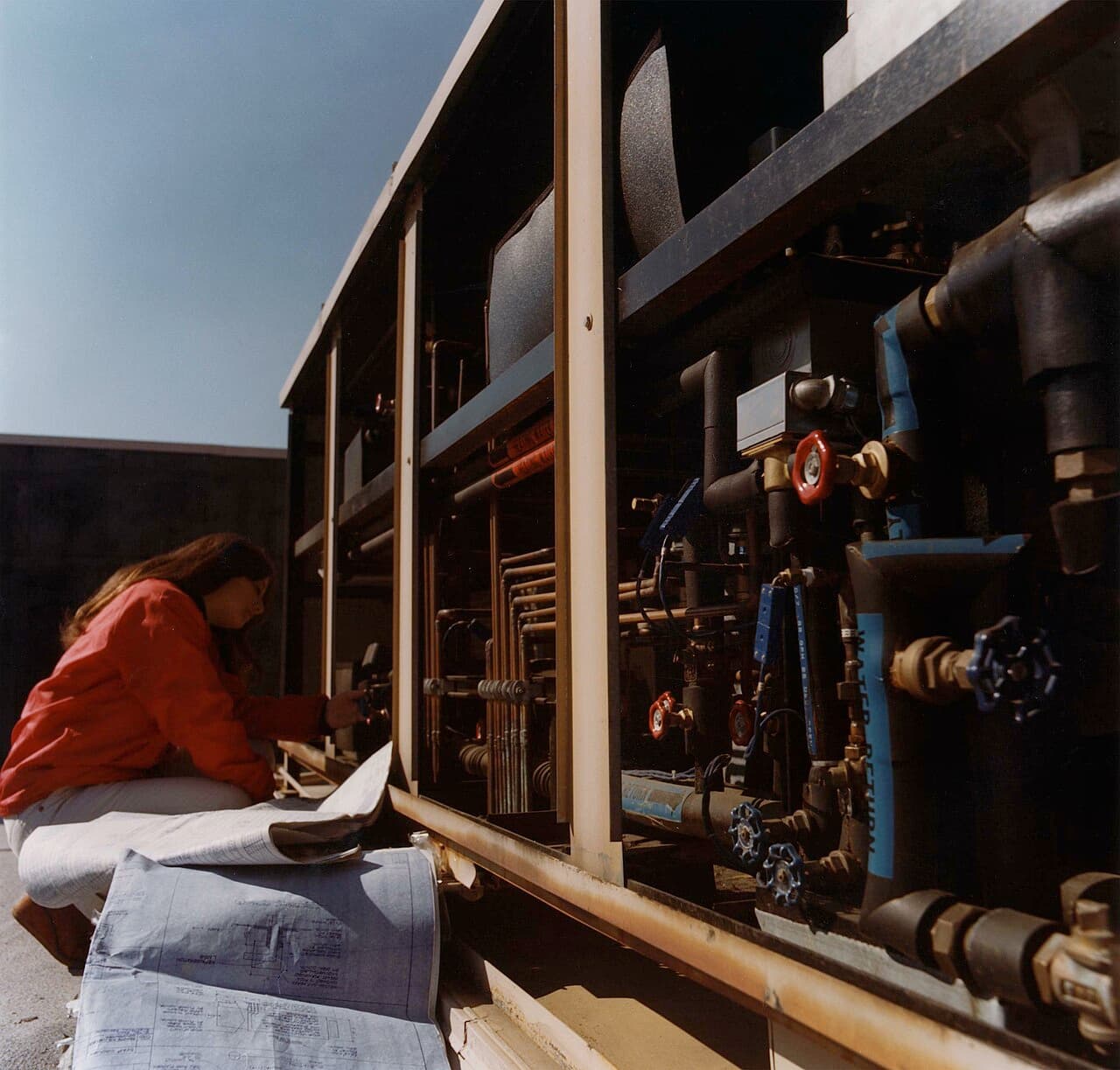
How long heat pumps usually last
The manufacturers do not agree on one number. Lennox says heat pumps typically last 10-15 years with proper care[1]. Trane gives an air conditioner or heat pump a service life expectancy of 10 to 12 years[2]. Carrier says air conditioners and heat pumps typically have a life expectancy of 15 to 20 years[3]. Ground-source (geothermal) systems can last even longer, sometimes 20-25 years[1].
The spread comes from the things that wear a unit out: how well it was installed, how well it has been maintained, how hard the climate works it, and how it was sized. An undersized unit runs constantly trying to keep up, while an oversized one short-cycles, turning on and off repeatedly and wearing out the compressor faster[1]. Two 12-year-old heat pumps on the same street can be in very different shape.
Ten years is a checkpoint, not a deadline
ENERGY STAR lists a heat pump or air conditioner more than 10 years old as one of the signs it may be time to call a contractor about replacing it[4]. Its reason is efficiency: installed correctly, an ENERGY STAR unit can save up to 20 percent on heating and cooling costs[4]. Carrier recommends considering replacement when an air conditioner or heat pump is more than 10 years old, particularly when it also needs frequent repairs or energy bills are increasing[3], and adds: "Age alone does not necessarily mean replacement is required."[3]
Trane puts the two together: "If you have an older heat pump (10+ years) or you're spending more money on more frequent repairs, it may be time to consider heat pump system replacement."[6]
Signs an older heat pump is near the end
Lennox's warning signs are rising energy bills without explanation, frequent repairs, uneven heating or cooling from room to room, and grinding, squealing or banging sounds[1]. On its own, any one of these can be a repairable fault. Several at once on a unit past ten years is the pattern that usually ends in replacement.
One sign is urgent at any age. Trane says a burning electrical smell can indicate a much more serious issue, and its advice is to shut off the unit immediately and contact a licensed HVAC professional[2].
The refrigerant question
Find out which refrigerant your heat pump uses before deciding. The refrigerant is typically listed on the unit's nameplate, which for a central system is usually on the outdoor unit[5].
If it says R-22 (HCFC-22), the system is from the older generation. As of January 1, 2020, no new HCFC-22 is made or imported into the United States, though reclaimed HCFC-22 cleaned to the same specifications as new remains available[5]. EPA does not require homeowners to replace their existing equipment[5], so an R-22 system can keep running and be repaired. But there are no "drop in" replacements for HCFC-22[5], and Trane says that for older heat pumps that use Freon, rather than a retrofit to R-410A, it might be time to invest in a new system[2]. Finding compatible parts and refrigerant for an older unit may also be harder, which makes repairs cost more[6].
Simple repair-or-replace tests
When a large repair comes up, two rules of thumb help. Trane's "$5,000 rule": multiply the age of the equipment by the estimated repair cost, and if the number is over $5,000, a new system probably makes more financial sense[2]. Carrier suggests considering replacement sooner if repair costs approach 50% of the value of a new system[3], and Lennox makes the same point: when repair bills start approaching half the cost of a new system, replacement makes more financial sense[1].
Warranty can change the math. According to Trane, most manufacturers' HVAC warranties last five to 10 or 20 years, depending on the type of unit, whether it was registered, and whether you are the original owner or it was transferred with the sale of the home[2]. Many manufacturers require proof of regular maintenance to honor warranties[1], so keep service records. A compressor covered under warranty on a nine-year-old unit is a very different decision from the same part on a 16-year-old one.
Ratings have also changed. Carrier notes that the U.S. Department of Energy changed the testing method and updated efficiency standards for residential air conditioners and heat pumps beginning January 1, 2023, and the new ratings are known as SEER2 for cooling and HSPF2 for heating[3]. A new unit's label will not compare directly with the old SEER and HSPF figures on yours, so ask the contractor to explain the difference.
For prices, see how much common heat pump repairs cost in Virginia and how much a new heat pump costs in Virginia.
Getting a straight answer from a contractor
Ask the technician who diagnoses the fault to put the repair-or-replace case in writing: the failed part, the unit's age and refrigerant, the condition of the coils and compressor, and the price of both options. If replacement is recommended, a second quote is reasonable. Before you agree to a new system, read what to ask a contractor before installing a heat pump, and ask whether your county or city needs a permit for the job and who will pull it.
When to call a licensed pro
Call for an inspection when an older heat pump starts needing repairs, running up bills or struggling to hold temperature, and right away for a burning smell or a breaker that keeps tripping. Both the repair and a replacement are licensed work in Virginia: no individual may work as a tradesman unless licensed, unless working under the supervision of a tradesman licensed in that specialty[7], and the Board for Contractors requires a master tradesman licence as a condition of licensing an HVAC contractor[8]. Check the business on DPOR's License Lookup[9].
To get the most years from the unit you have, see how often a heat pump should be serviced. You can also browse HVAC repair answers, heat pump services, or licensed HVAC businesses in Blacksburg.
Describe your heat pump's age and symptoms and licensed local HVAC businesses quote the repair, or the replacement.
Common questions
- How do I find out how old my heat pump is?
- Look at the label on the outdoor unit for the model and serial number, and check the paperwork from the installation or the home sale. The manufacturer or a technician can often tell you the build date from the serial number.
- Should I replace a 15-year-old heat pump that still works?
- Not necessarily. Carrier says age alone does not necessarily mean replacement is required. Plan for it, though: get a technician's view of its condition, find out which refrigerant it uses, and price a replacement before it fails in a cold snap, when your choices are fewer.
- Is it worth fixing an R-22 heat pump?
- Sometimes, for a small repair. EPA does not require you to replace R-22 equipment, and reclaimed R-22 is still available for repairs. A big leak, a compressor or a coil on an older R-22 system is often the point where replacement is worth pricing, since there is no drop-in substitute refrigerant.
- Does a heat pump wear out faster than a furnace?
- Usually a little. A heat pump heats and cools, so it runs most of the year. Carrier puts furnaces at 15 to 30 years and heat pumps at 15 to 20, while Lennox and Trane give heat pumps shorter typical lives.
- Who can tell me whether to repair or replace?
- A licensed HVAC business can inspect the system and quote both options. Getting a second quote on a large repair or a replacement is reasonable, and you can check each business's licence on DPOR's License Lookup.
Sources
- [1] How Long Do Heat Pumps Last? Expert Guide, Lennox. Checked October 26, 2026.
- [2] Warning Signs That It's Time to Replace Your HVAC, Trane. Checked October 26, 2026.
- [3] How Long Do HVAC Systems Last?, Carrier. Checked October 26, 2026.
- [4] When is it time to replace?, ENERGY STAR, U.S. Environmental Protection Agency. Checked October 26, 2026.
- [5] Homeowners and Consumers: Frequently Asked Questions, U.S. Environmental Protection Agency. Checked October 26, 2026.
- [6] Average Heat Pump Repair Cost, Trane. Checked October 26, 2026.
- [7] Va. Code § 54.1-1129, Necessity for licensure, Code of Virginia, Virginia General Assembly. Checked October 26, 2026.
- [8] Va. Code § 54.1-1100, Definitions, Code of Virginia, Virginia General Assembly. Checked October 26, 2026.
- [9] License Lookup, Virginia Department of Professional and Occupational Regulation. Checked October 26, 2026.
Want a pro to handle it?
Describe the job once. Licensed local businesses send quotes, and you pay only when you book one.
Get a quote for HVAC Repair