How much does a concrete driveway cost in Virginia?
There is no single price for a concrete driveway in Virginia. Each contractor prices the job from your site: the area and thickness, the base, tearing out an old driveway, truck access, the mix and the apron at the street, which may need a road permit. Write one specification and get at least three written bids on it from licensed contractors.
Free to ask. Local shops send quotes, and you pay only when you book one.
By Kasra Taheri, Founder, LoclisPublished
Researched and drafted with AI, then checked claim by claim against the sources listed below before it was published. Prices and rules change; the dates beside each source say when it was last checked.
Step by step
Read when to stop and call a pro, further down this page, before you start.
Step 1: Measure the driveway
Measure the length and width, and sketch any curves, flares at the garage and the connection to the street.
Step 2: Choose the thickness
Plan 4 inches for passenger cars only, or 5 to 6 inches where trucks and other heavy vehicles will use it.[1]
Step 3: Find out who owns the road
Ask whether VDOT, a city or a town maintains your street, since building or upgrading an entrance to a state highway needs a VDOT permit.[2]
Step 4: Write one specification
List the thickness, base, mix strength and air content, joints, removal of the old driveway and the apron work in one page every bidder gets.
Step 5: Get three written bids
Ask at least three licensed contractors for written bids on that same specification.[5]
Step 6: Check each licence
Look each business up on DPOR's licence lookup and confirm its class covers the contract amount.[6]
Step 7: Compare line by line
Ask why prices differ, and treat a bid far below the others as a likely mistake or missing work.[5]
Step 8: Keep the deposit small
Expect a deposit of no more than 10 percent of the price or $1,000, whichever is less, for ordinary work.[5]
Step 9: Sign a full written contract
Make sure the contract states start and finish dates, the total cost, the payment schedule and the work and materials.[8]
What you are paying for
Area and thickness. Concrete is the biggest material cost, and concrete is sold by volume, in cubic yards. Thickness multiplies the area. Quikrete says 4 inches is sufficient for passenger cars, and 5 or 6 inches is recommended where trucks and other heavy vehicles will use the driveway.[1] Going from 4 to 6 inches adds half again as much concrete. Bids usually include a little extra concrete beyond the plan dimensions, so ask how much overage is built in.
Truck loads. Concrete arrives by the truckload. A short parking pad uses only part of a load, so the delivery, setup and crew time are spread over very little concrete. That is why small jobs cost more per square foot than long driveways.
The mix. A driveway that freezes and gets salted needs a stronger, air-entrained mix, so ask each bidder to state the strength and air content in writing. Extras such as fibers, integral color and special aggregates raise the price, as do stamped or exposed-aggregate finishes.
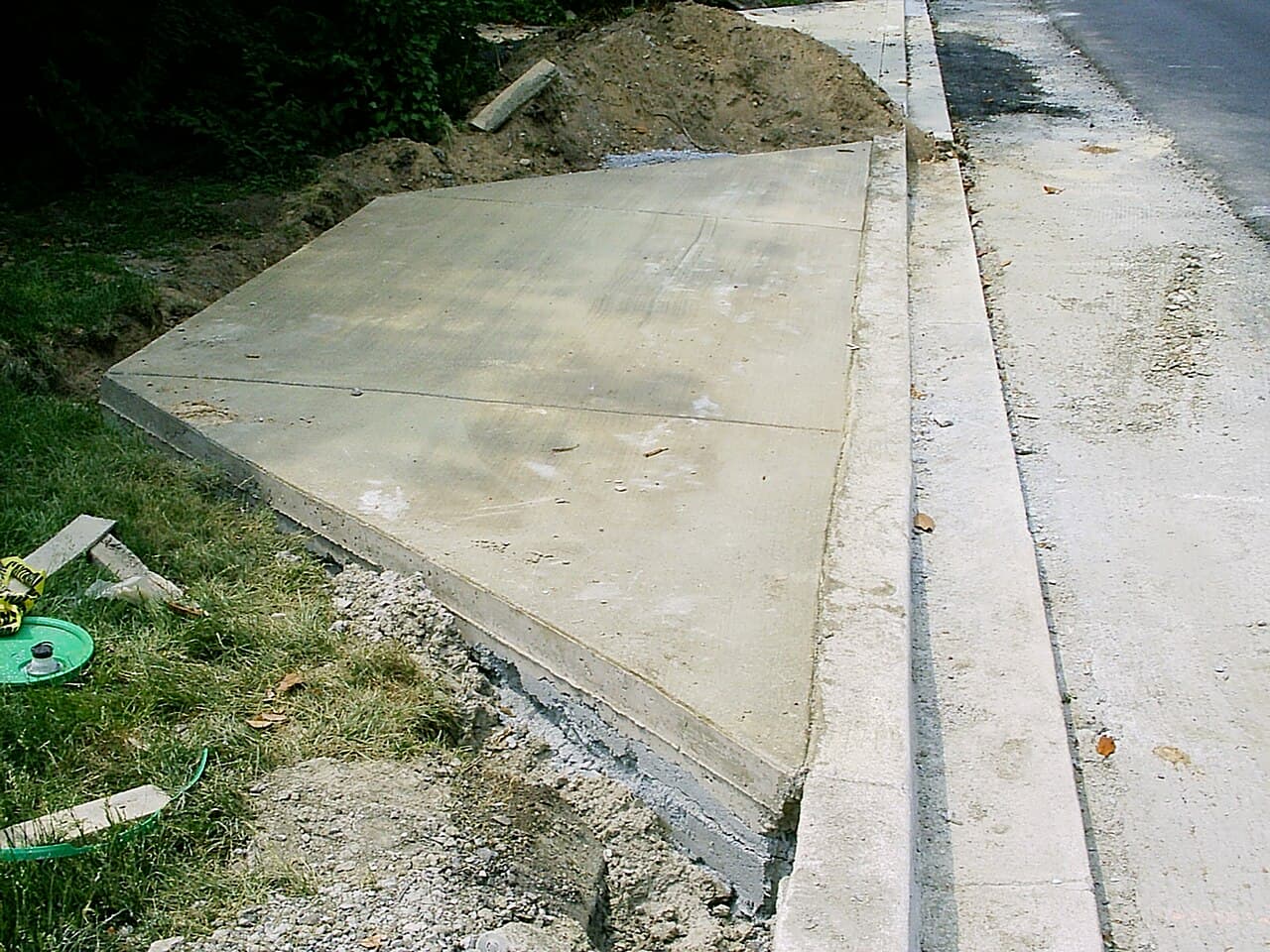
The base. Much of the labour is under the slab. Topsoil and soft spots have to come out and the soil under the slab has to be compacted. Soft or wet ground may need extra digging and gravel, and a contractor who skips this will be cheaper and less durable.
Removing the old driveway. Breaking out old asphalt or concrete, loading it and hauling it away is often a separate line on the bid. Ask whether it is included.
Access. A loaded concrete truck is very heavy and may not be able to maneuver on loose dirt or over residential curbs and pathways. If the truck cannot reach the forms, a pump or wheelbarrows add equipment and labour.
Season. A cold-weather pour needs protection with blankets or covers while it sets, which adds labour and materials. Some contractors price late-fall work higher or push it to spring.
The apron and permits. The connection to the street is its own small project. Under Virginia's land use permit rules, a single use permit is required before building a permanent entrance to a highway, making permanent upgrades to an existing entrance, or cutting or disturbing highway pavement, shoulders or ditches.[2] When we checked on October 27, 2026, the regulation set a $100 application fee for a single use permit and listed no additional fee for a private entrance.[3] Cities and towns that maintain their own streets have their own permits. Do you need a permit to widen your driveway? explains who to ask. Digging also means a utility locate: contact Virginia 811 at least 3 working days before excavation.[4]
How to get quotes you can compare
The Virginia Department of Professional and Occupational Regulation (DPOR) advises homeowners to get at least three written bids or estimates using identical plans and specifications.[5] It warns that a bid substantially lower than the others probably means the contractor made a mistake or left out work the others included.[5] On payments, its rule of thumb is an initial deposit of no more than 10% of the total price or $1,000, whichever is less.[5]
A useful one-page specification covers:
- Area, thickness, and any thicker section at the street or garage
- Excavation depth, base material and compaction
- Concrete strength and air content
- Joint layout, isolation joints at the garage and walks, and any rebar or mesh
- Finish (broom, stamped, exposed aggregate) and curing method
- Removal and disposal of the old driveway
- Apron work and who gets the road owner's permit
- Grading and seeding along the edges
How thick a concrete driveway should be explains the numbers to put in it.
Licences and the contract
Virginia sets licence classes by contract size: Class C contractors take single contracts over $1,000 but under $30,000, and Class B contractors take single contracts of $30,000 or more but under $150,000.[6] Two specialties fit driveway work. The concrete contracting specialty covers placing, finishing, curing and sawing concrete, along with forms and rebar,[7] and the home improvement specialty covers driveways, patios and decks that do not require a permit under the USBC.[7]
For residential work, the Board for Contractors requires a written contract that sets out when work is to begin and the estimated completion date, the total cost, the amounts and schedule of payments including the down payment, and a list of the specified materials and work.[8] It must also include a statement that the contractor will comply with local requirements for building permits, inspections and zoning.[8] What to ask a concrete contractor has more questions for the walk-through.
Stop and call a pro if
- The old driveway has sunk, heaved or cracked across many panels. The base may be the problem, and the bid should cover fixing it.
- Water runs onto or under the driveway from the house, the yard or the street.
- The driveway is steep, long or crosses a ditch, where drainage pipe or extra grading may be needed.
- Work reaches the road, curb or sidewalk, which needs the road owner's permit.
Getting quotes in Virginia
Loclis lists DPOR-licensed businesses with their licence number, class and a link to DPOR's lookup. Browse driveway contractors, find concrete businesses in Blacksburg, compare with what a concrete slab costs, or see all concrete and hardscaping answers.
When your specification is ready, describe the driveway once and licensed local businesses quote it.
Common questions
- Why do quotes for the same driveway vary so much?
- Usually because the bids are not for the same job. One may include tearing out the old driveway, a thicker slab, a gravel base or the apron at the street, and another may not. DPOR advises getting at least three written bids on identical plans and specifications, and asking each contractor to explain the differences.
- Is a small driveway cheaper per square foot?
- Usually not. NRMCA notes that truck mixers carry 8 to 12 cubic yards, and the trip, setup and crew time are spread over less concrete on a small job, so small pours tend to cost more per square foot even though the total is lower.
- Does VDOT charge for a driveway entrance permit?
- When we checked on October 27, 2026, the state's land use permit regulation set a $100 application fee for a single use permit and listed no additional fee for a private entrance. Cities and towns that maintain their own streets set their own permit rules, so ask the road owner.
- Is a thicker driveway worth paying for?
- If trucks or other heavy vehicles use it, yes. Quikrete recommends 5 or 6 inches for those loads instead of 4. The extra concrete costs more up front, and breaking out and replacing cracked panels later costs far more.
- What licence does a driveway contractor need in Virginia?
- For a contract over $1,000, a Board for Contractors licence of the right class: Class C for single contracts under $30,000 and Class B from $30,000 up to just under $150,000. The concrete contracting and home improvement specialties both cover driveway work. Check the licence on DPOR's lookup before you sign.
Sources
- [1] Concrete Driveways and Curbs (project instructions), The QUIKRETE Companies. Checked October 27, 2026.
- [2] 24VAC30-151-30. Types of permits and permit agreements, Virginia Administrative Code (Virginia General Assembly). Checked October 27, 2026.
- [3] 24VAC30-151-710. Fees, Virginia Administrative Code (Virginia General Assembly). Checked October 27, 2026.
- [4] Homeowners FAQ, Virginia 811. Checked October 27, 2026.
- [5] What You Should Know Before You Hire a Contractor, Virginia Department of Professional and Occupational Regulation. Checked October 27, 2026.
- [6] Code of Virginia § 54.1-1100. Definitions, Code of Virginia (Virginia General Assembly). Checked October 27, 2026.
- [7] 18VAC50-22-30. Definitions of specialty services, Virginia Administrative Code (Virginia General Assembly). Checked October 27, 2026.
- [8] 18VAC50-22-260. Filing of charges; prohibited acts, Virginia Administrative Code (Virginia General Assembly). Checked October 27, 2026.
Want a pro to handle it?
Describe the job once. Licensed local businesses send quotes, and you pay only when you book one.
Get a quote from a local pro