How thick should a concrete driveway be?
For a home driveway that carries only passenger cars, 4 inches of concrete is enough, and 5 to 6 inches is recommended where trucks or other heavy vehicles will use it. Thickness only works on a firm, compacted base, with a freeze-resistant mix, well-placed joints and a slope that drains. Put the thickness in the written quote.
Free to ask. Local shops send quotes, and you pay only when you book one.
By Kasra Taheri, Founder, LoclisPublished
Researched and drafted with AI, then checked claim by claim against the sources listed below before it was published. Prices and rules change; the dates beside each source say when it was last checked.
Step by step
Read when to stop and call a pro, further down this page, before you start.
Step 1: List the vehicles
Note the heaviest vehicle that will use the driveway, including work trucks, campers and delivery trucks that pull in.
Step 2: Pick the thickness
Plan 4 inches for passenger cars only, and 5 or 6 inches where trucks or other heavy vehicles will use it.[1]
Step 3: Clear the soft ground
Remove all topsoil and soft spots, then tamp the subbase firm before you check the form depth.[2]
Step 4: Add gravel where it stays wet
On large jobs or poorly drained ground, dig deeper and add several inches of gravel or crushed stone to the subbase.[2]
Step 5: Check the form depth
Measure from the top of the forms down to the compacted base at several points so the slab is full thickness everywhere, not just at the edges.
Step 6: Set the slope
Slope the driveway toward the street at about 1/4 inch per running foot, and keep any grade at or under 14 percent.[1]
Step 7: Order the right concrete
Ask for air-entrained concrete made for freezing weather and deicers, and have the strength and air content written into the quote and the mix ticket.
Step 8: Lay out the joints
Plan contraction joints so the slab breaks into roughly square panels, and ask the contractor to mark the layout before the pour.
Step 9: Isolate the garage and walks
Put isolation joint material where the driveway meets the garage slab, a sidewalk, a curb or steps so each part can move on its own.
Step 10: Cure it properly
Keep the new slab moist or covered for 5 days at 70 F or warmer, or 7 days at 50 to 70 F.[3]
Step 11: Get it in writing
Ask for the thickness, base, mix strength, air content and joint layout to be written into the quote and the contract.
For a home driveway, 4 inches of concrete is enough for passenger cars, and 5 to 6 inches is the better choice when trucks or other heavy vehicles will use it. Quikrete's driveway instructions put it plainly: "Driveway thickness depends solely on the weight of the vehicles that will be using it."[1] The base under the slab, the mix and the joints decide whether that thickness lasts.
Match the thickness to the heaviest vehicle
Quikrete says 4 inches is sufficient for a driveway that serves only passenger cars, and 5 or 6 inches is recommended where trucks and other heavy vehicles will use it.[1] Think about the heaviest thing that will regularly sit or turn on the slab, not the car you drive most days: a pickup with a plow, a camper parked for the winter, an oil delivery truck, a landscaping trailer.
The extra inches cost money because concrete is sold by volume, in cubic yards. Going from 4 to 6 inches means half again as much concrete over the same area. Even so, it is far cheaper to pour the right thickness once than to replace broken panels later.
A thick slab on a soft base still cracks
The ground under the concrete does as much work as the concrete. Topsoil and soft spots have to come out, and the subbase under the slab has to be tamped firm before you check the form depth.[2] Quikrete adds that for larger jobs or areas of poor drainage, dig deeper and add several inches of gravel or crushed stone to the subbase.[2] A slab poured on a soft or washed-out base cracks and settles whatever its thickness.
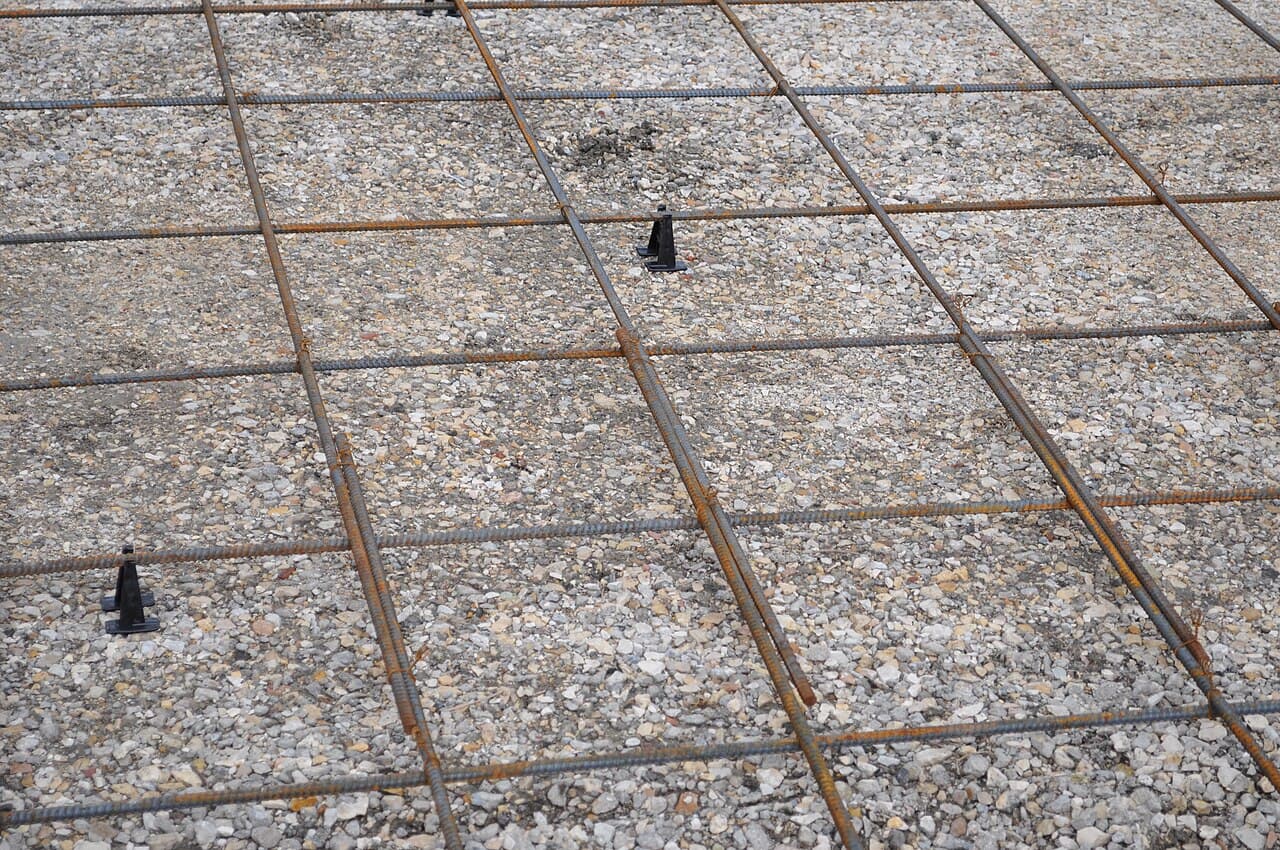
Steel does not replace thickness. For slabs, Quikrete says it may be desirable to add wire mesh reinforcement, supported on small stones so it is suspended at the midpoint in the slab.[2] Rebar or mesh lying on the gravel at the bottom does little; it needs to sit up inside the concrete.
If you are considering two concrete wheel strips instead of a full slab, Quikrete warns that a strip driveway shifts more easily with changes in ground conditions than the slab type and requires some type of reinforcement, preferably iron or steel rebar.[1]
The mix
Virginia driveways freeze, thaw and get salted, so the concrete has to be made for it. Ask for air-entrained concrete, which is the usual choice for slabs that see freezing weather and deicers, and ask the contractor to confirm the strength and air content on the mix ticket. Both belong in the written quote so every bidder prices the same thing.
Joints, slope and width
Joints. Concrete shrinks as it dries, and joints decide where it cracks. Contraction joints cut into the slab let it crack in a straight line under the groove instead of wandering across the panel. Panels should be square or close to it, and a thicker slab can take wider spacing. Isolation joint material belongs where the driveway meets the garage slab, a sidewalk, a curb or steps, so each part can move on its own. Ask the contractor for the joint layout before the pour.
Slope. Quikrete says a slope toward the street of 1/4 inch per running foot is sufficient for drainage, and a 14 percent grade is the recommended maximum.[1] Water that sits on or beside a driveway softens the base, so drainage matters as much as thickness.
Width. Quikrete notes that driveways for single-car garages are normally 10 to 14 feet wide, at least 14 feet if the driveway curves, and about 24 feet for a two-car garage.[1]
The apron at the street
The last few feet are often not yours to design. Quikrete points out that the part of the driveway between the street and the sidewalk is usually controlled by the local municipality, and permission must usually be obtained before cutting away part of the curb.[1] On roads VDOT maintains, the property owner must obtain an entrance permit for a private entrance onto a state highway.[4] The road owner may set its own thickness and detail for that section, so ask before the forms go in. Do you need a permit to widen a driveway? covers who to call.
Curing finishes the job
Thickness on paper means little if the slab dries out in its first days. Quikrete says curing should continue for 5 days in warm weather at 70 F or higher, or 7 days in colder weather at 50 to 70 F.[3] How long new concrete should cure before you drive on it has the details, and a late-season pour needs the extra care in protecting a new driveway in its first winter.
Stop and call a pro if
- Heavy vehicles will use the driveway every day, or it has to carry a dumpster, a boat or a large camper. The slab and base may need a design, not a rule of thumb.
- The ground is soft, wet or clay-heavy, or the driveway crosses fill from the house construction.
- The grade is steeper than 14 percent or the driveway turns sharply.
- Work reaches the street, curb or sidewalk, where the road owner's permit and standards apply.
- The pour is larger than your crew can place and finish in time. Concrete starts to set within hours, and a whole driveway is a lot of concrete to place and finish before then.
- An old driveway has to be broken out and hauled away first.
Getting it built in Virginia
Loclis lists DPOR-licensed concrete businesses with their licence number and class. Browse driveway contractors, look up concrete businesses in Blacksburg, see what a concrete driveway costs, or read all concrete and hardscaping answers.
When you know what the driveway has to carry, describe the job once and licensed local concrete businesses quote it.
Common questions
- Is 4 inches thick enough for a concrete driveway?
- For passenger cars, yes. Quikrete's driveway instructions say 4 inches is sufficient when only passenger cars use the driveway. It is only enough when the base under it is firm and compacted and the slab is jointed and cured properly.
- How thick should a driveway be for a truck or RV?
- Quikrete recommends 5 or 6 inches where trucks and other heavy vehicles will use the driveway. If a heavy camper, a box truck or a loaded work truck parks on it regularly, tell the contractor so they can price the thicker slab and a stronger base.
- Should the driveway apron at the street be thicker?
- The apron is often built to the road owner's standard rather than yours. Where the driveway meets a state-maintained road, VDOT's private entrance rule requires an entrance permit, and a city or town may control the part between the street and the sidewalk. Ask them what thickness and detail they require before the forms go in.
- Does rebar or wire mesh mean I can pour it thinner?
- No. Quikrete says driveway thickness depends solely on the weight of the vehicles using it, so reinforcement does not replace thickness. Reinforcement is a separate decision, and a strip driveway needs it. Ask the contractor what steel is in the bid and where it sits in the slab.
- How far apart should the joints be?
- Joint spacing depends on the slab thickness and how the panels are shaped, so ask the contractor to draw the layout and explain it. Panels should be close to square, and the garage slab, walks, curbs and steps should be separated from the driveway with isolation joint material.
Sources
- [1] Concrete Driveways and Curbs (project instructions), The QUIKRETE Companies. Checked October 27, 2026.
- [2] Concrete Sidewalks and Small Slabs (project instructions), The QUIKRETE Companies. Checked October 27, 2026.
- [3] QUIKRETE Concrete Mix No. 1101 data sheet, The QUIKRETE Companies. Checked October 27, 2026.
- [4] 24VAC30-73-90. Private entrances, Virginia Administrative Code (Virginia General Assembly). Checked October 27, 2026.
Want a pro to handle it?
Describe the job once. Licensed local businesses send quotes, and you pay only when you book one.
Get a quote from a local pro