Why is my concrete driveway sinking at the garage?
The garage floor sits on the house foundation, but the last few feet of driveway usually sit on soil that was dug out and backfilled when the house was built. That fill keeps settling, and roof water from gutters and downspouts near the garage softens and washes it out. Clay soil that shrinks in dry spells adds to it. Fix the water first, then lift or replace the slab.
Free to ask. Local shops send quotes, and you pay only when you book one.
By Kasra Taheri, Founder, LoclisPublished
Researched and drafted with AI, then checked claim by claim against the sources listed below before it was published. Prices and rules change; the dates beside each source say when it was last checked.
Step by step
Read when to stop and call a pro, further down this page, before you start.
Step 1: Measure the drop
Lay a straight board across the joint at the garage and measure the gap at each end, then write the numbers and date down.
Step 2: Watch it in the rain
During a hard rain, look at where roof water lands and whether it runs toward or along the low slab.
Step 3: Clean the gutters
Look for streaks or watermarks on the outside of the gutters, signs that they overflow and need cleaning.[3]
Step 4: Move the downspout water
Add a splash block or a non-perforated extension pipe so downspout water discharges away from the driveway edge.[3]
Step 5: Fill the low ground
Fill depressions beside the driveway and the garage so the soil slopes away and water does not stand against the slab edge.[3]
Step 6: Seal the joint
Clean the gap at the garage and fill it with a flexible joint sealant made for driveway expansion joints, above 40 F.[5]
Step 7: Check it each season
Re-measure the drop after a wet season and a dry summer to see whether it is still moving.
Step 8: Get a lifting quote
If the slab is sound but low, ask a licensed concrete contractor about slab lifting; if it is broken, ask about replacing the panel.
A driveway usually sinks at the garage because the soil under that last stretch is different from the rest. The garage floor rests on the house foundation, while the driveway beside it usually sits on soil that was dug out and backfilled when the foundation was built. That fill settles for years, and roof water pouring off the garage softens it and washes it away. The fix starts with the water, then the slab.
Why the garage end is different
The driveway and the garage floor are meant to move separately. The garage floor is part of the house foundation, and the driveway is a separate slab with a joint between them so each can move on its own. So when the soil under the driveway drops, the garage floor stays put and you see a step at the joint.
What sits under that joint is the problem. Builders usually dig wider than the foundation walls and fill the gap back in once the walls are up. The Federal Highway Administration (FHWA) notes that settlements on concrete pavements most usually are associated with fill areas, over culverts, and at bridge approaches.[1] The end of a driveway against a house is a small version of a bridge approach: a rigid structure next to filled ground.
The three usual causes
Backfill that keeps settling. Fairfax County's soils guide notes that clay backfill gradually settles under its own weight as years pass,[2] and that surface water can accumulate against foundation walls where the backfill has settled.[2] If the fill was not compacted well before the driveway was poured, it keeps going down.
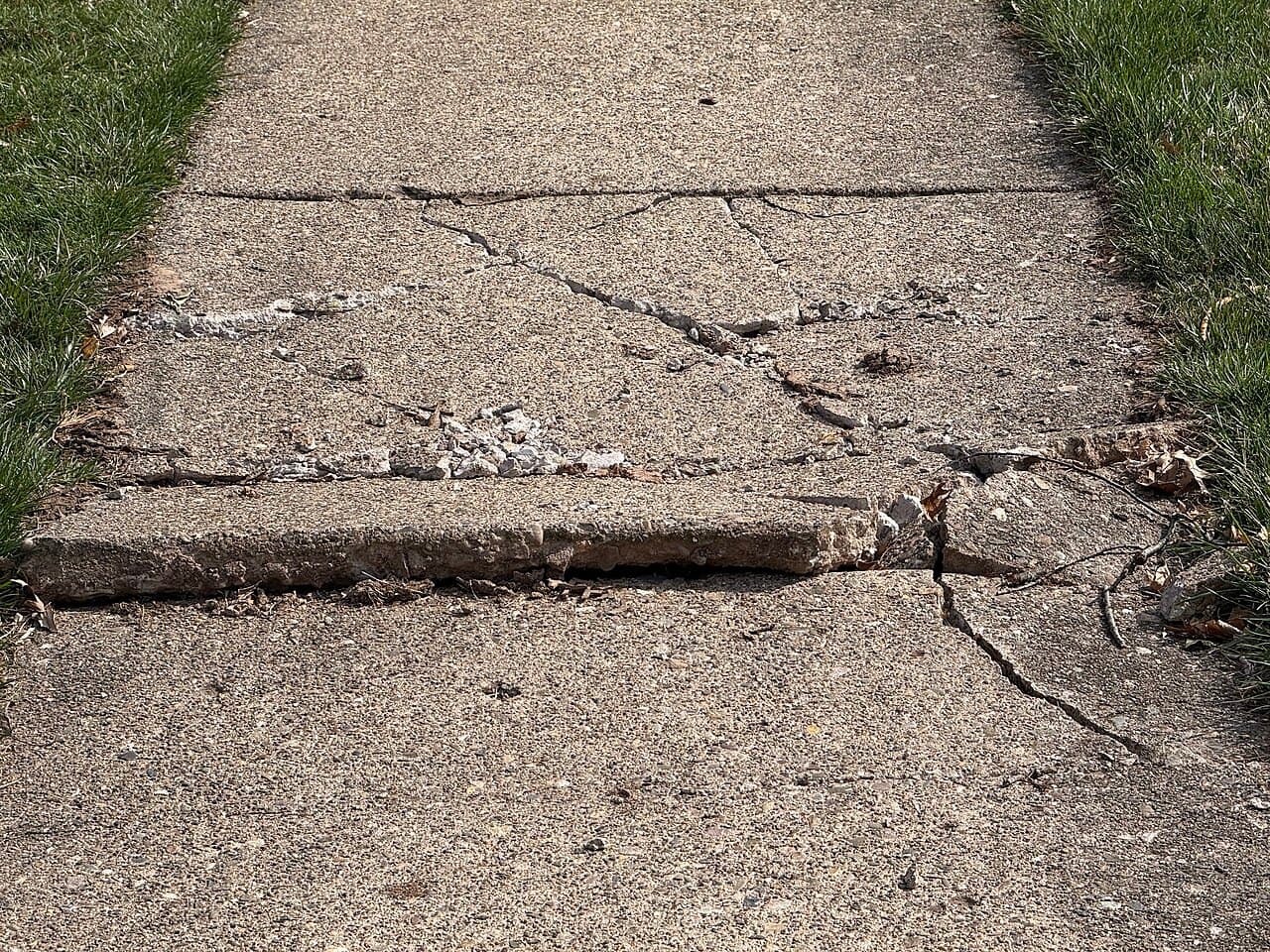
Water getting under the slab. FHWA explains that pumping and loss of support under concrete slabs come from three factors together: an erodible base or subbase, excessive moisture, and significant slab deflections.[1] It adds that loss of support can develop beneath slab corners and edges,[1] which is exactly where a garage driveway meets the house. The water usually comes off the roof. The Northern Virginia Soil and Water Conservation District says an average sized home can see hundreds of gallons of runoff coming off the roof in a hard rain, and downspouts that are not set up correctly can cause foundation problems, erosion or wet spots in the yard.[3] A downspout at the garage corner that empties onto the driveway edge, or a gutter that overflows above the garage door, sends that water straight into the backfill.
Clay that shrinks. In parts of Virginia with high shrink-swell clay, the ground moves with the weather. Fairfax County's guide says clays shrink during dry periods and swell during wet ones, and that curbs and gutters may settle excessively.[2] It also notes that trees draw water from the soil through roots that extend below and well beyond the farthest-reaching branches,[2] so a large tree near the garage can dry out the soil under the driveway in summer.
How to tell which one you have
- A clean step at the joint, slab otherwise intact: settled fill, often helped along by water.
- Washed-out soil or a gap under the slab edge, mud stains or a downspout nearby: water is the main cause.
- The drop grows in late summer and eases after wet weather: shrinking clay, sometimes with tree roots.
- The slab is cracked into pieces or tilted across its width: the support has failed more widely.
Check the slope too. Quikrete says a driveway should always be sloped slightly toward the street, and 1/4 inch per running foot is sufficient.[4] If the sinking has reversed that, water now runs toward the garage door and into the joint.
What you can do first
Fix the water before anything else, or a lifted slab will sink again. The conservation district suggests a splash block at the end of the pipe, stones no bigger than a fist along the flow path if erosion continues, or a non-perforated extension pipe to carry the water farther away.[3] It also says a 5% grade should ideally be maintained for a distance of ten feet around the house,[3] so fill any low spots along the garage and the driveway edges.
Then close the gap at the joint so rain cannot run under the slab. A flexible polymer sealant such as Quikrete's is sold for sealing and waterproofing horizontal or vertical control joints or expansion joints in sidewalks and driveways,[5] and it fills cracks and joints up to 1 inch wide.[5] Quikrete says to avoid applying sealants below 40 F.[5] A wider gap is a sign the slab needs a contractor.
Lifting or replacing
A slab that is still in one piece can often be raised. FHWA describes slab jacking as the pressure insertion of a cement-grout mixture or polyurethane material beneath the slab to slowly raise it,[1] and says ideal projects for slab jacking exhibit localized areas of settlement but are generally free of cracking.[1] A panel broken into pieces is usually broken out and repoured, with the fill under it dug out and compacted properly this time. How mudjacking and foam lifting work and whether lifting or replacing is the better choice go into the trade-offs, and why concrete slabs sink covers other slabs around the house.
In Virginia, the Board for Contractors' concrete contracting specialty covers placing, finishing, repairing, sawing and grinding concrete,[6] so ask for that specialty or a broader class licence when you get quotes.
Stop and call a pro if
- The drop is more than you can seal, or it creates a trip edge at the garage door.
- Water runs into the garage or the basement after rain.
- There is a hollow sound or a visible void under the slab edge.
- The garage floor, foundation wall or house walls are cracking too, or doors and windows have started to stick.
- The slab is broken into several pieces or keeps sinking after the drainage is fixed.
Getting it fixed in Virginia
Loclis lists DPOR-licensed concrete businesses with their licence number and class. Find concrete businesses in Blacksburg, browse slab lifting and leveling, or see all concrete and hardscaping answers.
When the water is under control, describe the sunken slab once and licensed local businesses quote lifting or replacement.
Common questions
- Why is only the end by the garage sinking?
- That end usually sits over the backfill along the house foundation, while the rest of the driveway sits on undisturbed or better-compacted ground. The garage floor rests on the foundation and does not move, so the difference shows up as a step at the joint. Federal Highway Administration guidance notes that pavement settlement is most often found over fill.
- Is a sinking driveway a sign of a foundation problem?
- Usually not by itself. A driveway dropping away from a steady garage floor points to soil under the driveway. If the garage floor or house walls are cracking too, or doors are sticking, have the foundation looked at separately.
- Will the driveway keep sinking?
- It may, especially if water keeps getting under it. Fairfax County's clay guide notes that backfill keeps settling for years. Measure the drop now and again after a wet season and a dry summer; if it is still growing, fix the drainage before paying for lifting.
- Can a sunken driveway slab be raised instead of replaced?
- Often, yes. Slab lifting pumps grout or polyurethane foam under the slab to raise it. Federal guidance says it suits slabs with localized settlement that are generally free of cracking, so a slab broken into pieces is usually a replacement job.
- Should I fill the gap at the garage?
- Yes, once you have measured it. An open joint lets rain run straight into the soil under the slab. Clean it and fill it with a flexible sealant made for driveway expansion joints, such as a polymer crack sealant rated for joints up to 1 inch wide.
Sources
- [1] Concrete Pavement Preservation Guide, Second Edition (FHWA-HIF-14-004), Federal Highway Administration. Checked October 27, 2026.
- [2] Homeowner's Guide to Overcoming Problems with Marine Clay-Marumsco Soils in Fairfax County, Fairfax County Land Development Services. Checked October 27, 2026.
- [3] Gutters and Downspouts: Wetness or Erosion Problems, Northern Virginia Soil and Water Conservation District. Checked October 27, 2026.
- [4] Concrete Driveways and Curbs (project instructions), The QUIKRETE Companies. Checked October 27, 2026.
- [5] QUIKRETE Advanced Polymer Concrete Crack Sealant No. 8620-17 data sheet, The QUIKRETE Companies. Checked October 27, 2026.
- [6] 18VAC50-22-30. Definitions of specialty services, Virginia Administrative Code (Virginia General Assembly). Checked October 27, 2026.
Want a pro to handle it?
Describe the job once. Licensed local businesses send quotes, and you pay only when you book one.
Get a quote from a local pro