How much does deck repair cost in Virginia?
It depends far more on what is under the boards than on the boards themselves. Replacing a few deck boards or balusters is a small job, while rotted joists, posts or a ledger mean framing work that may need a permit and an inspection. Get at least three written quotes for the same list of work, and check the contractor's licence once the job is over $1,000.
Free to ask. Local shops send quotes, and you pay only when you book one.
By Kasra Taheri, Founder, LoclisPublished
Researched and drafted with AI, then checked claim by claim against the sources listed below before it was published. Prices and rules change; the dates beside each source say when it was last checked.
Step by step
Read when to stop and call a pro, further down this page, before you start.
Step 1: Look underneath first
With a flashlight, check the joists, beams, posts and ledger under the damaged area, and note anything soft, split or rusty.
Step 2: Photograph everything
Take photos of each bad board, railing section and stair from above and below, with a tape measure in the shot for scale.
Step 3: Write one list
List every item to fix, with sizes and counts, so every business prices exactly the same work.[8]
Step 4: Note the deck's age
Say whether the deck was built before 2004, since older treated wood may be CCA-treated and needs careful handling and disposal.[4]
Step 6: Get written quotes
Get at least three written bids based on the same specifications, and ask about any bid far below the others.[8]
Step 8: Keep the deposit small
Keep the down payment to no more than 10% of the price or $1,000, whichever is less, unless special-order materials are involved.[8]
Step 9: Read the contract
Before work starts, make sure the signed contract has the start and finish dates, total price, payment schedule and licence number.[7]
There is no single price for deck repair, because the cost is set far more by what is under the boards than by the boards themselves. Swapping out a few rotten deck boards or loose balusters is a small job. Rot in the joists, beams, posts or the ledger along the house turns it into framing work, which may need a permit and an inspection. Below is what moves the number, and how to get quotes you can compare side by side.
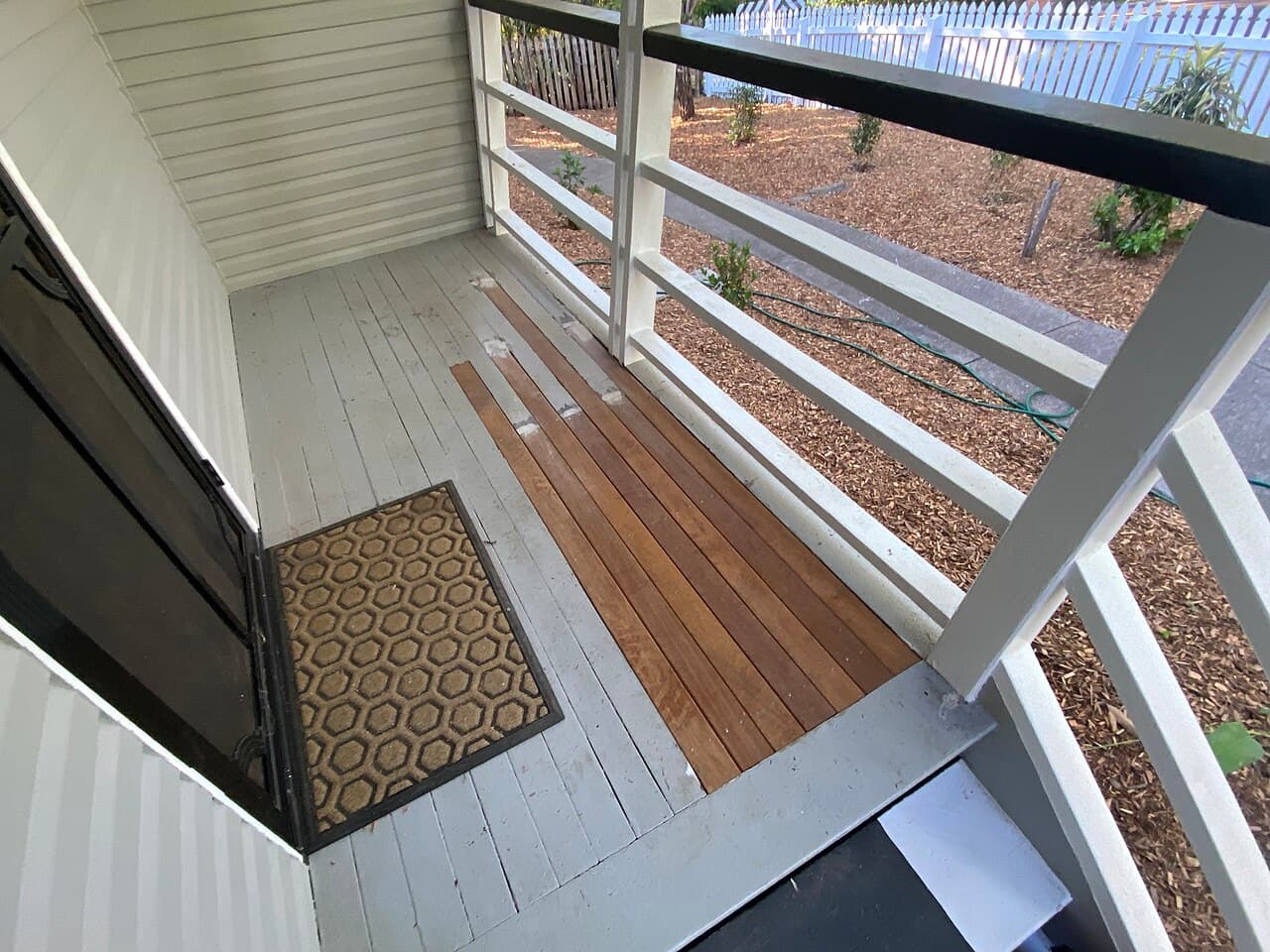
What drives the price
How far the damage goes. A contractor prices the visible problem plus what they expect to find. A deck where the boards are bad but the framing is firm stays a surface repair. If a screwdriver sinks into the joists under a rotten board, the job grows to replacing or reinforcing framing, which is slower and needs more material and skill.
Whether a permit is triggered. Where the line falls is set by the building code and your local building office. The Town of Christiansburg, for example, draws it this way: replacing deck floor boards, replacing balusters, replacing only one support post and replacing fewer than three stair risers need no building permit, while replacing more than one support post, guardrails and replacing more than three risers do.[1] Statewide, the Uniform Statewide Building Code requires a permit before work involving any structural component, and lets the building official treat other minor and ordinary repair work as exempt.[2] A permit adds the fee, drawings in some cases, inspection visits and the wait between them.
Code questions. When a guard or stair is rebuilt, ask your building official whether the new work has to meet current rules, and get the answer before you compare quotes. For reference, Fairfax County's typical deck details, written to the 2021 Virginia Residential Code, say a guard is required when the deck is more than 30 inches above grade at a point 36 inches from its edge, and that openings in a guard must stop a 4-inch sphere from passing through.[3] If your building official requires that standard, an older railing with wide gaps between balusters may need rebuilding in full rather than patching.
Hardware. A sound repair uses the right connectors, not just nails. Fairfax County's details call for joist hangers and post anchors that are stainless steel or galvanized with a G-185 coating.[3] Adding missing hangers, lateral connections or new ledger fasteners is labor-heavy and shows up in the quote.
The ledger. Where the deck meets the house is the most involved repair, because siding comes off and flashing goes in. Fairfax County's details also say attaching a ledger through brick or stone veneer is prohibited, and those decks need to be free-standing or engineered,[3] which can mean new posts and footings instead of a simple fix. For signs of trouble there, see how to tell if a deck ledger board is failing.
Materials. Matching treated pine boards is usually the least expensive replacement. Composite and hardwood boards usually cost more per board and have to match the brand, color and fastening system already on the deck, and discontinued colors sometimes mean replacing a whole section.
Old treated wood. If your deck was built before 2004 and is not cedar or redwood, the Consumer Product Safety Commission says it was most likely built with CCA-treated wood. It advises working with goggles, gloves and a dust mask, and to avoid sanding or power washing it; discarded CCA lumber can usually go to construction and demolition or municipal landfills, but state or local rules may be stricter.[4] Handling and hauling the old wood is part of the price.
Height and access. A second-storey deck needs ladders or scaffolding and more labor for the same repair as a deck a step off the lawn.
When the licence line matters
Virginia sorts contractors by job size. Under the Code of Virginia, Class C contractors are those whose single contract or project is over $1,000 but less than $30,000; Class B covers $30,000 up to $150,000, and Class A covers $150,000 or more.[5] The home improvement contractor (HIC) specialty covers repairs or improvements to dwellings and townhouses or structures annexed to them,[6] which includes an attached deck. A deck repair over $1,000 should come from a business you have looked up on DPOR's licence lookup. Hiring an unlicensed contractor has its own risks; see whether it is illegal to hire an unlicensed contractor in Virginia.
Comparing quotes
The Virginia Department of Professional and Occupational Regulation suggests getting at least three written bids or estimates using identical plans and specifications, and warns that a bid substantially lower than the others probably means a mistake or missing work.[8] For a deck, "identical" means the same list: which boards, which railing sections, which framing members, what fasteners and whether the permit is included.
On payment, DPOR's rule of thumb is an initial deposit of no more than 10% of the total price or $1,000, whichever is less, or as high as 30% of the total contract value when custom or special-order items are involved.[8]
Before work starts, the Board for Contractors requires licensed contractors to use a signed written contract for residential work that states when work will begin and the estimated completion date, the total cost, the amounts and schedule of progress payments including the down payment, and the contractor's name, address, licence number and class. The contract must also include a listing of specified materials and work to be performed, and a statement of assurance that the contractor will comply with all local requirements for building permits, inspections, and zoning. It also requires that any change to cost, materials, work or completion date must be in writing and signed by both of you.[7]
Doing part of it yourself
Replacing a few boards on a sound frame is a reasonable homeowner job; see how to replace rotten deck boards. Framing, posts, ledgers and guards are not, and a quote that splits the structural items from the surface ones makes it easier to decide what to keep.
Stop and call a pro if
- A joist, beam, post or the ledger is soft, cracked or pulling away from the house.
- Bolts, hangers or brackets are rusted, or the deck has nails but no connectors.
- A railing or stair moves when you push on it.
- The repair needs more than one post replaced, a guard rebuilt or more than three stair risers replaced, which needs a permit in Christiansburg and may in your locality too.
Getting quotes on Loclis
On Loclis you describe the deck repair once, with photos from above and below, and licensed local businesses quote it. A business that needs to see the deck first can offer an estimate visit, and a paid visit's fee comes off the price of the work. Loclis's own fees are on the pricing page. You can also browse deck repair businesses, find handyman businesses around Blacksburg, or read the other handyman answers.
Common questions
- Is it cheaper to repair a deck or replace it?
- Repair is usually cheaper when the framing is sound and the damage is limited to boards, balusters or a stair tread. Once several joists, posts or the ledger need work, the repair can carry much of the cost of a new frame plus any permit and inspections, and a replacement quote is worth getting alongside it.
- Does deck repair need a permit in Virginia?
- It depends on the work and the locality. The Virginia Uniform Statewide Building Code requires a permit for work involving any structural component. The Town of Christiansburg, for example, needs none for replacing deck boards, balusters or a single post, but requires one for replacing more than one post, guardrails or more than three risers. Ask your local building office.
- Does a handyman need a licence to repair my deck?
- Virginia's contractor licence classes start at Class C, for a single contract or project over $1,000. The home improvement contractor specialty covers repairs to dwellings and structures annexed to them, such as an attached deck. Look up any business on DPOR's licence lookup before you sign, and ask which class and specialty it holds.
- Why do deck repair quotes vary so much?
- Usually because the businesses are not pricing the same job. One may plan to replace only the visible boards, another to open up and repair the framing, pull a permit and rebuild the railings. Give everyone the same written list and ask each one what they found underneath.
- What should a deck repair quote include?
- Ask for the specific items to be replaced, the materials and fasteners, whether the permit is included and who pulls it, and debris removal. Virginia's Board for Contractors separately requires a signed written contract for residential work that states, among other things, the start and estimated completion dates, the total cost, the payment schedule, the materials and work to be performed, and an assurance that the contractor will comply with local permit and inspection requirements.
Sources
- [1] Deck Building FAQs, Town of Christiansburg, Virginia. Checked October 26, 2026.
- [2] 13VAC5-63-80. Section 108 Application for permit (Virginia Uniform Statewide Building Code), Virginia Administrative Code. Checked October 26, 2026.
- [3] Typical Deck Details (version 2021.0, 1/5/2024), Fairfax County Land Development Services. Checked October 26, 2026.
- [4] CCA-Pressure Treated Wood: Guidance for Outdoor Wooden Structures, U.S. Consumer Product Safety Commission. Checked October 26, 2026.
- [5] Code of Virginia § 54.1-1100. Definitions, Virginia General Assembly. Checked October 26, 2026.
- [6] 18VAC50-22-30. Definitions of specialty services, Virginia Administrative Code, Board for Contractors. Checked October 26, 2026.
- [7] 18VAC50-22-260. Filing of charges; prohibited acts, Virginia Administrative Code, Board for Contractors. Checked October 26, 2026.
- [8] What You Should Know Before You Hire a Contractor, Virginia Department of Professional and Occupational Regulation. Checked October 26, 2026.
Want a pro to handle it?
Describe the job once. Licensed local businesses send quotes, and you pay only when you book one.
Get a quote from a local pro