How do I protect deck boards and joists from rot?
Rot needs wood that stays wet, so the job is keeping the deck able to dry. Keep the gaps between boards clear, keep leaves, firewood and debris out from under it, steer downspouts and sprinklers away, refinish the boards with a penetrating stain or water-repellent preservative, seal cut ends, and check the framing every year so small problems are caught early.
Free to ask. Local shops send quotes, and you pay only when you book one.
By Kasra Taheri, Founder, LoclisPublished
Researched and drafted with AI, then checked claim by claim against the sources listed below before it was published. Prices and rules change; the dates beside each source say when it was last checked.
Step by step
Read when to stop and call a pro, further down this page, before you start.
Step 1: Clear the board gaps
Sweep the deck and run a putty knife along the gaps between boards so water can drain and air can move.
Step 2: Clean out underneath
Remove leaves, stored lumber, firewood and other wood debris from under and against the deck.[1]
Step 3: Redirect the water
Point downspouts and sprinklers away from the deck, and make sure water runs away from the house rather than toward it.[3]
Step 4: Move what traps water
Lift planters, rugs and mats off the boards, or set planters on feet, so the wood under them can dry.
Step 5: Check what the wood is
If the deck was built before 2004 and is not cedar or redwood, treat it as CCA-treated wood: no sanding or power washing, and no cleaner with bleach, sodium hydroxide, sodium percarbonate, oxalic acid or citric acid.[5]
Step 6: Clean the boards
On wood that is not CCA-treated, use a deck cleaner, or one part household bleach to three parts water with some detergent, never a liquid detergent or one containing ammonia.[2]
Step 7: Rinse and let it dry
Rinse the cleaner off with water and allow at least two warm, windy days of drying before you finish the wood.[2]
Step 8: Apply a penetrating finish
Brush on a water-repellent preservative or a semitransparent oil-based stain rather than paint or a solid-color stain.[2]
Step 9: Soak the end grain
Work extra finish into board ends, stair tread ends and post tops, where water and finish soak in most readily.[2]
Step 10: Shovel heavy snow
After a heavy snowfall, shovel the deck to minimize the burden and wear on it,[4] pushing a plastic shovel along the boards rather than across them.
Step 11: Inspect once a year
Each spring, probe the joists, posts and ledger with a screwdriver and look for rust on the hardware.[4]
Rot needs wood that stays wet, so protecting a deck comes down to helping it dry. Keep the gaps between boards open, keep debris out from underneath, steer water away, refinish the boards before the wood starts to crack, and look under the deck once a year. None of it is hard, and most of it costs little more than an afternoon.
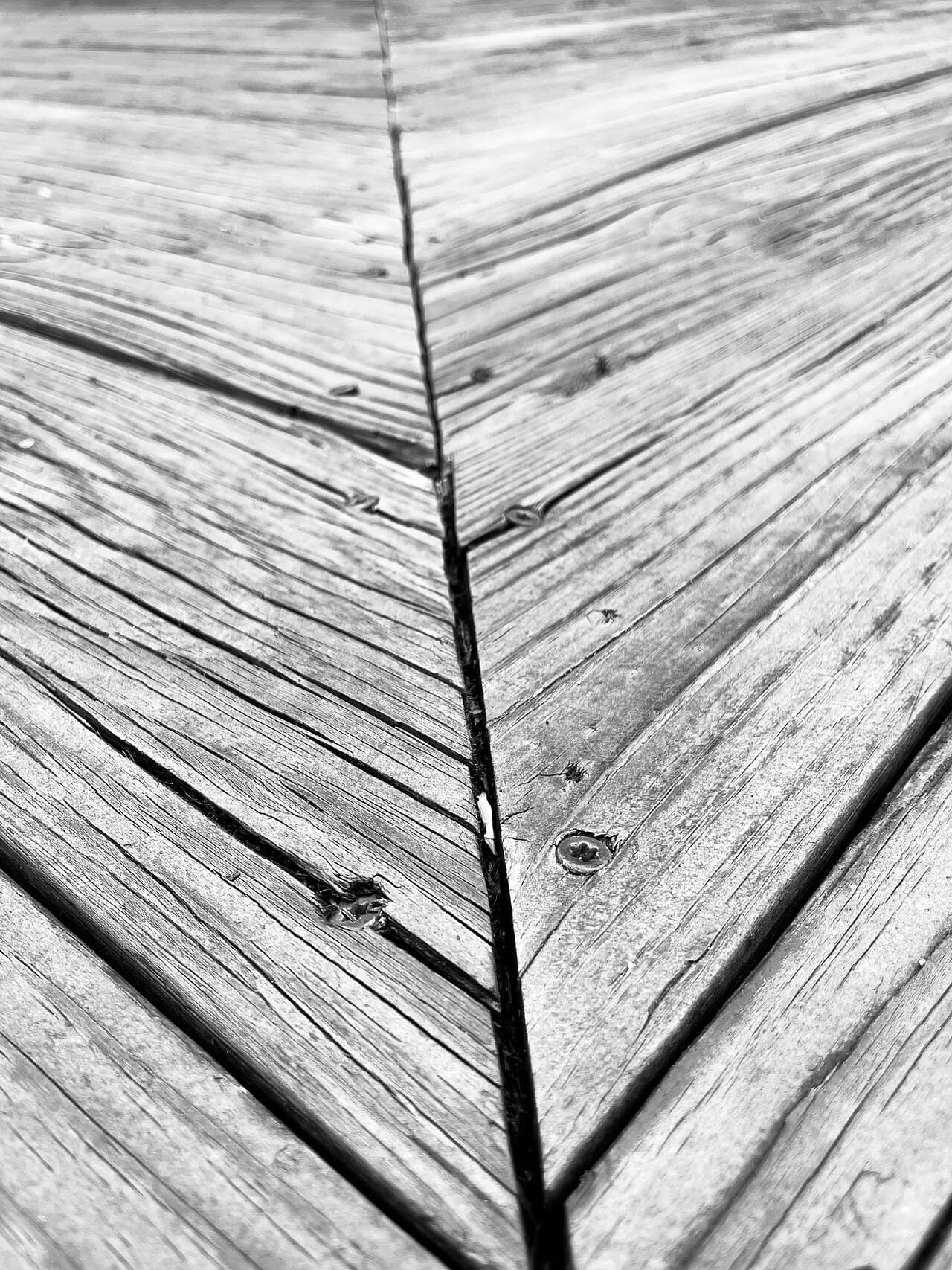
Why decks rot
Decay fungi are everywhere; what they need is water. The Forest Products Laboratory's Wood Handbook explains that serious decay occurs only when the moisture content of the wood is above the fiber saturation point (average 30%), and that only rain, condensation or contact with wet ground brings dried wood up to that point. Humid air alone will not wet wood enough to support significant decay.[1] Fully air-dried wood usually has a moisture content of 20% or less, and, in the handbook's words, "wood will not decay if it is kept air dry, and decay already present from prior infection will not progress."[1]
The practical lesson is in one line: "Spores of decay fungi are ubiquitous, so control of moisture is essential to prevent decay."[1] On a deck, the wet spots are predictable: where boards cross joists, at butt joints, under planters and mats, at post bases, and along the ledger at the house.
Keep the water moving
Clear the gaps. Leaves and dirt packed between boards hold water against the board edges and the tops of the joists below. Sweep often in fall and run a putty knife or a thin scraper along the gaps.
Keep the underside clean and open. The Wood Handbook warns that stumps, wood debris, stakes or wood concrete forms left under or near a building are frequently subject to decay and may become a source for decay infestation for the building.[1] Do not store firewood or spare lumber under the deck, and keep plantings trimmed back so air can move.
Point water away. Downspouts that empty onto or under the deck, and sprinklers that soak the same posts every evening, keep framing wet for months. Fairfax County's typical deck details say decks must be designed so rain and melting ice and snow flow away from the existing house.[3] If water pools against the house at the ledger, have that looked at; see how to tell if a deck ledger board is failing.
Lift what sits on the boards. Planters, outdoor rugs and grill mats trap water. Set planters on feet and move rugs after rain.
Shovel heavy snow. Fairfax County's building official advises that you shovel the snow off your deck after a heavy snow fall to minimize the burden and wear to your deck.[4] Push a plastic shovel along the boards, not across them.
Keep a finish on the boards
A finish slows the wetting and drying that cracks boards, and cracks let water deep into the wood. The Forest Products Laboratory is blunt about it: "Most decks are retired because of cracks and checks that mostly could have been avoided by timely finishing."[2]
It recommends that penetrating finishes, not film-forming finishes, should be used on wood decks, because "Film-forming finishes, such as paints and solid-color stains, are prone to trap moisture and fail by peeling."[2] Your two practical choices:
- Water-repellent preservative (WRP). Clear and easy to reapply. The Forest Products Laboratory says the service life of a WRP finish is about 1 year on the exposed surfaces of wood decks, but it absorbs readily into the end grain and can keep water out of it much longer than that.[2]
- Semitransparent oil-based stain. Compared with a WRP, semitransparent stains carry more pigment, which greatly increases their durability, and they do not form a film that can blister or peel.[2]
Give the end grain extra attention: board ends, stair tread ends and the tops of posts. When you replace a board, seal its cut ends before it goes down; see how to replace rotten deck boards. For the full refinishing job, see how to stain a deck and how often a deck should be stained or sealed.
Clean it the right way
Mildew and dirt hold moisture and keep stain from soaking in. On wood that is not CCA-treated, a commercial deck cleaner works, or, for mildew, the Forest Products Laboratory's recipe is to dilute household bleach with 3 parts water and add some detergent. Its caution is specific: "Do not use a liquid detergent or a detergent containing ammonia." The ammonia warning matters because ammonia and bleach together form a toxic gas. Afterwards, rinse the bleach off and allow at least 2 warm, windy days to dry before finishing.[2] It also cautions that aggressive scrubbing with a caustic cleaner or power washing can remove wood from the surface.[2]
Older decks need a different approach. If your deck was built before 2004 and is not cedar or redwood, the Consumer Product Safety Commission says it was most likely built with CCA-treated wood, and advises not to apply harsh cleaning products such as bleach, sodium hydroxide, sodium percarbonate, oxalic acid and citric acid to it, and to avoid sanding or power washing it.[5] Read the label of any deck cleaner or brightener before it goes on an older deck, and skip any that lists one of those ingredients. The EPA adds that applying a penetrating protective coating on a regular basis may reduce the leaching of chemicals from these decks.[6]
Protecting the framing
You cannot refinish the joists the way you refinish boards, so protecting them is mostly about the steps above: open gaps, dry ground, water directed away and nothing piled against the posts. When framing is replaced, the lumber has to suit where it goes. Fairfax County's details say lumber in contact with the ground must be rated for ground contact, and lumber buried or in direct contact with the earth rated UC4A.[3] When a contractor re-decks, ask what they will do to protect the tops of the joists before the new boards go on.
Check it every year
Fairfax County's building official advises that you evaluate your deck annually and regularly have it inspected by a licensed contractor, and asks whether the deck is still solid with "no wood rot or splitting or insect damage, including the posts at the ground."[4] A yearly look with a flashlight and a screwdriver catches a soft joist end or a rusting hanger while it is still a small repair. The full walk-through is in how to tell if a deck is safe.
Stop and call a pro if
- A screwdriver sinks into a joist, beam, post or the ledger.
- The ledger is wet, stained or pulling away from the house.
- Hangers, bolts or post brackets are rusting.
- Rot has spread under more than a few boards.
Framing repairs are structural work for a contractor, and your local building office can tell you whether a permit is needed. You can browse deck repair businesses, find handyman businesses around Blacksburg, or read more handyman answers. When you want help, describe the deck work once, with photos, and licensed local businesses can quote it.
Common questions
- Does pressure-treated wood still rot?
- It resists decay much better than untreated wood, but it is not immune, especially where it stays wet: board joints, the tops of joists, post bases and the ledger. Cut ends are a weak spot, which is why the Forest Products Laboratory advises treating ends cut during construction with a water-repellent preservative.
- How often should I seal or stain my deck?
- It depends on the finish and the sun and traffic the deck gets. The Forest Products Laboratory puts the service life of a clear water-repellent preservative at about 1 year on exposed deck surfaces; pigmented semitransparent stains last longer. Refinish when water stops beading and the wood starts to gray or check. See how often a deck should be stained or sealed for more.
- Should I paint my deck to protect it?
- Usually not on the walking surface. The Forest Products Laboratory says film-forming finishes such as paints and solid-color stains are prone to trap moisture and fail by peeling, and recommends penetrating finishes for decks. Paint or solid stain can work on railings, which do not take foot traffic and can be designed not to trap water.
- Can I power wash my deck?
- Gently, if at all. The Forest Products Laboratory warns that power washing can remove wood from the surface, especially on soft woods such as western redcedar. On a deck built before 2004 that may be CCA-treated, the Consumer Product Safety Commission advises avoiding power washing and sanding altogether.
- Do composite decks rot?
- The plastic in composite boards does not rot, but the wood fibers in them can. The Forest Products Laboratory notes that decay fungi can form voids in wood-plastic composites once moisture gets in through surface cracks, and the framing under a composite deck is usually treated wood that needs the same care as any other.
Sources
- [1] Wood Handbook, Chapter 14: Biodeterioration of Wood (FPL-GTR-282), USDA Forest Service, Forest Products Laboratory. Checked October 26, 2026.
- [2] Finishes for Wood Decks (revised July 2013), USDA Forest Service, Forest Products Laboratory. Checked October 26, 2026.
- [3] Typical Deck Details (version 2021.0, 1/5/2024), Fairfax County Land Development Services. Checked October 26, 2026.
- [4] How to Ensure the Safety of Your Decks, Fairfax County Government. Checked October 26, 2026.
- [5] CCA-Pressure Treated Wood: Guidance for Outdoor Wooden Structures, U.S. Consumer Product Safety Commission. Checked October 26, 2026.
- [6] Chromated Arsenicals (CCA), U.S. Environmental Protection Agency. Checked October 26, 2026.
Want a pro to handle it?
Describe the job once. Licensed local businesses send quotes, and you pay only when you book one.
Get a quote from a local pro