Should I repair my deck or replace it?
Repair it when the frame underneath is sound and the damage is limited to boards, balusters, a stair tread or a post or two. Replace it when rot or rust runs through the joists, beams, posts or ledger, when connections are missing, or when the railings, stairs and frame would all need rebuilding at once anyway.
Free to ask. Local shops send quotes, and you pay only when you book one.
By Kasra Taheri, Founder, LoclisPublished
Researched and drafted with AI, then checked claim by claim against the sources listed below before it was published. Prices and rules change; the dates beside each source say when it was last checked.
Step by step
Read when to stop and call a pro, further down this page, before you start.
Step 1: Look from underneath
With a flashlight, look at every joist, beam, post and the ledger along the house, not just the walking surface.
Step 2: Probe the wood
Press a screwdriver into joists, posts and the ledger at the spots that stay wet; note where it sinks in or the wood crumbles.
Step 3: Check the connections
Look for joist hangers, bolts and post brackets, and note any rust or any spot held only by nails.[1]
Step 4: Push on the railings
From a stable stance on solid decking, push guards and handrails sideways with your hands, without leaning your weight on them, and note any that wobble.[1]
Step 5: Find the deck's age
Check your closing papers or the county permit records for the year it was built, since a pre-2004 wood deck is likely CCA-treated.[6]
Step 7: Get both quotes
Ask contractors to price the repair and a replacement from the same inspection, so you can compare the two directly.[9]
Step 8: Check the licence
Look up each business on DPOR's licence lookup and confirm its class covers the size of the job.[7]
Repair your deck when the frame underneath is sound and the damage is limited: some rotten boards, a few loose balusters, a cracked stair tread, a single post. Replace it when decay or rust runs through the joists, beams, posts or the ledger along the house, when the connections that hold it together are missing, or when the railings, stairs and frame would all have to be rebuilt at once anyway. The walking surface rarely decides it. The frame does.
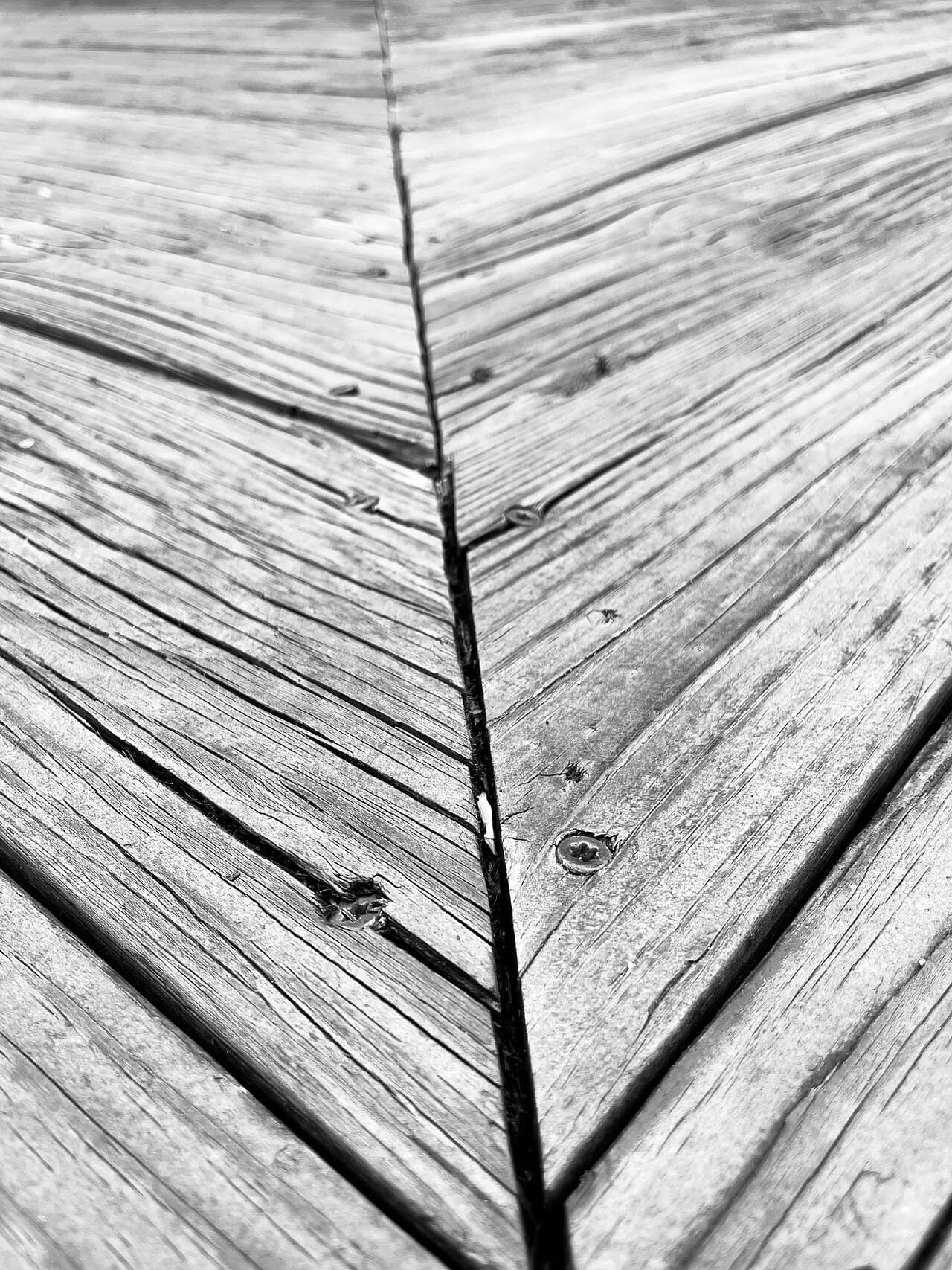
Start with the age and the frame
A deck does not have a fixed lifespan. Fairfax County's building official says it depends on materials, workmanship, use and upkeep, but that if the deck was built and inspected to code and maintained properly, it should last 20 years or more.[1] Not every deck was built, inspected or maintained that way, so an older deck's age alone does not settle the question.
Age only tells you where to look. The decision comes from what you find under the boards. Fairfax County's building official suggests asking whether the deck is "solid, no wood rot or splitting or insect damage, including the posts at the ground," and whether the guards, rails and stairs are "sturdy and well secured."[1]
Signs repair makes sense
- The boards are rotten, split or cupped, but a screwdriver will not sink into the joists, beams or posts.
- Rot is in one area, such as under a downspout or a planter, rather than all over.
- The joists sit in metal hangers, the beam is bolted to the posts and the ledger is bolted to the house, and that hardware is not badly rusted.
- The railing is solid and the gaps between balusters are narrow.
- One post is damaged, not several.
Repairs at this level are often modest and may not need a permit. The Town of Christiansburg, for example, says replacing deck floor boards, handrails, balusters, a single support post or fewer than three risers needs no building permit.[3] Replacing a few boards on a sound frame is a reasonable homeowner job; see how to replace rotten deck boards.
Signs replacement makes sense
- Several joists, the beam or more than one post are decayed or deeply split.
- The ledger is rotted, wet, or pulling away from the house. Fairfax County's building official asks whether every place the deck is attached to the home is secure.[1] See how to tell if a deck ledger board is failing.
- The fasteners and connectors are rusted or missing. Fairfax County's building official asks about rust or corrosion on the fasteners, bolts and brackets that connect a deck's rails, beams and joists.[1]
- The ledger is fastened through brick veneer. Fairfax County's typical deck details say a ledger cannot be fastened through brick or stone veneer,[2] so fixing it properly usually means a free-standing deck or an engineered design.
- The railings, stairs and frame all need work at once.
That last point is where many repairs become replacements. When a guard or stair is rebuilt, ask your building official whether the new work has to meet current rules. For reference, Fairfax County's details, written to the 2021 Virginia Residential Code, say a guard is required when a deck is more than 30 inches above grade at a point 36 inches from its edge, that its openings must stop a 4-inch sphere, and that stairs with four or more risers need a handrail on one side between 34 and 38 inches above the nosing.[2] An older deck may meet none of those, and if your building official requires them, rebuilding the railings and stairs adds to the cost of a repair.
Older wood is a factor too. If a wood deck was built before 2004 and is not cedar or redwood, the Consumer Product Safety Commission says it was most likely built with wood pressure-treated with chromated copper arsenate (CCA).[6] That does not force a replacement, but it adds care and disposal cost to any cutting.
Permits for each path
Statewide, the Uniform Statewide Building Code requires a permit for work involving any structural component.[5] Fairfax County reminds owners that building permits are required before replacing an existing deck.[1] Localities draw the line in their own words. In Christiansburg, replacing an existing deck, replacing more than one support post, guardrails and more than three risers all do need a permit.[3] Prince William County always requires a permit for porches or decks where the floor is 16.5 inches or more above the finished grade.[4] A replacement nearly always means plan review and inspections; a repair may or may not.
DPOR's advice is to have the contractor take out the permit: "Licensed contractors should apply for and obtain all building permits, not the consumer." It explains that the permit holder becomes the general contractor and assumes responsibility for the overall job.[9] For more on that side, see whether you need a permit to build a deck in Virginia.
Who to hire
Virginia licenses contractors by job size: under the Code of Virginia, Class C contractors handle a single contract over $1,000 but less than $30,000, and Class B from $30,000 to under $150,000.[7] The home improvement contractor (HIC) specialty covers repairs or improvements to dwellings and townhouses or structures annexed to them,[8] which fits most deck repairs. For a full replacement, ask each business which classification or specialty it holds and whether that covers new deck construction, then check it on DPOR's lookup.
Ask for two prices from the same visit: the repair, itemised, and a replacement. DPOR recommends at least three written bids or estimates using identical plans and specifications,[9] which for a deck means the same list of members and the same railing design.
Stop and call a pro if
- A screwdriver sinks into a joist, beam, post or the ledger.
- The ledger is pulling away from the house.
- The framing is held by nails alone, with no hangers, bolts or other connectors.
- The deck sways, bounces or leans when people walk on it.
- A railing or stair moves when you push on it by hand.
- Bolts, hangers or post brackets are rusted through.
Fairfax County's building official advises that if you see problems with the connection points or the wood, you consider staying off the deck until a professional inspects, repairs or replaces it.[1] For a walk-through of what to check, see how to tell if a deck is safe.
On Loclis you can browse deck repair businesses, find handyman businesses around Blacksburg, or read more handyman answers. To get both prices, describe your deck once, with photos from above and underneath, and say you want a repair quote and a replacement quote; licensed local businesses quote it, and one that needs to see the deck first can offer an estimate visit.
Common questions
- How long should a wood deck last?
- Fairfax County's building official says a deck that was built and inspected to code and maintained properly should last 20 years or more, depending on its materials, workmanship, use and upkeep. A deck past that age can still be sound, but it is worth having the framing and connections checked before you spend on new boards.
- Can I put new boards on an old deck frame?
- Only if the frame is sound. New boards on decayed joists or a failing ledger look good and leave the real problem in place. Have the framing, connectors and ledger checked first; if they pass, resurfacing is often a sensible middle path between a small repair and a full replacement.
- Do I need a permit to replace my deck in Virginia?
- Usually yes, unless the deck is very low. Fairfax County says permits are required before replacing an existing deck. Christiansburg lists replacing an existing deck as work that needs a permit, and Prince William County always requires one for decks with a floor 16.5 inches or more above grade. Check with your own building office.
- Who should I hire to replace a deck in Virginia?
- A contractor licensed by the Board for Contractors in a class that covers the job's value, with a classification or specialty that covers decks. For a job over $1,000, look the business up on DPOR's licence lookup, get at least three written bids based on the same plans, and have the contractor pull the permit in its own name.
- Is it worth repairing a deck built before 2004?
- It can be, if the framing is sound. Many wood decks of that age were built with CCA-treated lumber, which the Consumer Product Safety Commission says calls for gloves, goggles and a dust mask when cutting or handling it. The bigger question is usually the condition of the railings, stairs and ledger. If several of them need rebuilding along with the frame, get a replacement quote alongside the repair quote and compare the two.
Sources
- [1] How to Ensure the Safety of Your Decks, Fairfax County Government. Checked October 26, 2026.
- [2] Typical Deck Details (version 2021.0, 1/5/2024), Fairfax County Land Development Services. Checked October 26, 2026.
- [3] Deck Building FAQs, Town of Christiansburg, Virginia. Checked October 26, 2026.
- [4] Do I Need a Permit?, Prince William County Building Development Division. Checked October 26, 2026.
- [5] 13VAC5-63-80. Section 108 Application for permit (Virginia Uniform Statewide Building Code), Virginia Administrative Code. Checked October 26, 2026.
- [6] CCA-Pressure Treated Wood: Guidance for Outdoor Wooden Structures, U.S. Consumer Product Safety Commission. Checked October 26, 2026.
- [7] Code of Virginia § 54.1-1100. Definitions, Virginia General Assembly. Checked October 26, 2026.
- [8] 18VAC50-22-30. Definitions of specialty services, Virginia Administrative Code, Board for Contractors. Checked October 26, 2026.
- [9] What You Should Know Before You Hire a Contractor, Virginia Department of Professional and Occupational Regulation. Checked October 26, 2026.
Want a pro to handle it?
Describe the job once. Licensed local businesses send quotes, and you pay only when you book one.
Get a quote from a local pro