How much does driveway sealing cost in Virginia?
There is no fixed Virginia rate. The price follows the driveway's square footage, how much crack filling and patching it needs, how many coats go on and how much hand work the edges take. Doing it yourself costs the sealer, about one 5-gallon pail per 300 to 350 square feet per coat, plus tools. For a hired job, compare three written quotes.
Free to ask. Local shops send quotes, and you pay only when you book one.
By Kasra Taheri, Founder, LoclisPublished
Researched and drafted with AI, then checked claim by claim against the sources listed below before it was published. Prices and rules change; the dates beside each source say when it was last checked.
Step by step
Read when to stop and call a pro, further down this page, before you start.
Step 1: Measure the driveway
Multiply length by width for each section and add them up, so every quote and every pail count starts from the same square footage.
Step 2: Note its condition
Count the cracks, measure the widest, and note any holes, oil stains and low spots, because filling and patching are priced on top of the sealing.[2]
Step 3: Price the materials yourself
Work out how many pails two coats need at the label's coverage rate, then add crack filler, a squeegee and a broom.[1]
Step 4: Ask three businesses for written quotes
Give each the same measurements and condition notes and ask for a written bid, as Virginia's Board for Contractors advises.[8]
Step 5: Compare the quotes line by line
Check that each one names the product, the number of coats, the crack and patch work, and the cure time before you can drive on it.[4]
Step 6: Check the business's licence
Look the business up on DPOR's licence lookup and confirm its licence covers asphalt paving and sealcoating.[7]
Step 7: Agree the payment terms in writing
Keep the deposit small, pay the balance after you have walked the finished driveway, and do not pay cash.[8]
Driveway sealing in Virginia has no standard price you can look up and trust. Each quote is built from the same few things: how big the driveway is, how much repair it needs before it is sealed, how many coats go on, and how hard it is to work. If you know those for your driveway, you can judge any quote, and you can work out what doing it yourself would take.
What drives the price
Square footage. Sealer is sold and applied by area, so size is the starting point. Measure the length and width of each section and add them up. Gardner-Gibson rates its Drive-Maxx 300 at about 350 square feet per 5-gallon pail on smooth driveways and 300 square feet on rough or worn ones,[1] and says two thin coats are mandatory for optimum performance.[1] SealMaster's E-Z Stir label says one gallon covers approximately 70 to 82 square feet per coat.[3] Rough, porous, older asphalt drinks more sealer than smooth asphalt does.
Repairs before sealing. Sealer is a thin coating, not a filler for real damage. Under Gardner-Gibson's guide, cracks up to half an inch wide get crack filler, holes up to an inch deep get a trowelled patch, and deeper holes get a pothole patch.[2] Each of those is extra material and extra time, and a quote should list them. A driveway broken into small pieces or sinking in places needs paving work, which is a different and larger job (see why asphalt driveways crack).
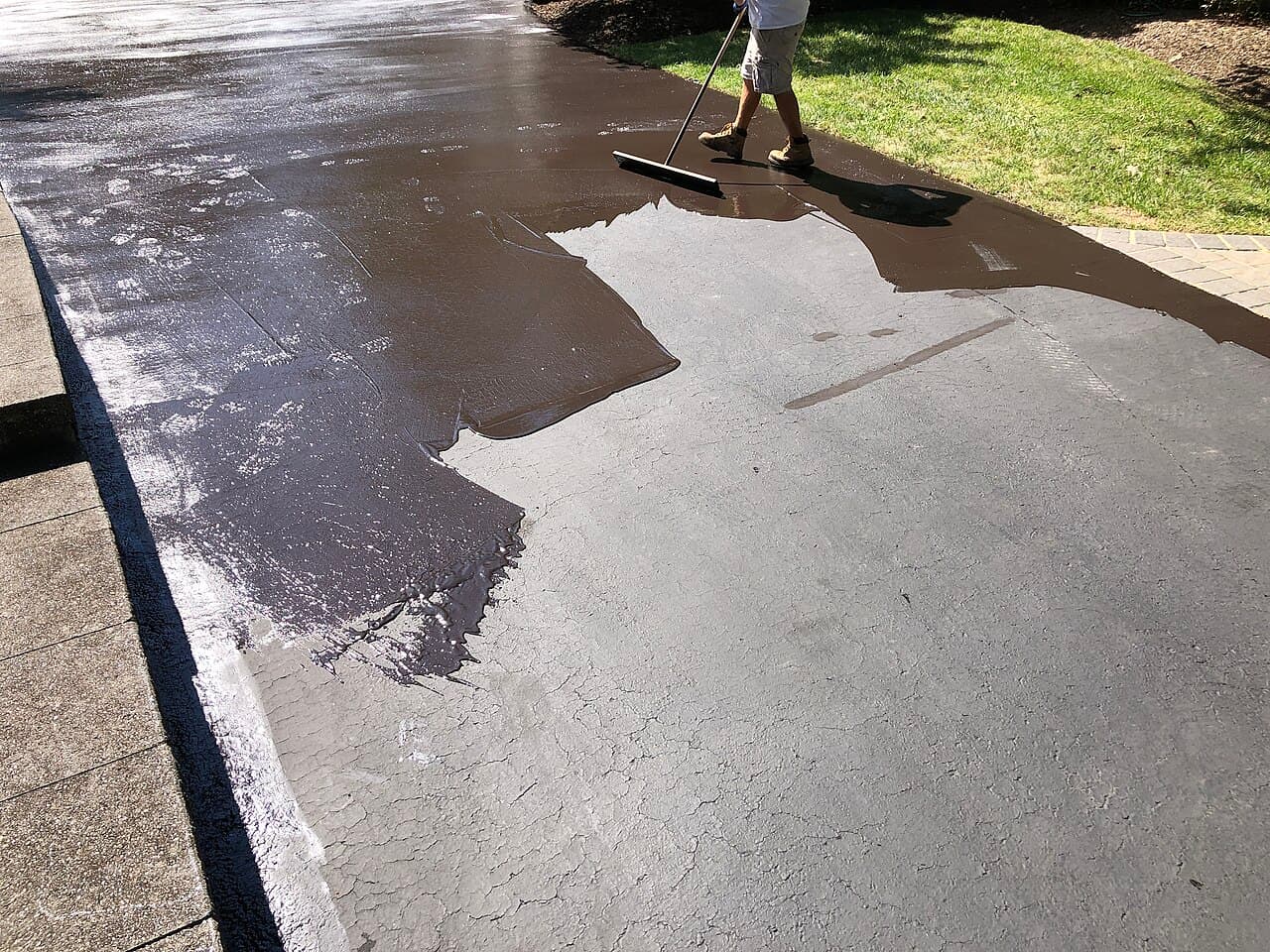
Coats and product. SealMaster's sealcoating FAQ says to apply two coats, with a third on high-traffic areas such as entrances and drive lanes.[4] Commercial crews may spray rather than squeegee; sealer can go on by brush, squeegee or spray equipment,[4] and SealMaster calls for clean silica sand in the mix for slip resistance and durability.[4] One coat with no sand will usually cost less, but it is not what SealMaster specifies.
The product has to be legal. Since July 1, 2025, no one in Virginia may apply a pavement sealant with more than one percent PAHs by weight,[5] which rules out coal-tar sealers. A quote should name the product. If a crew offers a coal-tar product, that is a reason to look elsewhere.
Access and hand work. Long or curving drives, steep sections, tight edges beside walks and beds, and parking areas the crew must work around all add hand work. So does moving cars and keeping a shared drive open.
What doing it yourself takes
Work out the area, double it for two coats, and divide by the coverage rate on the label. A 12-by-50-foot driveway is 600 square feet, so two coats come to 1,200 square feet, or about four Drive-Maxx 300 pails at the rough-surface rate. Add crack filler, a sealer squeegee, a push broom, a degreaser, tape and plastic sheeting. A full pail of Drive-Maxx 300 weighs 49 pounds,[1] so plan on carrying and pouring several of them. Prices change by store and season, so price the list at your local store on the day. The method is in how to seal an asphalt driveway.
What a written quote should include
Ask every business to put these in writing, so the quotes can be compared line by line:
- The square footage they measured.
- The sealer by product name, the number of coats, and whether sand is added.
- Crack filling (method and roughly how many feet of cracks) and any patching.
- Cleaning and oil-spot treatment.
- How long you must keep cars off, and who blocks the driveway.
- Cleanup, overspray on walks and garage floors, and what happens if it rains before it cures.
- The total price, payment schedule and start date.
Virginia's Board for Contractors says: "Virginia law requires all licensed contractors to provide a written contract for residential work."[8] It also advises homeowners to get at least three written bids or estimates[8] for the same described work, and adds: "Beware of any bid substantially lower than the others."[8]
Licences and payment
Sealing is improvement work under Virginia's contractor law, where a Class C licence covers jobs where a single contract is over $1,000 but less than $30,000.[6] Asphalt paving and sealcoating is its own licensing specialty, abbreviated PAV, and it covers sealcoating on driveways.[7] Check the business on DPOR's lookup before you sign.
On payment, the Board's rule of thumb is an initial deposit of no more than 10% of the total price or $1,000, whichever is less.[8] Its other advice: do not pay 100% of the bill until the job is 100% complete, and never pay cash.[8] If a crew knocks with an offer, take its card and get the quote in writing like any other. If you agreed to a deal at your home after a seller came to you, the notice that Virginia's Home Solicitation Sales Act requires the seller to give you says you may cancel this transaction at any time prior to midnight of the third business day after the date of this transaction.[9]
Stop and call a pro if
- The driveway has wide cracks, potholes, sunken areas or patches of small broken pieces; that is a repair or paving job to price first.
- It is too steep, long or busy for you to keep cars off for a day or two.
- A quote is far below the others, asks for most of the money up front, or does not name the product.
Get quotes on Loclis
Browse driveway sealing businesses, find exterior pros around Blacksburg, or read more exterior answers, including how often a driveway should be sealed and whether to do it yourself or hire someone. When you are ready, describe your driveway once and local businesses will quote it.
Common questions
- Is it cheaper to seal the driveway myself?
- Usually, in cash: you pay for the sealer, crack filler and a couple of tools, and the labour is yours. What you give up is spray equipment, sand-filled commercial mixes and a crew that does the edges and patching in a few hours. A steep, long or badly cracked driveway narrows the gap.
- Why do quotes for the same driveway differ so much?
- Usually because they are not for the same work. One may include crack filling, oil-spot treatment and two coats; another one coat and no prep. Ask each business to list the product, coats, crack and patch work, and cleanup, so you compare like with like.
- Does a driveway sealing company need a Virginia licence?
- Virginia licenses contractors by class and specialty, and asphalt paving and sealcoating has its own specialty. Check the business on DPOR's licence lookup before you sign, and ask for references and proof of insurance either way.
- A crew knocked on my door with a deal. Can I back out?
- If you agreed to the sale at home after the seller came to you, the written notice that Virginia's Home Solicitation Sales Act requires the seller to give you says you may cancel until midnight of the third business day after the transaction. Do not pay before the work is done.
- Can Loclis get me quotes?
- Yes. Describe the driveway once on Loclis, with measurements and photos, and local businesses quote it. Contact details are shared only after you book.
Sources
- [1] Black Jack Drive-Maxx 300 Blacktop Filler & Sealer product sheet (D-19), Gardner-Gibson. Checked October 26, 2026.
- [2] How to seal an asphalt / blacktop driveway, Gardner-Gibson. Checked October 26, 2026.
- [3] SealMaster E-Z Stir Pavement Sealer, SealMaster. Checked October 26, 2026.
- [4] Sealcoating FAQ, SealMaster. Checked October 26, 2026.
- [5] Va. Code § 62.1-196.1, Prohibiting high-PAH pavement sealants; civil penalty, Code of Virginia, Virginia General Assembly. Checked October 26, 2026.
- [6] Va. Code § 54.1-1100, Definitions (Contractors), Code of Virginia, Virginia General Assembly. Checked October 26, 2026.
- [7] 18VAC50-22-30, Definitions of specialty services (Board for Contractors Regulations), Virginia Administrative Code, Virginia General Assembly. Checked October 26, 2026.
- [8] What You Should Know Before You Hire a Contractor, Virginia Board for Contractors, DPOR. Checked October 26, 2026.
- [9] Va. Code § 59.1-21.4, Receipt or written agreement (Virginia Home Solicitation Sales Act), Code of Virginia, Virginia General Assembly. Checked October 26, 2026.
Want a pro to handle it?
Describe the job once. Licensed local businesses send quotes, and you pay only when you book one.
Get a quote for Roofing