Why is my asphalt driveway cracking?
Most driveway cracks come from age and weather: asphalt hardens and shrinks over the years, and daily heating and cooling splits it into lines and blocks. A pattern of small, many-sided pieces where the tyres run is different. That is fatigue from repeated loads, usually over a weak base, and it needs repair, not just sealer.
Free to ask. Local shops send quotes, and you pay only when you book one.
By Kasra Taheri, Founder, LoclisPublished
Researched and drafted with AI, then checked claim by claim against the sources listed below before it was published. Prices and rules change; the dates beside each source say when it was last checked.
Step by step
Read when to stop and call a pro, further down this page, before you start.
Step 1: Look at the pattern
Stand back and note whether the cracks are single lines, large rectangles, or small many-sided pieces, and whether they sit where the tyres run.[1]
Step 2: Measure the widest cracks
Measure a few cracks with a ruler; federal highway inspectors rate block cracks of a quarter inch or less as low severity and over three quarters of an inch as high.[2]
Step 3: Check the edges
Walk the edges where the asphalt meets lawn or gravel and look for crescent-shaped cracks or crumbling.[2]
Step 4: Watch the water
After a rain, look for puddles that stay in the same low spots and for water running onto the driveway from a downspout or slope.[1]
Step 5: Look for bulges and roots
Check for raised humps, and for tree roots or stumps near cracks that run toward a tree.
Step 6: Fill the narrow cracks
Clean out cracks up to half an inch wide and fill them with an asphalt crack filler before the next sealing.[3]
Step 7: Get the rest looked at
Have a paving or sealcoating business look at broken pieces, sinking areas and wide cracks before you seal anything.
Asphalt driveways crack for a few well-understood reasons, and the pattern of the cracks tells you which one you have. Most cracking is age and weather: the asphalt hardens and shrinks over the years, and the daily swing between hot afternoons and cool nights splits it. A smaller group of cracks comes from the weight of cars on a base that is too weak or too wet. The first kind is maintenance; the second is repair.
Read the pattern
Large rectangles across the whole driveway: block cracking. In the federal pavement distress manual used for airfields, Block cracking is caused mainly by shrinkage of the asphalt and daily temperature cycling, it is not caused by traffic loads, and it usually means the asphalt has hardened significantly.[1] The same manual sizes the pieces as blocks from roughly 1 by 1 foot up to 10 by 10 feet.[1] It can appear even where nobody drives, which sets it apart from load cracking. This is an old-age crack: fill it and keep the surface sealed.
Single long lines, along or across the driveway. Longitudinal and transverse cracks can come from a poorly built paving joint, from shrinkage of the asphalt in low temperatures or as it hardens, or from cracks in a layer underneath reflecting up through the surface.[1] The manual adds that these cracks are not usually load associated.[1] A straight crack down the middle of a wide driveway is often the seam between two paving passes.
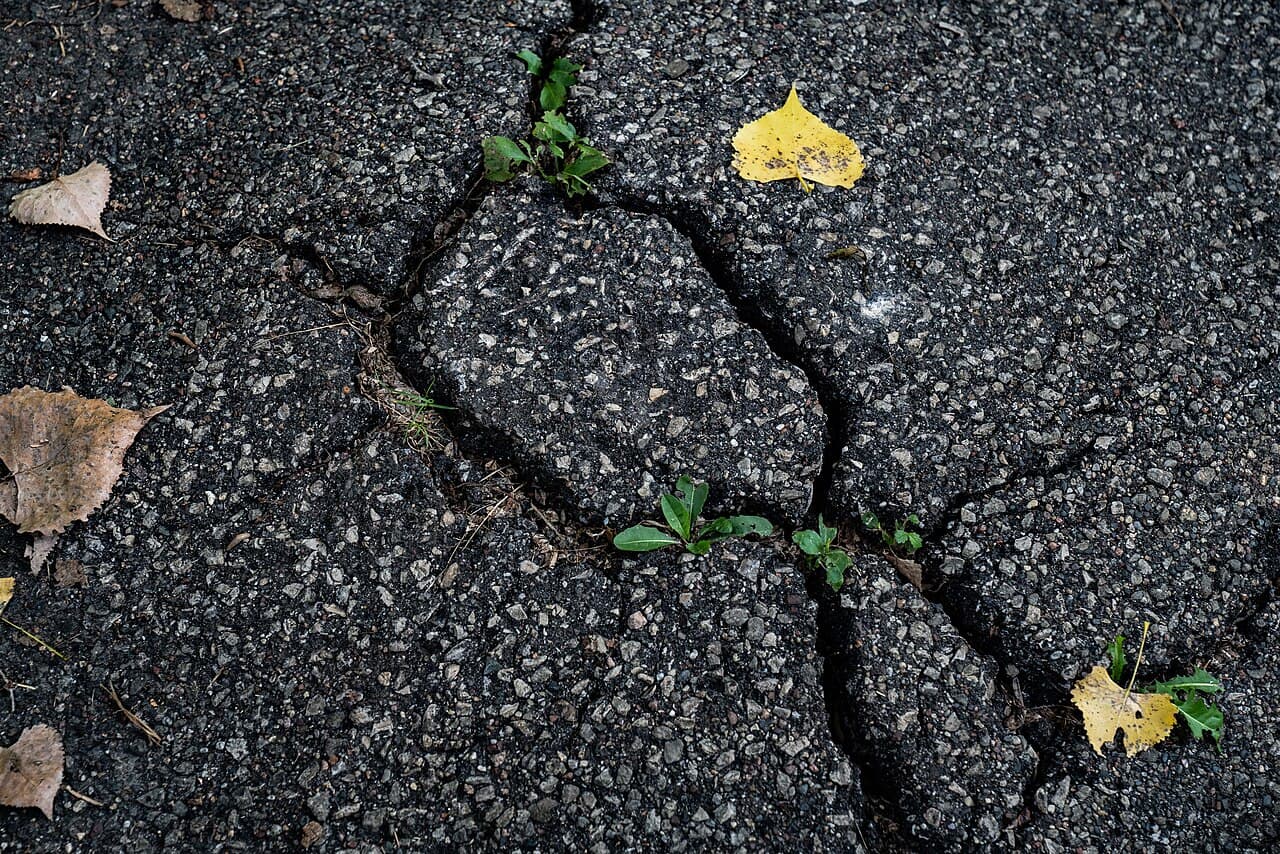
Small, many-sided pieces where the tyres run: alligator cracking. This is the one to take seriously. "Alligator or fatigue cracking is a series of interconnecting cracks caused by fatigue failure of the asphalt surface under repeated traffic loading."[1] It starts at the bottom of the asphalt, where the strain under a wheel is highest, and works up to the surface as parallel cracks that later join into sharp-angled pieces.[1] Because the cause is load, it shows up only where wheels pass repeatedly:[2][1] in the tyre tracks, at the turn into the garage, or where a delivery truck parks. Texas's highway maintenance manual says alligator cracking is generally caused by inadequate base support or a brittle asphalt surface,[6] and that where the base is unstable or wet, the base has to be removed and replaced or stabilized.[6]
Cracks along the edge. Federal highway inspectors record crescent-shaped or fairly continuous cracks within 0.6 m (about 2 feet) of a pavement edge beside an unpaved shoulder[2] as edge cracking. On a driveway that is the strip beside the lawn. The Texas manual traces edge cracking to shrinkage of the asphalt at the edge or of the base below, with loads on the edge breaking it off.[6] Tyres that drift off the side are the usual edge load.
Look for sinking, humps and wear
Cracks around a low spot point to the ground below. Depressions can be caused by settlement of the foundation soil or can be built up during construction,[1] and you will usually see them as puddles that sit in the same place after rain. A raised hump is a swell, and "A swell is usually caused by frost action in the subgrade or by swelling soil."[1] Tree roots can also lift asphalt; a crack or bulge that runs toward a nearby tree is a clue.
A rough, grey, gritty surface with stones showing is weathering: the wearing away of the asphalt binder and fine aggregate from the surface, often with fading of the asphalt colour.[1] It is not a crack yet, but it is where the next cracks start. SealMaster says sealcoating prevents oxidation of the asphaltic binder,[5] which is the main reason to keep a sound driveway sealed.
How serious is it?
Width is a quick guide. The Federal Highway Administration's manual rates block cracks as low severity at a mean width of 6 mm (about a quarter inch) or less, moderate up to 19 mm (about three quarters of an inch), and high above that.[2] For a homeowner, the practical lines are the products on the shelf. Gardner-Gibson's guide uses crack filler for cracks up to half an inch wide[3] and a trowel-on patch for wider cracks, deteriorated surface and holes up to an inch deep.[3]
Water is what turns small cracks into big ones. Cracks allow surface water to enter the subgrade and further destroy its stability,[6] and a weakened base gives way under the next car. Gardner-Gibson's warranty for its driveway sealer says: "Warranty not applicable for areas that have ponding water, poor drainage or snow removal damage."[4] If downspouts empty onto the driveway or the yard drains across it, fixing that is part of fixing the cracks.
What to do about it
- Hairline and narrow cracks, block cracking, weathering: clean the cracks, fill them, and seal the driveway. See how to seal an asphalt driveway and how often to seal it.
- Wide cracks, small potholes: patch them, let the patch cure for as long as its label says, then seal.
- Alligator cracking, sinking, humps, potholes that keep coming back: have the area repaired. That usually means cutting out the failed asphalt and rebuilding the base under it, and in Virginia asphalt paving and sealcoating is a licensed specialty (PAV) that includes repair work on driveways.[7]
Stop and call a pro if
- Cracks have joined into small pieces that rock or break loose when you step on them.
- An area is sinking, or water stands in the same place for a day after rain.
- A hump is lifting near a tree, a buried line or a culvert pipe.
- Cracks are wider than your crack filler is made for, or keep reopening every season.
Related on Loclis
If you are weighing the work, read should I seal my driveway myself or hire someone and what driveway sealing costs in Virginia. For a concrete drive, how to fix cracks in a concrete driveway is the guide. Browse driveway sealing businesses or the other exterior answers, or describe the cracks once, with photos, and local businesses will quote the repair and sealing.
Common questions
- Will sealing my driveway fix the cracks?
- No. Sealer is a thin coating. Fill narrow cracks with crack filler first, and have wider cracks, broken pieces and sunken spots repaired. Sealing over damage hides it for a while, and the cracks come back through.
- Are hairline cracks in a new driveway a problem?
- A few fine cracks are common as asphalt ages and are worth filling and watching. Cracks that spread into a pattern of small pieces where the cars drive, or a new driveway that sinks, are worth raising with the paving company while the work is fresh.
- Why do the cracks get worse after winter?
- Open cracks let water into the layers underneath, and cold makes asphalt shrink. Federal pavement manuals list shrinkage at low temperatures as one cause of long cracks and frost action under the pavement as the usual cause of swells. Filling cracks before winter keeps more water out.
- Do tree roots crack asphalt driveways?
- They can. A crack or hump that runs toward a nearby tree, or appears beside a stump, often has a root under it. Cutting large roots can harm or destabilize the tree, so ask an arborist before anyone digs.
- Is alligator cracking something I can repair myself?
- Not well. It usually means the support under the asphalt has failed, so the damaged area is cut out and rebuilt, base included, by a paving business. Sealer and crack filler will not hold the pieces together.
Sources
- [1] Asphalt Surfaced Airfields PAVER Distress Identification Manual (June 2009), U.S. Army Corps of Engineers ERDC-CERL, published by the Federal Aviation Administration. Checked October 26, 2026.
- [2] Distress Identification Manual for the Long-Term Pavement Performance Program (FHWA-HRT-13-092, revised May 2014), Federal Highway Administration. Checked October 26, 2026.
- [3] How to seal an asphalt / blacktop driveway, Gardner-Gibson. Checked October 26, 2026.
- [4] Black Jack Drive-Maxx 300 Blacktop Filler & Sealer product sheet (D-19), Gardner-Gibson. Checked October 26, 2026.
- [5] Sealcoating FAQ, SealMaster. Checked October 26, 2026.
- [6] Flexible Pavement Distress Maintenance (Maintenance Operations Manual), Texas Department of Transportation. Checked October 26, 2026.
- [7] 18VAC50-22-30, Definitions of specialty services (Board for Contractors Regulations), Virginia Administrative Code, Virginia General Assembly. Checked October 26, 2026.
Want a pro to handle it?
Describe the job once. Licensed local businesses send quotes, and you pay only when you book one.
Get a quote for Roofing