How often should an asphalt driveway be sealed?
Reseal when the old coat has worn through, not on a fixed calendar. Applicators commonly recommend every 1 to 5 years. The signs are grey patches where the black coat has worn off, a gritty surface and new hairline cracks. Seal a new driveway only after the cure time on the sealer's label.
Free to ask. Local shops send quotes, and you pay only when you book one.
By Kasra Taheri, Founder, LoclisPublished
Researched and drafted with AI, then checked claim by claim against the sources listed below before it was published. Prices and rules change; the dates beside each source say when it was last checked.
Step by step
Read when to stop and call a pro, further down this page, before you start.
Step 1: Look the driveway over each spring
Walk it after the winter and note grey worn patches, exposed stones, new cracks, oil spots and puddles.[1]
Step 2: Fill new cracks the same season
Clean out and fill cracks up to half an inch wide as soon as you find them, before water gets under the asphalt.[5]
Step 3: Clean oil and fuel spots
Scrub drips with a degreaser or dish soap and a brush before they soak in, so the next coat of sealer can bond there.[4]
Step 4: Keep water moving off
Point downspouts away from the driveway and fill low spots in the lawn beside it so water does not stand against the edges.[4]
Step 5: Reseal when the coat has worn
When grey asphalt shows through across the main traffic areas, plan a resealing in the next warm, dry stretch.[1]
Step 6: Use two thin coats
Apply two thin coats rather than one thick one, and consider a third on the busiest strip where cars turn and park.[2]
Step 7: Go easy on it in winter
Use a plastic shovel blade or a raised plow shoe and avoid chipping ice with a metal edge, since snow removal damage voids some sealer warranties.[4]
There is no single right interval. Reseal an asphalt driveway when the last coat has worn off, which can be anywhere in a range of years. The U.S. Geological Survey's summary of the industry puts it simply: "Applicators recommend reapplication of sealcoat from every 1 to 5 years."[1] Where your driveway falls in that range depends on how much traffic it gets, how much sun it takes, and how well the last coat went on. Look at the surface, not the calendar.
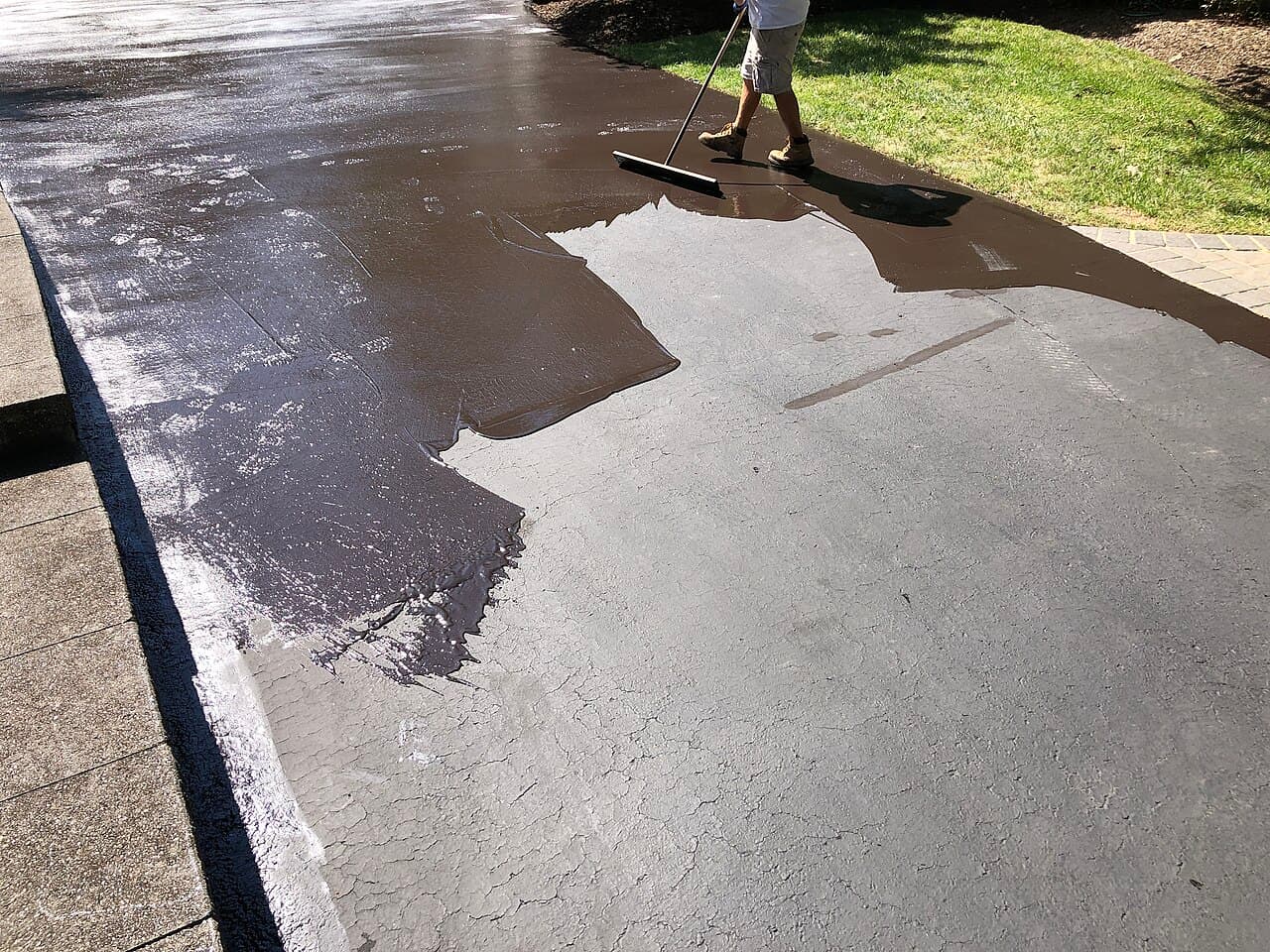
How to tell it is time
Sealer wears away slowly, mostly under tyres. Friction from vehicle tires abrades sealcoat into small particles,[1] so the tyre tracks, the turn into the garage and the parking spot wear first. Three signs say the coat is gone:
- Grey patches. "Light gray patches of asphalt show where sealcoat has been worn from the pavement."[1] When grey shows across the main traffic areas, it is time.
- A rough, gritty surface. Pavement inspectors call this weathering: the wearing away of the asphalt binder and fine aggregate from the surface, which can begin on asphalt as new as six months old and may come with fading of the asphalt colour.[6]
- New hairline cracks. Fine cracks across an unsealed surface are the start of the age cracking described in why asphalt driveways crack.
That protective coat is the point. SealMaster says sealcoating prevents oxidation of the asphaltic binder and prevents weather damage,[2] which is a maker's claim, but it matches what the wear signs show: asphalt left bare turns grey and rough.
The first seal on a new driveway
Fresh asphalt needs to cure first, and the wait depends on the product. Gardner-Gibson's Black Jack labels ask for at least six months, including one full summer.[4][5] SealMaster's FAQ says new asphalt should cure a minimum of 30 to 60 days,[2] and its E-Z Stir label asks for at least four weeks under ideal weather.[3] Follow the label on the pail you will use, or your paving contractor's advice if they gave you a time. SealMaster's rule of thumb is to seal once the asphalt is free from oils and sufficiently cured.[2]
What to do between sealings
Resealing is the big job. The small jobs in between do as much to make a driveway last.
Fill cracks every year. Texas's highway maintenance manual gives the reason: "Since cracks allow surface water to enter the subgrade and further destroy the stability of the subgrade, sealing should be accomplished as soon as practical."[7] Clean out and fill cracks up to half an inch wide[5] with an asphalt crack filler each spring or fall. Fill to the surface, not above it; the same manual warns: "Efforts should be made to avoid a buildup of crack sealing material."[7]
Clean oil and fuel drips. Scrub them with a degreaser or dish soap while they are fresh; Gardner-Gibson's label says treating oil spots promotes proper bonding of the next coat.[4]
Keep water off and away. Gardner-Gibson's sealer warranty is blunt about what shortens a coating's life: "Warranty not applicable for areas that have ponding water, poor drainage or snow removal damage."[4] Turn downspouts away from the driveway, fill low spots along the edges, and use a plastic shovel blade on the surface.
Keep heavy loads off the edges. Texas's manual notes that edge loads tend to break off the pavement edge.[7] Park delivery trucks, trailers and dumpsters toward the middle, on boards if the load is heavy.
How much to put on each time
More sealer is not better. SealMaster's sealcoating FAQ says to apply two coats of sealer, and a third coat may go on high-traffic areas such as entrances, exits and drive lanes.[2] Thin coats dry evenly; thick ones puddle and track. When you reseal, spend the extra effort on the strip that wore first. The method is in how to seal an asphalt driveway.
The product matters too. Since July 1, 2025, Virginia law has barred anyone from applying a pavement sealant with more than one percent PAHs by weight,[8] which rules out coal-tar sealers. USGS research identified coal-tar-based sealcoat as a major source of PAH contamination in urban and suburban areas.[1] Asphalt-emulsion sealers such as SealMaster's E-Z Stir[3] are the kind to buy, or to ask a contractor to name.
Stop and call a pro if
- The driveway cracks into small pieces where the cars drive, or areas sink, within a year or two of sealing.
- Cracks are wider than half an inch, or potholes keep reopening after you patch them.
- Water stands on the driveway or runs toward the house after rain.
- The old coating is peeling or flaking off in sheets.
Related on Loclis
Weigh the work in should I seal my driveway myself or hire someone and what driveway sealing costs in Virginia, browse driveway sealing businesses, or read the other exterior answers. When it is time to reseal, describe your driveway once and local businesses will quote it.
Common questions
- Can I seal my driveway every year?
- You can, but it often does not need it, and each coat is time and money. Look at the surface instead: reseal when grey asphalt shows through where the cars drive, and fill cracks every year whether you seal or not.
- When should I seal a brand-new driveway?
- Only after the cure time on the label you buy. Gardner-Gibson's Black Jack sealers ask for at least six months, including one full summer; SealMaster's FAQ gives 30 to 60 days. If your paving contractor gave you a time, follow theirs.
- What is the best time of year to seal in Virginia?
- A warm, dry stretch when days and nights both stay above the label's minimum, which for many sealers is 50°F for a full day after application. Late spring through early fall usually gives the most of those days; sealing late in the season risks a cold night before it cures.
- Does sealing make a driveway last longer?
- Sealer makers say so: SealMaster says sealcoating protects the asphalt binder from oxidation and weather. It does not fix structural damage. A driveway with a failed base will crack through any coating, so repair those areas first.
- Is coal-tar sealer longer lasting, and can I still use it?
- Whatever its wear life, it is no longer an option in Virginia: since July 1, 2025, no one may apply a pavement sealant with more than one percent PAHs by weight. Use an asphalt-emulsion sealer.
Sources
- [1] Coal-Tar-Based Pavement Sealcoat: Potential Concerns for Human Health and Aquatic Life (Fact Sheet 2016-3017), U.S. Geological Survey. Checked October 26, 2026.
- [2] Sealcoating FAQ, SealMaster. Checked October 26, 2026.
- [3] SealMaster E-Z Stir Pavement Sealer, SealMaster. Checked October 26, 2026.
- [4] Black Jack Drive-Maxx 300 Blacktop Filler & Sealer product sheet (D-19), Gardner-Gibson. Checked October 26, 2026.
- [5] How to seal an asphalt / blacktop driveway, Gardner-Gibson. Checked October 26, 2026.
- [6] Asphalt Surfaced Airfields PAVER Distress Identification Manual (June 2009), U.S. Army Corps of Engineers ERDC-CERL, published by the Federal Aviation Administration. Checked October 26, 2026.
- [7] Flexible Pavement Distress Maintenance (Maintenance Operations Manual), Texas Department of Transportation. Checked October 26, 2026.
- [8] Va. Code § 62.1-196.1, Prohibiting high-PAH pavement sealants; civil penalty, Code of Virginia, Virginia General Assembly. Checked October 26, 2026.
Want a pro to handle it?
Describe the job once. Licensed local businesses send quotes, and you pay only when you book one.
Get a quote for Roofing