How do I seal an asphalt driveway?
Wait until the asphalt is old enough for your sealer's label and the forecast gives you a warm, dry day and night. Trim, sweep and wash the driveway, scrub out oil spots, fill cracks up to half an inch wide, then squeegee on two thin coats, the second at right angles to the first, and keep cars off for a day or two.
Free to ask. Local shops send quotes, and you pay only when you book one.
By Kasra Taheri, Founder, LoclisPublished
Researched and drafted with AI, then checked claim by claim against the sources listed below before it was published. Prices and rules change; the dates beside each source say when it was last checked.
Step by step
Read when to stop and call a pro, further down this page, before you start.
Step 1: Check the asphalt's age and the forecast
Make sure the driveway is older than your sealer's minimum cure time and that no rain or cold night is forecast for the next day and a half.[1]
Step 2: Trim and sweep
Cut grass and plants back from the edges, sweep off all debris, and scrape loose material out of the cracks with a screwdriver.[2]
Step 3: Treat oil and fuel spots
Scrub each oil stain with a degreaser or dish soap and a stiff brush so the sealer can bond there.[1]
Step 4: Wash and rinse
Wash the whole surface, flush the cracks with a stream of water, rinse, and push out any puddles.[2]
Step 5: Fill the cracks
Fill cracks up to half an inch wide with an asphalt crack filler and let it cure for the time on its label.[2]
Step 6: Patch shallow holes
Trowel an asphalt patch into holes up to an inch deep, feathering it into the surface; deeper potholes need a pothole patch that cures for weeks.[2]
Step 7: Mask the edges
Lay tape and plastic sheeting or a drop cloth along concrete walks, the garage slab and brick so the black sealer stays off them.[2]
Step 8: Mix the sealer
Stir each pail until it is even, and do not thin it unless the label tells you to.[3]
Step 9: Spread the first thin coat
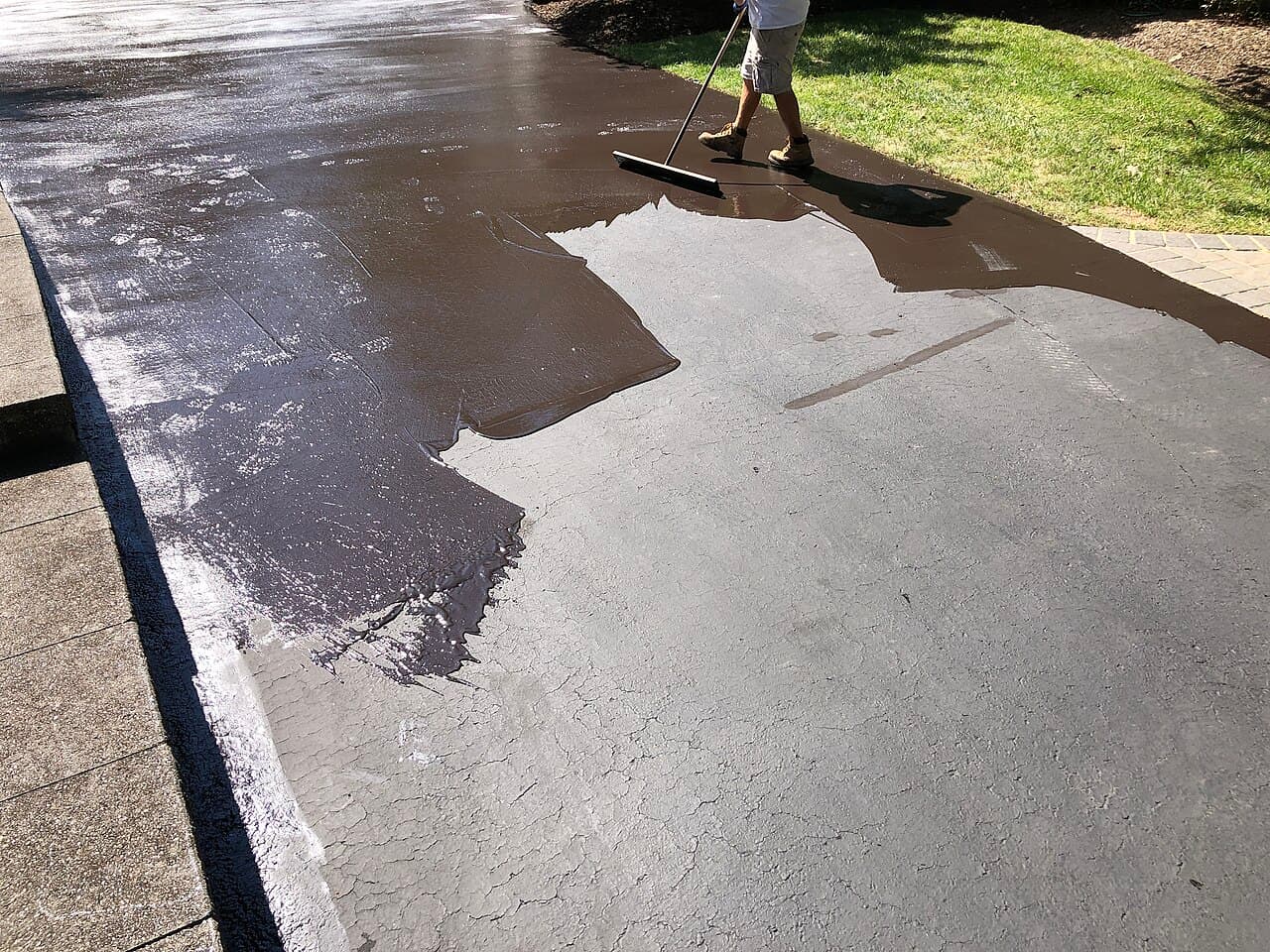
Pour a band of sealer and spread it thin with a squeegee, one small section at a time, overlapping each pass so no edge line dries.[2]
Step 10: Let the first coat dry
Wait until the first coat is dry to the touch everywhere, shaded spots included, before starting the second.[2]
Step 11: Spread the second coat crosswise
Apply the second thin coat at right angles to the first so the two together fill every low spot.[1]
Step 12: Keep traffic off
Block the driveway with tape or cones and keep cars off for the full time on the label, usually a day or two.[1]
Step 13: Clean up
Wash tools with soap and warm water while the sealer is still wet, and never rinse leftover sealer into a drain, ditch or stream.[1]
Sealing an asphalt driveway is a one-weekend job for most homeowners: a morning of cleaning and crack filling, then two thin coats of sealer spread with a squeegee, and a day or two with the cars parked on the street. The work is simple. What decides whether the coating lasts is timing, preparation and keeping each coat thin.
Before you buy anything
Is the asphalt old enough? Fresh asphalt needs time to cure before it is sealed, and products disagree on how long. Gardner-Gibson's Drive-Maxx 300 label is the strictest: "Newly paved asphalt surfaces must be allowed to cure for a minimum of six months or a full summer’s season prior to application of any sealer."[1] SealMaster's E-Z Stir label asks for a minimum of four weeks of cure under ideal weather.[3] Follow the pail you actually buy.
Will the weather hold? Sealer cures by drying, so it needs warmth and no rain. E-Z Stir needs temperatures above 50°F both during application and for at least 24 hours afterwards, and no rain imminent or forecast.[3] Drive-Maxx 300 asks for 60°F and rising, but below 90°F, during application, and no rain or overnight temperatures below 50°F expected within 36 hours.[1] A cool night or a pop-up storm is the usual reason a home sealing job peels or streaks.
Is the driveway flat enough? Drive-Maxx 300 is not recommended or warranted for slopes greater than 20°.[1] A steep drive is also hard to work safely while it is wet and slick.
Which sealer? Since July 1, 2025, Virginia law has barred anyone from applying or using a high-PAH pavement sealant, meaning one with more than one percent polycyclic aromatic hydrocarbons by weight,[4] with a civil penalty of $250 for a violation.[4] That rules out coal-tar sealers. Coal-tar-based sealcoat typically contains 50,000 to 100,000 mg/kg of PAHs, while asphalt-based sealcoat typically contains about 50 mg/kg,[5] so the asphalt-emulsion pails sold for homeowners are the ones to use. Asphalt driveway sealers are made for blacktop only, not for concrete or brick.[2]
How much sealer you need
Measure the driveway's length and width and multiply to get square feet, then double it for two coats. Gardner-Gibson gives Drive-Maxx 300 about 350 square feet per 5-gallon pail on a smooth driveway and 300 square feet on a rough or worn one,[1] and SealMaster lists one gallon of E-Z Stir covering roughly 70 to 82 square feet per coat.[3] A 12-by-50-foot driveway is 600 square feet, or 1,200 square feet for two coats: about four pails at the rough-surface rate. Buy one extra if the surface is very porous; an unopened pail is easier to return than a half-sealed driveway is to finish.
You will also need a stiff push broom, a squeegee made for sealer, a garden hose, a degreaser or dish soap with a scrub brush, asphalt crack filler, plastic sheeting or a drop cloth and tape, and old clothes. Gardner-Gibson's label says: "Protective clothing and eyewear should be used during application of these products, as product may cause skin irritation."[1] Its label also tells you not to carry it on a passenger seat or inside the passenger compartment[1] of your vehicle, so bring the pails home in the trunk or a truck bed, standing upright on a drop cloth.
Preparation does most of the work
Sealer only sticks to clean, sound asphalt. Trim the grass back from the edges, sweep thoroughly, and pick or scrape dirt and weeds out of the cracks. Scrub oil stains with a degreaser; sealer tends to lift off oil spots that were skipped. Then wash the whole driveway and let the cracks drain.
Fill cracks before you seal, not with the sealer. Gardner-Gibson's guide uses crack filler for cracks up to half an inch wide and a trowel-on patch for holes up to an inch deep.[2] Holes deeper than an inch take a pothole patch, which should cure for at least thirty days before it is sealed over.[2] If your driveway needs that much patching, it may be better to fill and patch this season and seal next. For what the cracks are telling you, see why asphalt driveways crack.
Applying the two coats
Some sealers, Drive-Maxx 300 among them, go on applied to a slightly damp surface, not a wet one,[1] so a light rinse just before you start helps on a hot day. Mix each pail fully; Gardner-Gibson suggests turning the pails upside down the night before[1] so the solids loosen.
Work from the garage toward the street so you are never trapped. Pour a band of sealer across the driveway, pull it thin with the squeegee, and keep a wet edge by overlapping each pass. Thin is the rule. Two thin coats are mandatory for optimum sealer performance.[1] Gardner-Gibson explains why: "Single thick coats cure less evenly, have a tendency to puddle, and are more prone to tracking."[2]
Wait for the first coat to dry before the second. The Drive-Maxx 300 label gives about 3 to 6 hours between coats,[1] and Gardner-Gibson's longer guide recommends waiting 4 to 12 hours, until the first coat is fully dry,[2] and notes that sealer in shaded areas generally dries more slowly than in sun.[2] Spread the second coat at right angles to the first.
Afterwards, Drive-Maxx 300 needs 2 to 4 hours before foot traffic and 24 to 48 hours before vehicles,[1] and longer in humid or cloudy weather. Put tape or bins across the end of the driveway so a delivery driver does not pull in.
Cleanup
Wash squeegees and brushes with soap and warm water while the sealer is wet. The label is direct about leftovers: "Do not pour excess product in drains or watercourses."[1] Stafford County's stormwater program points out that stormwater does not get treated at the local wastewater treatment plants,[6] so anything rinsed into a street drain goes straight to a creek. Let small leftovers dry out in the pail and ask your county or town how it takes household paint-type waste.
Stop and call a pro if
- More than a few patches are broken into small, many-sided pieces (alligator cracking), or the asphalt moves when you step on it. Sealer will not hold the pieces together.
- Potholes are wide or deep, or water stands in the same low spots after every rain.
- The driveway is steeper than your sealer allows, very long, or shared with neighbours who need access while it cures.
- You find soft or sinking areas near a buried utility line, a culvert or the road edge.
Related on Loclis
Compare doing it yourself with hiring in should I seal my driveway myself or hire someone, see what driveway sealing costs in Virginia, and plan the next coat with how often to seal an asphalt driveway. For a concrete drive, read how to seal a concrete driveway. More exterior answers and driveway sealing businesses are a click away. If you would rather have it done, describe your driveway once and local businesses will quote it.
Common questions
- How old does new asphalt have to be before I seal it?
- It depends on the product. Gardner-Gibson's Black Jack sealers ask for at least six months or a full summer, while SealMaster's E-Z Stir asks for at least four weeks under ideal weather. Go by the label on the pail you buy, and if in doubt, wait through one summer.
- Can I seal my driveway with coal-tar sealer in Virginia?
- No. Since July 1, 2025, Virginia law has barred anyone from applying a pavement sealant with more than one percent PAHs by weight, which is the coal-tar kind. Asphalt-emulsion sealers, such as SealMaster's E-Z Stir, are the kind that remain.
- Should I use a squeegee or a brush?
- A squeegee spreads the sealer at the right thickness, which is why Gardner-Gibson calls for one on its Drive-Maxx 300. A brush is useful along edges and to work sealer into rough spots, and some labels allow a brush follow-up for texture.
- What happens if it rains right after I seal?
- Rain on uncured sealer can wash some of it off, leave streaks, and carry it toward the street or a ditch. That is why labels ask for a dry forecast for a day or more afterwards. If it does rain, let the surface dry fully and look at it before deciding whether a touch-up coat is needed.
- Can I seal my concrete walk with the leftover sealer?
- No. Asphalt driveway sealer is made for blacktop only. Concrete needs a concrete sealer; see the guide to sealing a concrete driveway.
Sources
- [1] Black Jack Drive-Maxx 300 Blacktop Filler & Sealer product sheet (D-19), Gardner-Gibson. Checked October 26, 2026.
- [2] How to seal an asphalt / blacktop driveway, Gardner-Gibson. Checked October 26, 2026.
- [3] SealMaster E-Z Stir Pavement Sealer, SealMaster. Checked October 26, 2026.
- [4] Va. Code § 62.1-196.1, Prohibiting high-PAH pavement sealants; civil penalty, Code of Virginia, Virginia General Assembly. Checked October 26, 2026.
- [5] Coal-Tar-Based Pavement Sealcoat: Potential Concerns for Human Health and Aquatic Life (Fact Sheet 2016-3017), U.S. Geological Survey. Checked October 26, 2026.
- [6] Illicit Discharge, Detection, & Elimination Program, Stafford County, Virginia. Checked October 26, 2026.
Want a pro to handle it?
Describe the job once. Licensed local businesses send quotes, and you pay only when you book one.
Get a quote for Roofing