Should I seal my driveway myself or hire someone?
Seal it yourself if the asphalt is sound, with only narrow cracks, the driveway is fairly flat and short, and you can keep cars off it for a day or two. Hire a licensed sealcoating business for a long or steep drive, a surface with wide cracks or potholes, or when you want spray application with sand in the mix.
Free to ask. Local shops send quotes, and you pay only when you book one.
By Kasra Taheri, Founder, LoclisPublished
Researched and drafted with AI, then checked claim by claim against the sources listed below before it was published. Prices and rules change; the dates beside each source say when it was last checked.
Step by step
Read when to stop and call a pro, further down this page, before you start.
Step 1: Walk the driveway
Note every crack and hole, measure the widest crack, and look for patches broken into small pieces or areas that sink.
Step 2: Check the slope and length
Compare the steepest part with your sealer's limit, which is 20° for Drive-Maxx 300, and measure the total area.[1]
Step 3: Check your weather and parking
Pick a stretch that meets the label's temperature and dry-weather window and plan where the cars will go for a day or two.[3]
Step 4: Decide what to hire out
Plan to hire out wide cracks, potholes, sunken areas and broken patches even if you seal the rest yourself.[2]
Step 5: Get three written quotes
Ask at least three businesses to quote the same described work in writing, naming the product, the coats and the crack work.[8]
Step 6: Check the licence
Look the business up on DPOR's licence lookup and confirm the licence covers asphalt paving and sealcoating.[7]
Step 7: Agree payment in writing
Keep the deposit small, pay the balance after the job is complete, and never pay cash.[8]
Most homeowners can seal a sound asphalt driveway themselves. The job is cleaning, filling narrow cracks and spreading two thin coats, and SealMaster markets its E-Z Stir pail as suited to maintenance crews and do-it-yourselfers.[3] Hiring makes sense when the driveway needs more than a coating, when it is long or steep, or when you cannot give up the driveway and a weekend to the weather window. Many people do both: a business fixes the damage, and they seal it themselves.
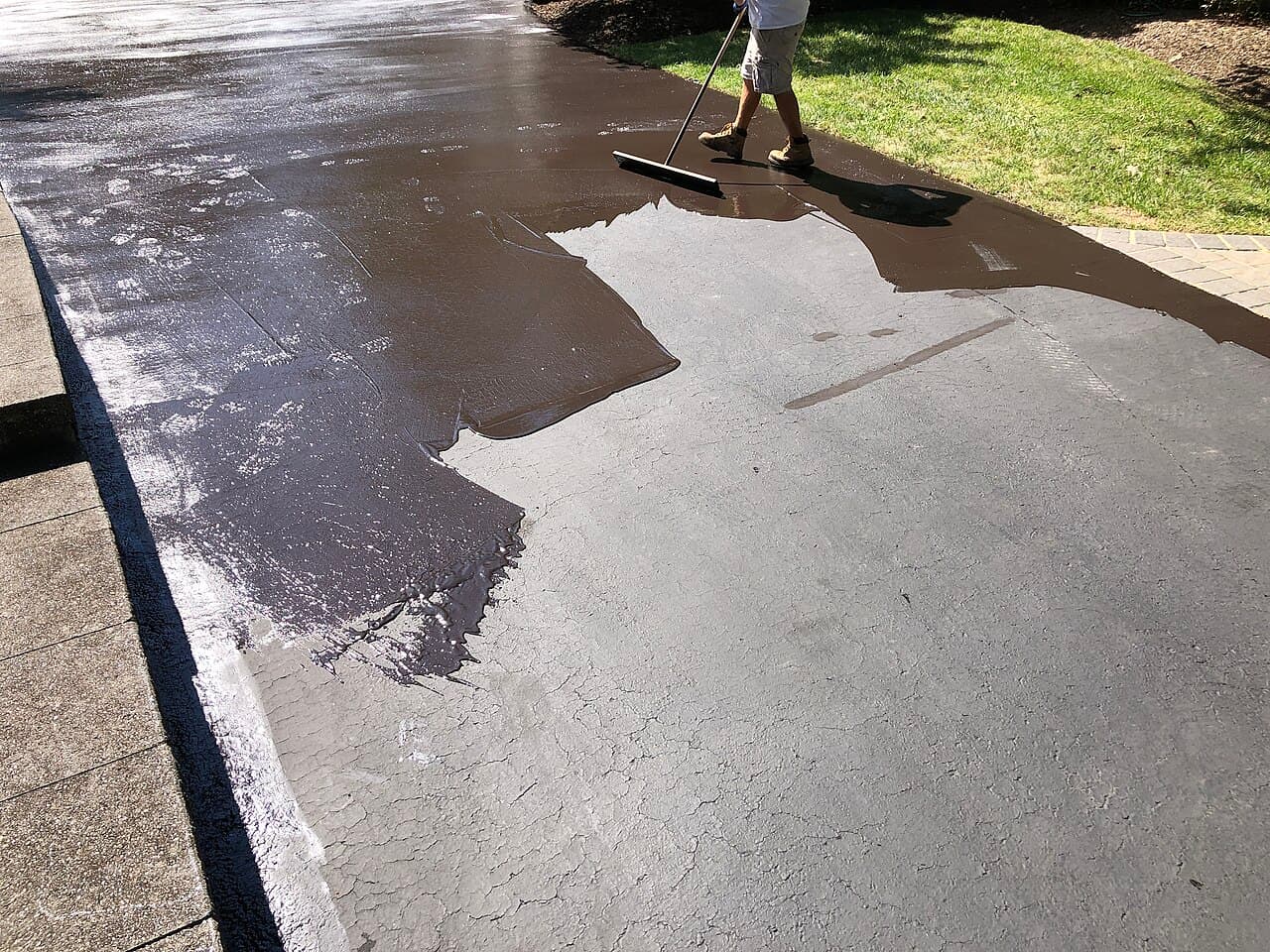
When doing it yourself makes sense
The asphalt is sound. Sealer protects a surface; it does not rebuild one. A driveway that has faded to grey and has a few narrow cracks is a good candidate. Gardner-Gibson's guide sends cracks up to half an inch wide to a crack filler and holes up to an inch deep to a trowel-on patch.[2]
You have the weather and the parking. Sealer needs a warm, dry window. SealMaster's E-Z Stir label asks for temperatures above 50°F during application and for at least 24 hours afterwards,[3] and Gardner-Gibson's Drive-Maxx 300 needs 24 to 48 hours before vehicles can use it.[1] If your cars can sit on the street or a neighbour's drive for two days, you are set.
The driveway is flat and not huge. Drive-Maxx 300's label is plain: "This sealer is not recommended or warranted for use on surfaces containing slopes of greater than 20°."[1] Size matters for your back as much as your budget. A full 5-gallon pail weighs 49 pounds,[1] and one covers about 300 to 350 square feet per pail per coat,[1] so a large driveway means many pails lifted, poured and spread in one session.
You are fine getting dirty. Wear old clothes, gloves and eye protection; the label warns that the product may cause skin irritation.[1] The full method is in how to seal an asphalt driveway.
When to hire someone
The damage is beyond a coating. Wide cracks, potholes, sunken areas and patches broken into small many-sided pieces need repair first, and some need the asphalt replaced. Sealing over them hides the problem for a season. Why asphalt driveways crack explains what each pattern usually means.
You want a commercial-grade application. Professional sealer can be applied by brush, squeegee or specialized spray equipment,[4] and SealMaster says clean silica sand should be in the mix because it adds slip resistance and durability,[4] and that a third coat may go on high-traffic areas.[4] A crew with spray equipment and a mixing tank can also do the whole job in one visit.
The driveway is long, steep or shared. A steep or very long drive is hard to coat evenly and safely, and a shared drive has to be closed in sections.
Virginia rules that apply either way
The product. Since July 1, 2025, no one in Virginia may apply or use a pavement sealant with more than one percent PAHs by weight,[5] which means coal-tar sealers are out for homeowners and contractors alike, with a civil penalty of $250[5] for a violation. Ask any business to name its product in writing.
The licence. Virginia's contractor law treats this as improvement work: a Class C licence covers jobs where a single contract is over $1,000 but less than $30,000,[6] and the Board for Contractors defines a specialty for asphalt paving and sealcoating (PAV) that covers sealcoating on driveways.[7] Do not take the number on a flyer at face value. The Board puts it this way: "A license number in an advertisement or on a business card does not necessarily mean the contractor’s license is valid."[8] Check it on DPOR's licence lookup.
How to hire well
If a crew comes to the door with an offer, hold it to the same standard as any other quote. Two of the Board's warning signs fit these pitches closely: "The contractor tells you this is a special price available only if you sign the contract today"[8] and "You are asked to pay for the entire job in advance, or to pay cash instead of writing a check or money order."[8] Either one is a reason to say no.
Then do what the Board recommends for any home job: get at least three written bids or estimates[8] for the same described work. Each should name the sealer, the number of coats, whether sand is added, the crack filling and patching included, and how long you must stay off the driveway. Keep the down payment to an initial deposit of no more than 10% of the total price or $1,000, whichever is less,[8] and pay the rest after you have walked the finished driveway.
If you said yes at home to a seller who came to your door, the notice that Virginia's Home Solicitation Sales Act requires the seller to give you says you may cancel this transaction at any time prior to midnight of the third business day after the date of this transaction.[9] Costs and what to ask for in a quote are covered in what driveway sealing costs in Virginia.
Stop and call a pro if
- More than a small area is broken into pieces, or the surface moves or sinks underfoot.
- Potholes are wider or deeper than a homeowner patch can fill.
- Water pools on the driveway or runs toward the house after rain.
- The driveway is steeper than your sealer allows.
Find a business on Loclis
Browse driveway sealing businesses, look for exterior pros around Blacksburg, or keep reading the exterior answers, starting with how often to seal an asphalt driveway. To get quotes, describe your driveway once and licensed local businesses will respond.
Common questions
- Is sealing a driveway hard work?
- It is more tiring than difficult. The cleaning and crack filling take the longest, and a full 5-gallon pail of sealer weighs about 49 pounds, so a two-coat job on a typical driveway means lifting and pouring several of them. The spreading itself is a steady push with a squeegee.
- How do I get the driveway ready for a crew?
- Move the cars out the night before, clear bins, toys and planters off the edges, and turn off any sprinklers that reach the driveway. Ask the crew how long to stay off it, and who will put up tape or cones at the street.
- Can a sealcoating company still use coal-tar sealer in Virginia?
- No. Since July 1, 2025, the law bars anyone, contractors included, from applying a pavement sealant with more than one percent PAHs by weight. Ask the business to name its product in the quote.
- What if a crew offers to seal my driveway with leftover material?
- Treat it like any other quote: ask for a business card, a written price and the licence number, and do not pay before the work is done. Virginia's Board for Contractors lists a special price that is only good today, and requests to pay in advance or in cash, as warning signs.
- Can I seal the driveway and hire out only the repairs?
- Yes, and it is often the sensible split. Have a business repair wide cracks, potholes and sunken spots, let the patches cure for as long as the patch maker says, then seal the whole driveway yourself.
Sources
- [1] Black Jack Drive-Maxx 300 Blacktop Filler & Sealer product sheet (D-19), Gardner-Gibson. Checked October 26, 2026.
- [2] How to seal an asphalt / blacktop driveway, Gardner-Gibson. Checked October 26, 2026.
- [3] SealMaster E-Z Stir Pavement Sealer, SealMaster. Checked October 26, 2026.
- [4] Sealcoating FAQ, SealMaster. Checked October 26, 2026.
- [5] Va. Code § 62.1-196.1, Prohibiting high-PAH pavement sealants; civil penalty, Code of Virginia, Virginia General Assembly. Checked October 26, 2026.
- [6] Va. Code § 54.1-1100, Definitions (Contractors), Code of Virginia, Virginia General Assembly. Checked October 26, 2026.
- [7] 18VAC50-22-30, Definitions of specialty services (Board for Contractors Regulations), Virginia Administrative Code, Virginia General Assembly. Checked October 26, 2026.
- [8] What You Should Know Before You Hire a Contractor, Virginia Board for Contractors, DPOR. Checked October 26, 2026.
- [9] Va. Code § 59.1-21.4, Receipt or written agreement (Virginia Home Solicitation Sales Act), Code of Virginia, Virginia General Assembly. Checked October 26, 2026.
Want a pro to handle it?
Describe the job once. Licensed local businesses send quotes, and you pay only when you book one.
Get a quote for Roofing