How much does exhaust repair cost in Virginia?
There is no one Virginia price, so be wary of any flat figure. The bill depends on which part failed: a pipe, a muffler, or a catalytic converter. Get the failed part identified, ask for an itemized written estimate, and know that a patched muffler or converter is rejected at a Virginia safety inspection.
Free to ask. Local shops send quotes, and you pay only when you book one.
By Kasra Taheri, Founder, LoclisPublished
Researched and drafted with AI, then checked claim by claim against the sources listed below before it was published. Prices and rules change; the dates beside each source say when it was last checked.
Step by step
Read when to stop and call a pro, further down this page, before you start.
Step 1: Write down the symptoms
Note when the noise happens (cold start, acceleration, idle), any exhaust smell, any rattle from underneath and any warning light. A clear description helps the shop find the failed part faster.
Step 2: Keep the engine out of a closed garage
Do not idle the car inside the garage while you wait for a repair, because automobile exhaust from an attached garage is a source of carbon monoxide.[4]
Step 3: Ask which part has failed
Ask the shop to put the car on a lift and show you the leak, the rusted section or the broken hanger, and to name the part: pipe, muffler, catalytic converter or hanger.
Step 4: Get an itemized written estimate
Ask for parts, labor and tax on separate lines, with the part brand or type, so quotes from different shops can be compared line by line.
Step 5: Ask whether the part is factory-comparable
Ask whether the replacement matches or is comparable to the factory part, since Virginia law requires a standard or comparable exhaust system.[1]
Step 6: Ask about patches
If one quote is a patch and another is a replacement, ask whether the patch will pass a Virginia safety inspection.[2]
Step 7: Compare two or three quotes
Quote the same described problem to each shop and compare what each one proposes to repair or replace, not only the total.
Step 8: Keep the old part
Ask for the old part back, or a photo of it, so you can see what was replaced.
There is no single Virginia price for exhaust repair, so any flat figure you see online is a guess. The bill depends on which part has failed: a pipe, a muffler, a catalytic converter or just a hanger. What you can do is get the failed part identified, compare itemized written estimates, and avoid the repair that costs less now and gets rejected later.
What counts as the exhaust system
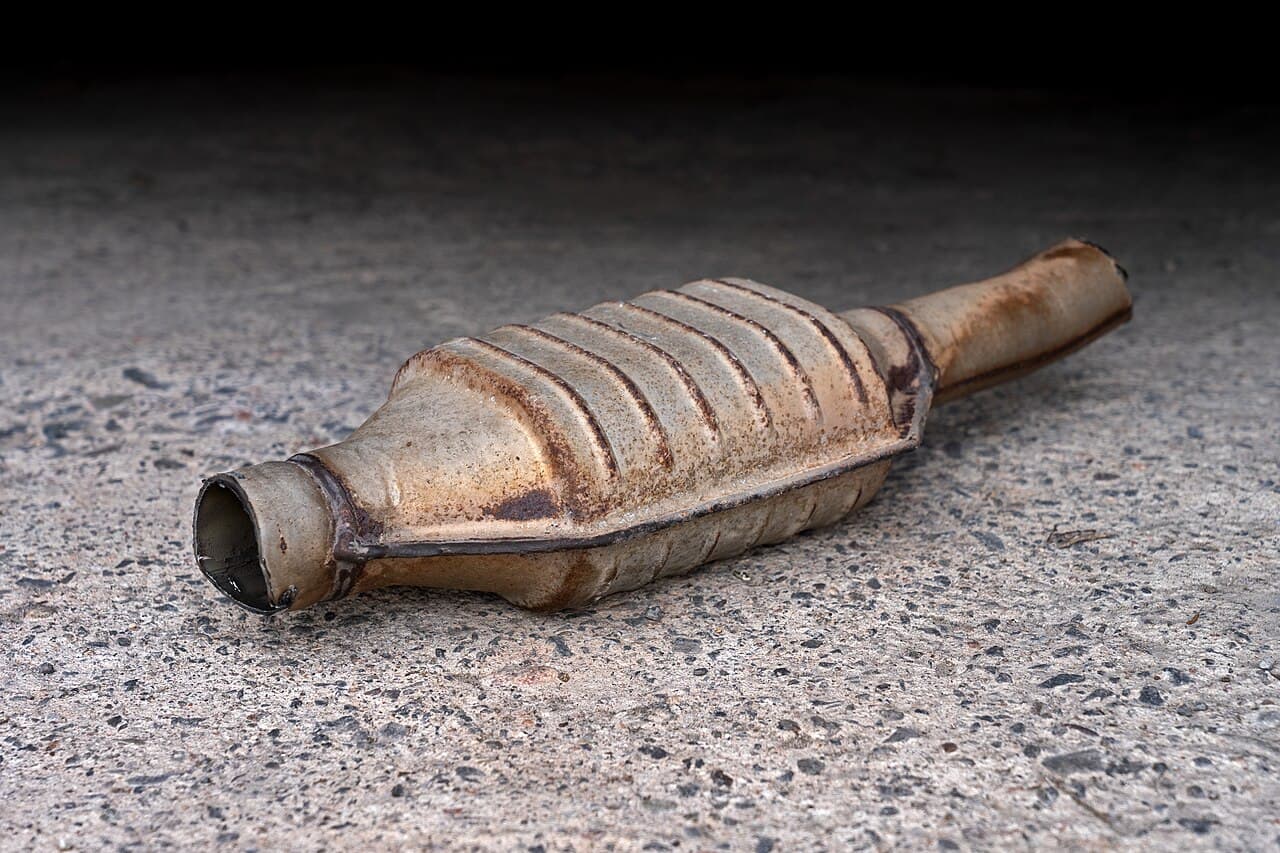
Virginia law defines the exhaust system as all the parts of a vehicle through which the exhaust passes after leaving the engine block, including mufflers and other sound dissipative devices.[1] That covers the manifold side pipes, the catalytic converter, the resonator and muffler, the tailpipe and the hangers that hold it all up. A repair estimate is really a decision about which of those parts to fix or replace.
What drives the cost
Which part failed. A broken hanger or a small section of rusted pipe is a different job from a failed muffler, and a catalytic converter is a different job again. The converter is also the part where the choice of replacement matters most (see below).
Repair or replace. A welded crack is cheaper than a new section when the metal around it is sound. When the pipe is rusted thin, welding fails again nearby, and replacing the section is the better value.
Rust and access. Seized bolts, corroded flanges and long pipe runs add labor. A shop may quote more for a car that has lived on salted roads.
The part you choose. Virginia requires that such an exhaust system must be of a type installed as standard factory equipment, or comparable to that designed for use on the particular vehicle as standard factory equipment.[1] Flexible tubing may be used anywhere in the exhaust system.[2]
The cheap fix that can cost twice
Sealants, wraps and clamp-on patches are the lowest-priced option on a quote, and they are the one to ask about. Virginia's inspection rules say a muffler or catalytic converter that has been repaired in any manner is rejected, except that the exhaust pipe may be welded to the muffler or catalytic converter, and holes or cracks in the exhaust line that have been repaired with a patch or caulking are also rejected.[2] If the car is due for a safety inspection, a patch can mean paying for the same repair twice. See will a loud exhaust fail a Virginia state inspection for what inspectors check.
Catalytic converters
A converter is usually the most expensive part of the system, and the rules for it are strict. Any aftermarket catalytic converter installed after December 31, 1987 must meet EPA specifications and carry a visible, permanent label identifying the manufacturer, vehicle application and month and year of manufacture.[3] On 1973 and later vehicles, an inspector rejects a vehicle whose catalytic converter has been removed or rendered inoperable.[3] A cheaper converter without that label, or a "delete" pipe in its place, is not a saving.
How to get a quote you can compare
Steps you can take before the repair, none of which involve working under the car yourself.
For the quote, ask each shop for the same things: the part named, whether it is factory-comparable, parts and labor on separate lines, and whether the quote covers only the failed part or other worn parts too. Ask what happens if the shop finds more rust once the old pipe is off.
Two or three quotes for the same described problem is enough. If one is far lower, it is usually a patch, a lower-grade part or a smaller scope, and the line items will show which.
Stop and call a pro if
This guide does not have you work on the exhaust. Take the car to a shop if:
- you smell exhaust inside the car. Automobile exhaust from attached garages is a source of carbon monoxide,[4] and at higher concentrations it causes impaired vision and coordination, headaches, dizziness and confusion[4]
- the exhaust is dragging, hanging low or sparking
- the check engine light is on together with a loud or changed exhaust sound
- the car is due for inspection and you know the muffler or converter has been patched
Do not crawl under a car supported only by a jack, and never run the engine in a closed garage.
For more, browse the automotive repair answers. To get prices for your own car, describe the job once.
Common questions
- Why can't you give a price for exhaust repair?
- Because the cost swings with the failed part, the vehicle and the shop. A flat figure would be a guess, so this page explains the cost drivers and how to get a written quote.
- Is a patch or sealant a cheaper fix?
- It may cost less today, but a patched muffler or converter is rejected at a Virginia safety inspection. Holes or cracks in the exhaust line repaired with a patch or caulking are rejected too, so you may pay twice.
- Can the shop weld a cracked pipe?
- Yes. Virginia's inspection rules allow the exhaust pipe to be welded to the muffler or catalytic converter. What they reject is a muffler or converter that has itself been repaired.
- Do I need an original-equipment part?
- Not necessarily. Virginia law asks for an exhaust system of a type installed as standard factory equipment or comparable to it, so an aftermarket part designed for your vehicle may qualify. Ask the shop to confirm.
- Is it safe to keep driving with an exhaust leak?
- Treat it as urgent. Exhaust contains carbon monoxide, and if you smell exhaust inside the car, or feel headache or dizziness while driving, get it inspected right away.
Sources
- [1] Code of Virginia § 46.2-1049, Exhaust system in good working order, Code of Virginia, Virginia General Assembly. Checked October 27, 2026.
- [2] 19VAC30-70-300, Muffler, exhaust system and trailer venting, Virginia Administrative Code, Department of State Police. Checked October 27, 2026.
- [3] 19VAC30-70-310, Air pollution control system or device, Virginia Administrative Code, Department of State Police. Checked October 27, 2026.
- [4] What is carbon monoxide?, U.S. Environmental Protection Agency. Checked October 27, 2026.
Want a pro to handle it?
Describe the job once. Licensed local businesses send quotes, and you pay only when you book one.
Get a quote for Automotive