Will a loud exhaust fail a Virginia state inspection?
Not for noise alone. Virginia's inspection rules say the exhaust inspection does not concern noise level. The car is rejected for exhaust leaks, a patched muffler or converter, a pinched tailpipe, loose hangers or a missing converter. A loud exhaust is usually a leak, though, and Virginia law separately bans excessive or unusual noise on the road.
Free to ask. Local shops send quotes, and you pay only when you book one.
By Kasra Taheri, Founder, LoclisPublished
Researched and drafted with AI, then checked claim by claim against the sources listed below before it was published. Prices and rules change; the dates beside each source say when it was last checked.
Step by step
Read when to stop and call a pro, further down this page, before you start.
Step 1: Let the car sit cold
Park on level ground and let the engine and exhaust cool completely before you look, because exhaust parts stay hot enough to burn for a long time after driving.
Step 2: Look for the failure signs
From the side of the car, look under it with a flashlight for rust holes, black soot streaks around joints, a hanging pipe or a bent tailpipe.
Step 3: Check the tailpipe opening
Look at the tailpipe end. A mashed or pinched opening is grounds for rejection.[1]
Step 4: Check the hangers
Look for rubber hangers and brackets that are cracked, broken or missing. Loose, broken or missing brackets or hangers are grounds for rejection.[1]
Step 5: Confirm the catalytic converter is there
Check that the converter is still in the line. A removed converter is grounds for rejection.[2]
Step 6: Listen at a cold start
Stand clear and listen at the next cold start for hissing, ticking or puffing from underneath. Any leakage of exhaust gases is grounds for rejection.[1]
Step 7: Book a shop for anything you find
Ask the shop to name the failed part and quote the repair in writing before the inspection, not after.
A loud exhaust does not fail a Virginia safety inspection by itself. The state's inspection rules say that inspection of the exhaust system does not concern noise level.[1] But a loud exhaust is very often a leak or a broken part, and those do fail, and driving with excessive or unusual noise is a separate violation on the road.
What the inspector rejects
For the exhaust system, Virginia's safety inspection rules say an inspector rejects the vehicle if:
- there is any leakage of exhaust gases at any point in the system, though built-in drain holes in a muffler or tailpipe are not rejected[1]
- a muffler or catalytic converter that has been repaired in any manner is rejected, except that the exhaust pipe may be welded to the muffler or catalytic converter[1]
- holes or cracks in the exhaust line repaired with a patch or caulking are rejected as well[1]
- a mashed or pinched tailpipe opening, and exhaust components that are not properly secured, including loose, broken or missing brackets or hangers[1]
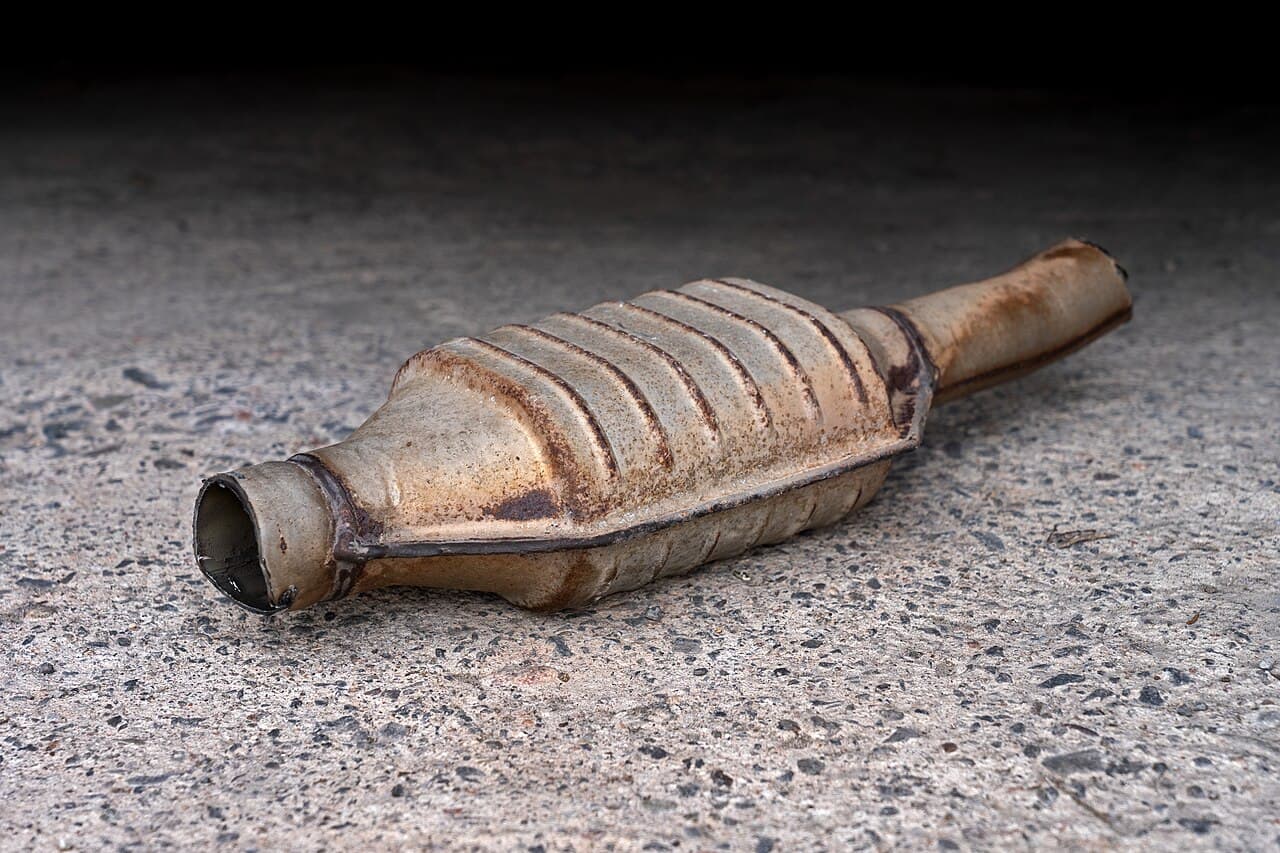
The catalytic converter has its own rule. On 1973 and later vehicles, an inspector rejects a vehicle if its catalytic converter has been removed, rendered inoperable or disconnected.[2] Virginia law adds that no motor vehicle may be issued a safety inspection approval sticker if it violates the pollution control requirements.[4]
Passing inspection is not the same as being legal
The inspection rules go further than most people expect. An inspector who sees a car with no muffler is told to explain that although the vehicle will pass inspection without a muffler, it is a violation of state law for the vehicle to be operated on the highway without it.[1]
The law itself is about the road, not the inspection lane. No person may drive a vehicle on a highway unless it is equipped with an exhaust system in good working order and in constant operation to prevent excessive or unusual levels of noise.[3] Chambered pipes are not an effective muffling device, and any vehicle equipped with chambered pipes is deemed in violation of this section.[3] The section exempts an antique motor vehicle licensed under § 46.2-730 and converted electric vehicles.[3]
In short, a loud car can pass inspection and still be pulled over for noise.
What to check before your inspection
These are look-and-listen checks from the side of the car with the exhaust cold. None of them involves taking anything apart. If you find anything, book a repair.
Common reasons a loud exhaust fails are a rusted-through muffler, a cracked flex pipe, a failed gasket at a flange, and a hanger that has let the pipe sag. A loud exhaust that also smells of exhaust inside the car should be looked at the same day.
Fixing it before the sticker runs out
Ask the shop to name the failed part and to quote repair or replacement in writing. If a quote is a patch or sealant, ask whether it will pass inspection, because the rules above reject it. A welded pipe is allowed; a repaired muffler or converter is not. For what the repair may cost, see how much exhaust repair costs in Virginia.
Stop and call a pro if
Take the car to a shop, and do not drive it more than needed, if:
- the exhaust is dragging or hanging low
- you smell exhaust in the cabin or feel headache or dizziness while driving
- the check engine light is on along with a louder sound
- you find a missing catalytic converter, since replacing it with a part that meets the rules is shop work
Never get under a car held up only by a jack.
For more, browse the automotive repair answers. To get a quote for your own car, describe the job once.
Common questions
- Can I pass inspection with no muffler?
- The inspection rules say the vehicle will pass without a muffler, but they add that it is a violation of state law to operate it on the highway without one. Passing the inspection does not make it legal to drive.
- Will an exhaust leak fail inspection?
- Yes. Any leakage of exhaust gases at any point in the system is grounds for rejection. Built-in drain holes in the muffler or tailpipe are not.
- Will a patched muffler pass?
- No. A muffler or catalytic converter repaired in any manner is rejected, and so are holes or cracks in the exhaust line repaired with a patch or caulking. Welding the pipe to the muffler or converter is allowed.
- Are aftermarket loud mufflers legal in Virginia?
- Virginia requires an exhaust system of a type installed as standard factory equipment or comparable to it, or one approved by the Superintendent or meeting recognized standards. It also deems chambered pipes a violation. A system that is not comparable to the factory one risks a citation even if it passes inspection.
- Does removing the catalytic converter fail inspection?
- Yes. A removed, disconnected or inoperable converter is grounds for rejection on 1973 and later vehicles, and Virginia law says no inspection sticker may be issued to a vehicle that violates the pollution control rules.
Sources
- [1] 19VAC30-70-300, Muffler, exhaust system and trailer venting, Virginia Administrative Code, Department of State Police. Checked October 27, 2026.
- [2] 19VAC30-70-310, Air pollution control system or device, Virginia Administrative Code, Department of State Police. Checked October 27, 2026.
- [3] Code of Virginia § 46.2-1049, Exhaust system in good working order, Code of Virginia, Virginia General Assembly. Checked October 27, 2026.
- [4] Code of Virginia § 46.2-1048, Pollution control systems or devices, Code of Virginia, Virginia General Assembly. Checked October 27, 2026.
Want a pro to handle it?
Describe the job once. Licensed local businesses send quotes, and you pay only when you book one.
Get a quote for Automotive