Why is my car exhaust so loud?
A sudden, louder exhaust almost always means a leak: a rusted-through muffler or pipe, a cracked flex pipe or manifold, a failed gasket at a joint, or a hanger that let the system sag. A deep rumble that arrived overnight points to a hole after the engine. Virginia bans excessive or unusual exhaust noise, and any exhaust leak fails inspection.
Free to ask. Local shops send quotes, and you pay only when you book one.
By Kasra Taheri, Founder, LoclisPublished
Researched and drafted with AI, then checked claim by claim against the sources listed below before it was published. Prices and rules change; the dates beside each source say when it was last checked.
Step by step
Read when to stop and call a pro, further down this page, before you start.
Step 1: Let the car cool completely
Park on level ground and let the engine and exhaust cool for several hours, because exhaust parts stay hot enough to burn long after a drive.
Step 2: Note when the noise happens
Write down whether it is loudest at a cold start, under acceleration or at idle, and whether it ticks, rumbles, hisses or rattles. A ticking that fades as the engine warms often points to a manifold or flange leak; a rumble that grows with speed points to a hole at the muffler or pipe.
Step 3: Look for the exhaust system underneath
From the side of the car, shine a flashlight along the pipes, muffler and tailpipe. Look for rust holes, flaking metal, black soot streaks around a joint, and anything hanging lower than it should.
Step 4: Check the tailpipe opening
Look at the end of the tailpipe. A mashed or pinched opening fails inspection.[1]
Step 5: Check the hangers
Look at the rubber hangers and brackets holding the system up. Brackets or hangers that are loose, broken or missing fail inspection, and they let the pipe sag and bang.[1]
Step 6: Check that the converter is still there
Confirm the catalytic converter, a canister in the line ahead of the muffler, has not been removed. A removed converter on a 1973 or later vehicle is grounds for rejection.[2]
Step 7: Book a shop with your notes
Give the shop your notes on when the noise happens and ask it to name the failed part and quote the repair in writing before work starts.
A suddenly louder exhaust almost always means the exhaust is leaking somewhere before the tailpipe. The usual causes are a rusted-through muffler or pipe, a cracked flex pipe or manifold, a failed gasket where two sections join, or a broken hanger that lets the system sag and bang. The noise is the sound of exhaust escaping where the muffler was supposed to quiet it.
Virginia law cares about the sound. The law says no person shall drive and no owner of a vehicle shall permit or allow the operation of any such vehicle on a highway unless it is equipped with an exhaust system in good working order and in constant operation to prevent excessive or unusual levels of noise.[3]
What the sound tells you
The pattern of the noise narrows down the cause before anyone lifts the car.
- A deep rumble that grows with speed usually means a hole in the muffler or pipe behind the engine. Rust is the usual cause, and the muffler is the first part to go because it collects moisture inside.
- A ticking or puffing at a cold start that fades as the engine warms points to a leak near the engine, such as a cracked manifold or a failed manifold gasket. Cold metal opens the gap; heat closes it.
- A rattle or metallic buzz often means a loose heat shield, a failed hanger, or a broken baffle inside the muffler.
- A clunk over bumps suggests the system is hanging low because a rubber hanger or bracket has failed.
- A raspy, aggressive tone after an aftermarket part was fitted may be the part itself, not a failure. Virginia says the exhaust system must be of a type installed as standard factory equipment, or comparable to it, or approved by the Superintendent or meeting recognized standards.[3] Chambered pipes are not an effective muffling device, and any vehicle equipped with chambered pipes is deemed in violation of this section.[3]
How to find it yourself
Everything here is looking and listening with the car cool and on level ground. Nothing involves unbolting a part or crawling under a car held up by a jack.
Shine a flashlight along the system from the side of the car. Look for flaking rust, holes, wet or sooty streaks around a joint, and any section hanging lower than the rest. Soot trails are a good clue because escaping exhaust leaves black marks where it leaks. Check that the tailpipe opening is round, since a mashed or pinched opening fails inspection.[1] Check the rubber hangers; brackets or hangers that are loose, broken or missing fail it too.[1]
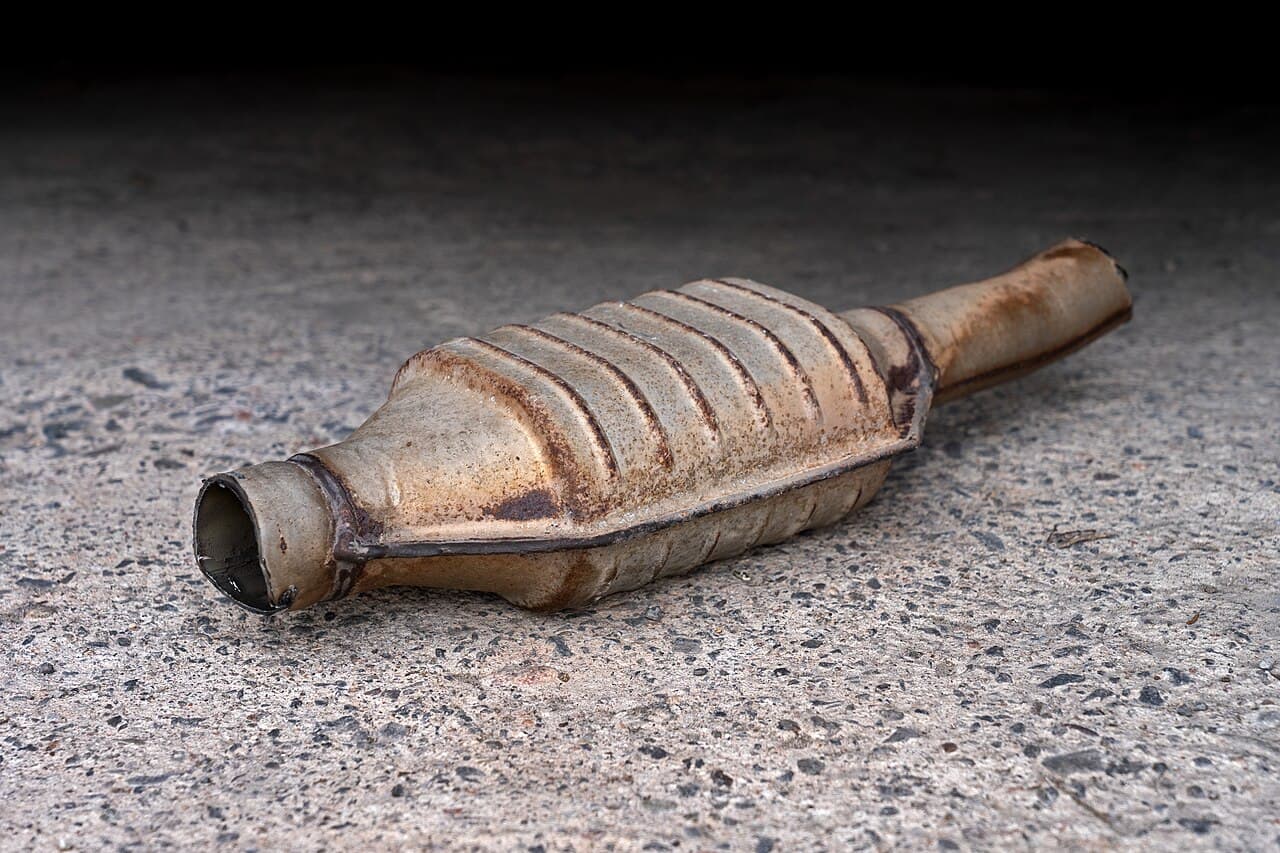
Also confirm the catalytic converter, the canister near the front of the system, is still in place. On 1973 and later vehicles, an inspector rejects a vehicle if its catalytic converter has been removed or otherwise rendered inoperable.[2] A car that suddenly got loud after a theft or a hit from road debris may be missing its converter.
Why repairs are not always a patch
A patch or sealant can quiet a small hole, but it is a poor plan in Virginia. In Virginia's inspection rules, a muffler or catalytic converter that has been repaired in any manner is rejected, except that the exhaust pipe may be welded to the muffler or catalytic converter.[1] Likewise, holes or cracks in the exhaust line repaired with a patch or caulking are rejected as well.[1] Inspectors also reject the car if there is any leakage of exhaust gases at any point in the system, though built-in drain holes in a muffler or tailpipe are not rejected,[1] so even a small leak counts.
The practical fix is to replace the failed section: a muffler, a flex pipe, a gasket, a hanger, or a pipe segment welded in. Ask the shop to name the failed part and to quote it in writing. For what that tends to cost, see how much exhaust repair costs in Virginia.
Loud is not the same as failing inspection
Virginia's rules say inspection of the exhaust system does not concern noise level.[1] That surprises people. A car can be loud and pass, and a quiet car can fail because of a small leak or a loose hanger. The inspection note on mufflers adds that although the vehicle will pass inspection without a muffler, it is a violation of state law for the vehicle to be operated on the highway without it.[1] The full breakdown is in will a loud exhaust fail a Virginia state inspection.
Stop and call a pro if
Take the car to a shop and avoid driving it more than needed if:
- You smell exhaust inside the car. The EPA says auto, truck or bus exhaust can be a source of carbon monoxide, including from attached garages, nearby roads or parking areas.[4] At higher concentrations, carbon monoxide causes impaired vision and coordination, headaches, dizziness, confusion and nausea, and can be fatal.[4] Open the windows and get it looked at the same day.
- The pipe or muffler is dragging or hanging low. It can catch the road and tear loose.
- The check engine light is on along with the new noise. A leak before the oxygen sensors can confuse the engine's fuel readings, and a missing converter needs shop work.
- You find a missing catalytic converter. Replacing it with a compliant part is shop work.
- The cracks are at the manifold, next to the engine, where parts are hard to reach and bolts often snap.
Never get under a car held up only by a jack.
Getting help in Virginia
For more, browse the automotive repair answers. When you are ready, describe the exhaust problem once and local shops quote it.
Common questions
- Is it safe to drive with a loud exhaust?
- Short trips to a shop are usually fine if the pipe is not dragging, but a leak before the muffler can let exhaust gas reach the cabin. If you smell exhaust inside the car or feel headache or dizziness, stop driving and have it looked at the same day.
- Why did my exhaust get loud overnight?
- Usually a part let go: a rusted muffler seam opened, a flex pipe cracked, a gasket failed or a hanger broke and the pipe dropped. Rust works slowly, but the final break can be sudden.
- Can I patch a hole in my muffler?
- A patch quiets it for a while, but Virginia's inspection rules reject a muffler or converter repaired in any manner, and holes or cracks in the line repaired with a patch or caulking. Welding the pipe to the muffler or converter is allowed.
- Is a loud exhaust illegal in Virginia?
- Virginia law bars driving without an exhaust system in good working order that prevents excessive or unusual noise, and it deems chambered pipes a violation. The safety inspection itself does not measure noise, so a loud car can pass inspection and still be cited on the road.
- Why does my exhaust sound loudest when I start the car cold?
- Metal contracts when cold, so a small crack or loose flange can open up and leak, then quiet down as the parts warm and expand. A cold-start tick or puff that fades is worth a shop look because it can be a manifold or gasket leak.
Sources
- [1] 19VAC30-70-300, Muffler, exhaust system and trailer venting, Virginia Administrative Code, Department of State Police. Checked October 27, 2026.
- [2] 19VAC30-70-310, Air pollution control system or device, Virginia Administrative Code, Department of State Police. Checked October 27, 2026.
- [3] Code of Virginia § 46.2-1049, Exhaust system in good working order, Code of Virginia, Virginia General Assembly. Checked October 27, 2026.
- [4] What is carbon monoxide?, U.S. Environmental Protection Agency. Checked October 27, 2026.
Want a pro to handle it?
Describe the job once. Licensed local businesses send quotes, and you pay only when you book one.
Get a quote for Automotive