How much does hedge trimming cost in Virginia?
There is no published statewide rate for hedge trimming. The price depends on how many feet of hedge you have, how tall it is, how overgrown it has become, how often it is trimmed, and whether hauling away the clippings is included. Measure the hedges, then ask two or three businesses for written quotes that list the visits, the cleanup and the disposal.
Free to ask. Local shops send quotes, and you pay only when you book one.
By Kasra Taheri, Founder, LoclisPublished
Researched and drafted with AI, then checked claim by claim against the sources listed below before it was published. Prices and rules change; the dates beside each source say when it was last checked.
Step by step
Read when to stop and call a pro, further down this page, before you start.
Step 1: Measure the hedges
Pace off the length of each hedge and estimate its height and width, so every quote prices the same amount of work.
Step 2: Name the plants
Note whether each hedge is boxwood, holly, arborvitae, privet or something else, since growth rate and pruning method vary by plant.[2]
Step 3: Take photos from two sides
Photos let a business quote more accurately and show how overgrown the hedge is today.
Step 4: Look for overhead wires
Point out any power line near the hedges; work within 10 feet of a high voltage line needs precautions under Virginia law.[7]
Step 5: Decide on one visit or a season
Ask for a price per visit and a price for a season, since most hedges need trimming at least twice a year.[1]
Step 6: Ask what happens to the clippings
Find out whether hauling and disposal are included or whether the clippings are left bundled at the curb.
Step 7: Ask about boxwood sanitation
If you have boxwood, ask how the crew cleans tools and equipment between yards to avoid spreading boxwood blight.[4]
Step 8: Check credentials for add-ons
Anyone spraying pesticides for pay needs Virginia commercial applicator certification.[8]
Step 9: Get it in writing and compare
Compare quotes line by line, plants, visits, cleanup and disposal, rather than on the total alone.
There is no published price list for hedge trimming in Virginia, and an honest quote depends on the job in front of the crew: how many feet of hedge, how tall, how overgrown, how often, and what happens to the clippings. You will get the most useful numbers by measuring your hedges and asking for written quotes that spell out each of those things.
What drives the price
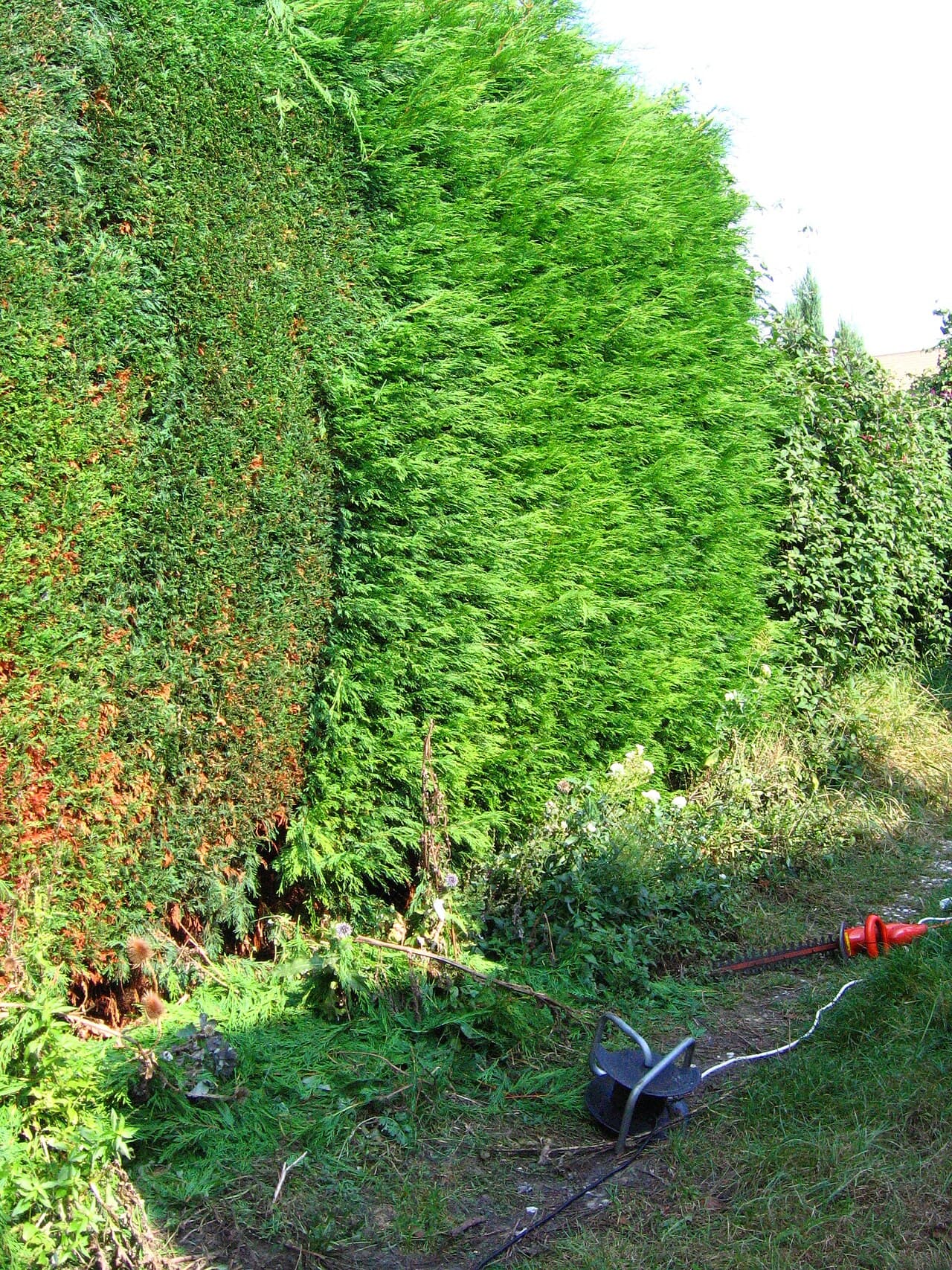
Size. Length and height are the core of every quote. A waist-high boxwood border along a walk is a short job from the ground. A 10-foot privacy screen needs staging and takes much longer per foot, and the top is the slow part.
How often it is trimmed. Most hedges need trimming at least twice a year, and some need three or four trimmings[1] to stay tight. A season of visits costs more in total than one visit, but each visit is lighter work. Many businesses price a season or a maintenance plan differently from a single trim.
The plant. Growth rate decides how much comes off each time. Virginia Tech notes that most boxwoods grow about 3 to 6 inches a year,[2] while the upright cultivar 'Highlander' grows as much as 20 to 24 inches a year once established.[2] Hollies can outgrow a spot quickly too: a 5-foot 'Nellie R. Stevens' holly left unpruned will be about 15 feet tall and 8 feet wide in ten years.[3] Faster growers mean more visits and more debris.
How overgrown it is. A first visit to a long-neglected hedge is a different job from a routine trim. It often needs loppers and saws rather than shears, it fills a truck, and it may take more than one season to bring back. A neglected plant is difficult or nearly impossible to prune,[1] and when a plant has become too large for normal pruning, replacement should be considered.[1] If a crew suggests replacing a hedge rather than cutting it hard, that can be the cheaper answer over a few years. Our guide to trimming overgrown hedges and shrubs explains why some plants recover and others do not.
Access. Hedges on slopes, against walls, over retaining walls, or behind fences with narrow gates all slow a crew down.
Cleanup and disposal
Ask every business whether hauling away the clippings is included. Disposal has a real cost. For example, Fairfax County's residential rates for July 2026 to June 2027 listed $20 for a mini pickup load of brush and $28 for a full-size pickup without a rack[5] at its I-66 and I-95 sites, and brush heaped above the cab or past the closed tailgate is weighed instead, at $59 a ton with a $39 minimum.[5] Those are Fairfax's resident rates; your county or town sets its own.
If you plan to put the clippings out yourself, check your locality's rules first. Fairfax County counts branches and twigs under 4 feet long as yard waste and prohibits plastic bags for it,[6] so a quote that leaves clippings at the curb should leave them the way your collection service accepts.
Boxwood with blight is the exception to normal disposal. Virginia Tech's guidance is that diseased boxwood should be double-bagged and taken to the landfill, or buried 2 feet deep where allowed, and never composted or put out for curbside brush pickup,[4] which takes more handling and may cost more.
Questions that change the quote
Boxwood sanitation. Boxwood blight can move from yard to yard on pruning tools, tarps, lawnmowers and clothing,[4] and Virginia Tech suggests you talk to any landscape company about how it avoids carrying the disease from one client's yard to the next.[4] Cleaning tools between properties takes time, and a crew that does it may price slightly higher. See why boxwoods turn brown for the signs.
Power lines. Under Virginia's Overhead High Voltage Line Safety Act, no one working in a trade or business may cause a person, tool or ladder to come within 10 feet of an overhead high voltage line[7] unless the danger has been guarded against. A hedge grown up into a service line may need the utility involved, which affects scheduling and price.
Spraying. If a quote includes treating for insects or disease, Virginia requires that anyone who uses any pesticide on someone else's property for pay must be a certified commercial applicator working for a company with a Pesticide Business License.[8] Ask for the certification.
Bigger landscape work. If the quote grows into removing shrubs with their roots, regrading or building walls, that is a different job. The Board for Contractors' landscape service specialty covers excavation, clearing, grading, retaining walls for landscaping and landscaping timbers,[9] so check that part of the work against DPOR's License Lookup.[10]
What a good written quote includes
- Which hedges and shrubs, with approximate length and height
- What will be done to each: shearing, thinning, renewal cuts or height reduction
- The number of visits and when they will happen
- Cleanup, hauling and disposal, or where clippings will be left
- How tools are cleaned between properties if you have boxwood
- Who handles any work near power lines
Stop and call a pro if
- The hedge is tall enough that the top can only be reached from a ladder with a powered trimmer.
- Any power line runs through or near the hedge.
- The stems have become trunks that need a saw, or the plants need to come out.
- Boxwood is browning with leaf spots, black stem streaks or heavy leaf drop.
To weigh doing it yourself against hiring out, see whether it is worth hiring someone to trim your shrubs. Browse more lawn and landscaping answers, see hedge and shrub trimming services, or look up lawn and landscaping businesses around Blacksburg. For quotes you can compare line by line, describe the job once and local businesses quote it.
Common questions
- Is hedge trimming priced per hour or per job?
- Both are common. Some businesses quote a flat price per visit for a measured amount of hedge, others an hourly crew rate, and some bundle trimming into a seasonal maintenance contract. Ask how the price is figured and what happens if the job runs long, so you can compare quotes fairly.
- Why does the first trim cost more than later ones?
- A hedge that has been left for years needs heavier cutting, more saw work and far more debris than one trimmed on schedule. Once it is back in shape, regular light trims take less time and produce fewer clippings, so ongoing visits usually cost less than the first one.
- Does hauling away the clippings add much to the price?
- It can. Hauling takes truck space and labor, and disposal sites charge fees. In Fairfax County, for example, the residential rates for July 2026 to June 2027 listed $20 for a mini pickup load of brush and $28 for a full-size pickup without a rack. Ask whether disposal is in the quote.
- Can I save money by trimming low hedges myself?
- Often, yes. Low hedges you can reach from the ground with hand shears or a trimmer are a manageable job for many homeowners. Tall hedges, wires overhead, or plants so overgrown they need saw work are where a hired crew earns its price.
- Does a hedge trimming business need a contractor licence in Virginia?
- The Board for Contractors' landscape specialty is defined around excavation, clearing, grading, retaining walls and landscaping timbers, which is a different kind of job from trimming. If a quote adds that kind of work, look the business up on DPOR's License Lookup. Anyone spraying pesticides for pay needs VDACS certification.
Sources
- [1] Pruning Ornamental Shrubs (G6870), University of Missouri Extension. Checked October 27, 2026.
- [2] Selecting Landscape Plants: Boxwoods (426-603), Virginia Cooperative Extension, Virginia Tech. Checked October 27, 2026.
- [3] Evergreen Hollies (Ilex spp.) (3010-1482), Virginia Cooperative Extension, Virginia Tech. Checked October 27, 2026.
- [4] Best Management Practices for Boxwood Blight in the Virginia Home Landscape (PPWS-29NP), Virginia Cooperative Extension, Virginia Tech. Checked October 27, 2026.
- [5] Residential Disposal Fees and Regulations, Fairfax County Department of Public Works and Environmental Services. Checked October 27, 2026.
- [6] Yard Waste, Fairfax County Department of Public Works and Environmental Services. Checked October 27, 2026.
- [7] Va. Code § 59.1-408, Prohibited activities (Overhead High Voltage Line Safety Act), Code of Virginia, Virginia General Assembly. Checked October 27, 2026.
- [8] Pesticide Applicator Certification, Virginia Department of Agriculture and Consumer Services. Checked October 27, 2026.
- [9] 18VAC50-22-30, Definitions of specialty services, Virginia Administrative Code, Board for Contractors. Checked October 27, 2026.
- [10] License Lookup, Virginia Department of Professional and Occupational Regulation. Checked October 27, 2026.
Want a pro to handle it?
Describe the job once. Licensed local businesses send quotes, and you pay only when you book one.
Get a quote from a local pro