Is it worth hiring someone to trim my shrubs?
It is worth hiring out when the hedges are tall, overgrown, near power lines, or need trimming more often than you have time for, or when boxwood is showing signs of disease. A few low shrubs you can reach from the ground are a reasonable do-it-yourself job with hand pruners, loppers and a little knowledge of when each plant should be cut.
Free to ask. Local shops send quotes, and you pay only when you book one.
By Kasra Taheri, Founder, LoclisPublished
Researched and drafted with AI, then checked claim by claim against the sources listed below before it was published. Prices and rules change; the dates beside each source say when it was last checked.
Step by step
Read when to stop and call a pro, further down this page, before you start.
Step 1: List what you have
Walk the yard and note each shrub or hedge, roughly how long and tall it is, and what kind of plant it is.
Step 2: Check the height
Mark anything whose top you cannot reach from the ground or a sturdy step; that is the part most worth hiring out.
Step 3: Check for wires
Mark any shrub with an overhead line through or near it; crews must stay 10 feet from high voltage lines by law.[5]
Step 4: Count the visits
Most hedges need trimming at least twice a year, so price your time and a crew's for every trim, not one.[4]
Step 5: Price the tools
Doing it well takes hand pruners, loppers, a pruning saw and hedge shears or a trimmer, plus a way to haul clippings.[4]
Step 6: Learn each plant's timing
Note which shrubs bloom on old wood and must be pruned just after flowering, and which can wait.[1]
Step 7: Look closely at boxwood
Check for brown leaf spots and black streaks on stems before anyone prunes; suspected blight needs a diagnosis first.[3]
Step 8: Split the job if it helps
Many homeowners keep the low shrubs and hire out the tall hedges, the first heavy renewal, or the boxwood.
Step 9: Ask hired crews the right questions
Ask about cleanup and disposal, tool sanitation between yards, insurance, and pesticide certification if they spray.[7]
Hiring out shrub trimming is worth it when the work is tall, heavy, risky or frequent: hedges you cannot reach from the ground, plants grown into power lines, shrubs so overgrown they need saw work, or more hedge than you have weekends for. A handful of low shrubs is a reasonable do-it-yourself job if you learn when each plant should be cut. Many homeowners split the difference, keeping the easy shrubs and hiring out the rest.
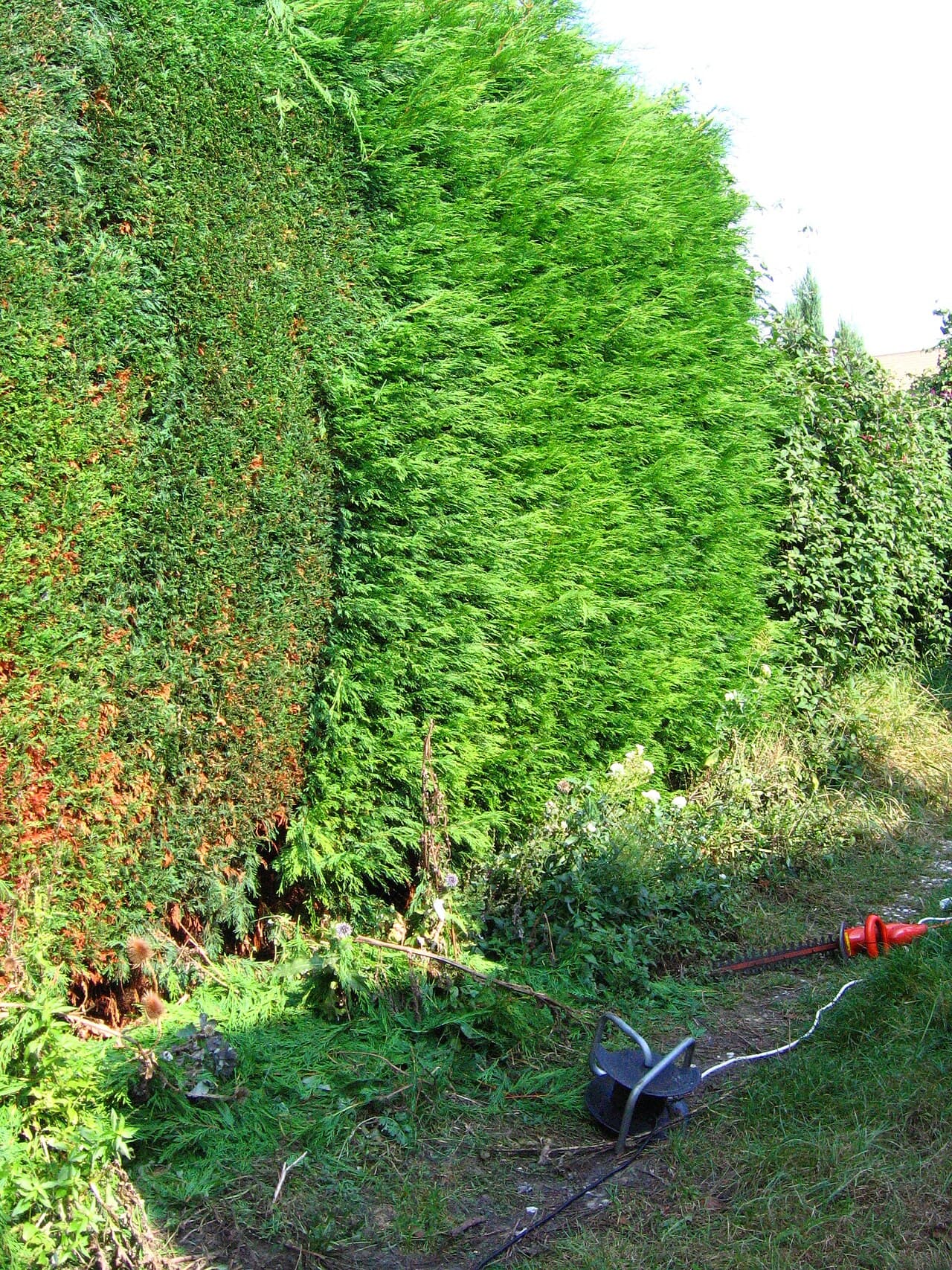
The case for doing it yourself
Low hedges and foundation shrubs you can reach from the ground are well within most homeowners' reach. You need hand pruners for branches up to 3/4 inch, loppers for 3/4 to 1-1/2 inches, a pruning saw for anything larger, and hedge shears for hedges,[4] or a powered trimmer if you have a lot of hedge. Doing it yourself also means you control the timing, which matters more than most people expect.
That timing is the main thing to learn. Virginia Tech's guidance is that shrubs that flower on old wood are pruned just after they flower, or next year's flower buds are cut off,[1] while shrubs without showy flowers, such as yews and boxwood, can be pruned most any time except late summer.[1] Our guide to when to prune shrubs in Virginia goes plant by plant, and how to trim overgrown hedges and shrubs covers the technique.
The case for hiring out
Frequency. Most hedges need trimming at least twice a year, and some need three or four trimmings[4] to stay crisp. One trim is a pleasant Saturday; four a year on a long privacy hedge, plus raking and hauling, is a standing commitment.
Height and staging. The top of a tall hedge is where most of the effort and risk sits. Holding a powered trimmer overhead on a ladder is the part of shrub care most worth paying someone else to do.
Power lines. Under Virginia's Overhead High Voltage Line Safety Act, no one working in a trade or business may cause a person, tool, ladder or equipment to come within 10 feet of an overhead high voltage line[5] unless the danger has been guarded against. The act covers above-ground lines carrying more than 600 volts.[6] A professional crew has to plan around that, and you should not be working there either. Shrubs grown into lines may need the power company involved.
Overgrown plants. A neglected hedge often needs a multi-year renewal plan, saw work and a truck for debris. Some plants are also unforgiving. Arborvitae and junipers form a dead zone in the center, and cuts into it seldom regrow.[4]
Boxwood that looks sick. Watch for brown leaf spots, leaf drop and black streaks on the stems.[3] Those can be signs of boxwood blight, which spreads easily, and the plant should be diagnosed before anyone prunes it. See why boxwoods turn brown.
Hiring well
A crew that shears everything into the same shape at the wrong time can do more harm than an unhurried homeowner. Topping, cutting stems back at an arbitrary height rather than to a bud, side branch or main stem, is regarded as an unacceptable practice by trained horticulturists and arborists,[2] and Virginia Tech warns that topping crapemyrtles can lead to stem decay and eventual plant death.[2] Before work starts, walk the yard together and agree what happens to each plant.
Ask about boxwood sanitation. Boxwood blight spores can be spread on pruning tools, clothing, equipment and anything that has touched infected plants.[3] Virginia Tech's advice is to discuss your concern about boxwood blight with any lawn or landscape company you hire, learn what it does to avoid moving the disease from one client's landscape to another, and then decide whether that approach is acceptable to you.[3]
Ask about spraying. If the crew offers to treat insects or disease, Virginia requires that anyone who uses any pesticide on another person's property for pay must be a certified commercial applicator and work for a company with a Pesticide Business License.[7] Ask to see the certification.
Ask about bigger work. Trimming is different from reshaping the yard. The Board for Contractors' landscape service specialty covers excavation, clearing, grading, retaining walls for landscaping and landscaping timbers;[8] if a quote grows into that, look the business up on DPOR's License Lookup.[9]
Get the basics in writing. Which plants, what will be done to each, how many visits, whether cleanup and hauling are included, and proof of liability insurance. Our guide to hedge trimming costs in Virginia lists what a good quote includes.
Stop and call a pro if
- You cannot reach the top of the hedge without holding a powered trimmer on a ladder.
- An overhead line runs through or near the shrubs.
- The job needs a chainsaw, or the shrubs need to come out roots and all.
- Boxwood shows leaf spots, black stem streaks or sudden leaf drop.
Browse more lawn and landscaping answers, see hedge and shrub trimming services, or look up lawn and landscaping businesses around Blacksburg. When you are ready, describe the job once and local businesses quote it.
Common questions
- What shrub jobs are easiest to do myself?
- Low hedges and foundation shrubs you can reach from the ground, light trims on a regular schedule, and removing dead or broken branches. These need only hand tools, little cleanup, and some attention to when each plant flowers.
- When does hiring a crew clearly make sense?
- When the top of a hedge is out of reach without a ladder, when a power line runs through or near the plants, when shrubs are so overgrown they need saw work or a multi-year renewal plan, and when boxwood may have blight and needs careful handling and disposal.
- Can a hired crew damage my shrubs?
- Yes, if it shears everything to the same shape at the wrong time. Watch for topping, cutting arborvitae or junipers back into the bare center, and heavy pruning in late summer. Ask how the crew will handle each plant before the work starts.
- Do shrub trimmers need a licence in Virginia?
- The Board for Contractors' landscape specialty is defined around excavation, clearing, grading, retaining walls and landscaping timbers, and DPOR's License Lookup will show whether a business holds it. Anyone spraying pesticides on your property for pay must be a certified commercial applicator working for a licensed pesticide business.
- Should I ask a crew about boxwood blight?
- Yes, if you have boxwood. The disease travels on tools, tarps and clothing, so Virginia Tech suggests asking any landscape company what it does to avoid carrying it from one yard to the next, then deciding whether that is good enough for you.
Sources
- [1] Shrubs: Functions, Planting, and Maintenance (426-701), Virginia Cooperative Extension, Virginia Tech. Checked October 27, 2026.
- [2] Pruning Crapemyrtles (430-451), Virginia Cooperative Extension, Virginia Tech. Checked October 27, 2026.
- [3] Best Management Practices for Boxwood Blight in the Virginia Home Landscape (PPWS-29NP), Virginia Cooperative Extension, Virginia Tech. Checked October 27, 2026.
- [4] Pruning Ornamental Shrubs (G6870), University of Missouri Extension. Checked October 27, 2026.
- [5] Va. Code § 59.1-408, Prohibited activities (Overhead High Voltage Line Safety Act), Code of Virginia, Virginia General Assembly. Checked October 27, 2026.
- [6] Va. Code § 59.1-407, Definitions (Overhead High Voltage Line Safety Act), Code of Virginia, Virginia General Assembly. Checked October 27, 2026.
- [7] Pesticide Applicator Certification, Virginia Department of Agriculture and Consumer Services. Checked October 27, 2026.
- [8] 18VAC50-22-30, Definitions of specialty services, Virginia Administrative Code, Board for Contractors. Checked October 27, 2026.
- [9] License Lookup, Virginia Department of Professional and Occupational Regulation. Checked October 27, 2026.
Want a pro to handle it?
Describe the job once. Licensed local businesses send quotes, and you pay only when you book one.
Get a quote from a local pro