How do I trim overgrown hedges and shrubs?
Bring an overgrown shrub back in stages rather than in one hard cut. Clear dead and crossing wood first, then take out about a third of the oldest stems at the base each year, and shape hedges so the bottom stays wider than the top. Time the cuts to the plant's bloom habit, and leave anything near power lines or above ladder height to a pro.
Free to ask. Local shops send quotes, and you pay only when you book one.
By Kasra Taheri, Founder, LoclisPublished
Researched and drafted with AI, then checked claim by claim against the sources listed below before it was published. Prices and rules change; the dates beside each source say when it was last checked.
Step by step
Read when to stop and call a pro, further down this page, before you start.
Step 1: Identify the shrub and when it blooms
Shrubs that flower on old wood are pruned just after they flower; a yew or boxwood without showy flowers can be pruned most of the year except late summer.[1]
Step 2: Look up before you start
If any overhead wire runs through or close to the shrub, stop here and call the power company or a pro instead.[6]
Step 3: Match the tool to the branch
Use hand pruners up to 3/4 inch, loppers from 3/4 to 1-1/2 inches, and a pruning saw above that.[4]
Step 4: Take out the obvious problems
Cut out dead, broken, crossing and rubbing branches, and suckers from the base, before you decide how much more to remove.[4]
Step 5: Remove the oldest stems at the base
On a multi-stemmed shrub, cut up to one-third of the oldest, thickest stems right down to the ground this year.[5]
Step 6: Shorten long shoots to a bud or branch
Cut wayward shoots back to a healthy bud or side branch inside the outline, not at an arbitrary height.
Step 7: Shape hedges wider at the bottom
Taper the sides so the base of the hedge stays wider than the top and the lower branches keep their light.[4]
Step 8: Stay out of the bare center
On arborvitae and junipers, keep every cut in green foliage and never cut into the dead zone inside the plant.[4]
Step 9: Spread a big reduction over three years
Repeat the one-third cut each year until the old trunks are gone, then go back to light maintenance pruning.[5]
Step 10: Clean tools between plantings
Clean and sanitize pruners and shears between boxwood plantings, and do not work in boxwood while the leaves are wet.[3]
Step 11: Clear and dispose of the clippings
Rake the clippings out from under the shrubs and bundle or bag them the way your locality or hauler asks.
Bring an overgrown shrub back in stages rather than in one hard cut. Clear out the dead and crossing wood first, then remove about a third of the oldest stems at the base each year, and keep hedges wider at the bottom than at the top. A plant that has been neglected is difficult to prune, and one that has outgrown its space may be better replaced[4] with a variety that stays the size you need.
Start with timing
Cutting at the wrong time costs you a year of flowers or invites winter damage. Virginia Tech's rule of thumb is to prune shrubs that flower on old wood just after they bloom,[1] because their buds for next spring form the summer before. Shrubs that flower on new wood, such as butterfly bush and crape myrtle, can be pruned any time after they flower until just before they leaf out in spring.[1] Shrubs without showy flowers, such as yews, barberries and boxwood, can be pruned most any time except late summer,[1] because late-summer pruning tends to push a flush of new shoots that may not harden off before winter.[1] Our guide to when to prune shrubs in Virginia has the season-by-season version.
Tools that fit the cut
Hand pruners handle branches up to 3/4 inch thick, loppers 3/4 to 1-1/2 inches, and a pruning saw anything larger.[4] Keep blades sharp so they cut cleanly rather than crush. Remember that hedge shears are meant for hedges and formally shaped plants, not general pruning;[4][5] shearing an informal shrub all over makes it denser on the outside and bare inside.
Renewal pruning: the safe way back
Most overgrown deciduous shrubs, and many broadleaf evergreens, recover best with renewal pruning. Each year, cut up to one-third of the oldest, thickest stems[5] down to the ground. New shoots grow from the base, and in about three years the shrub has been rebuilt from young wood without ever looking butchered. Once the thick, overgrown trunks are gone, you switch back to ordinary maintenance pruning.[5]
Before the renewal cuts, walk around the plant and take out the obvious problems: dead or broken branches, branches that cross or rub, suckers from the base and shoots growing back into the center. Often that alone opens the plant up more than you expect.
For a faster reset, some multi-stemmed shrubs tolerate rejuvenation: cutting all the canes back as close to the ground as possible in early spring.[5] It works on overgrown spirea, forsythia, cane-growth viburnums and honeysuckle[5] that are otherwise healthy. It is not a method for evergreens in general.
Evergreens need a lighter hand
Evergreens differ a great deal in what they forgive. Yews can often survive a 50 percent size reduction,[4] but junipers seldom grow back from bare stubs, so green foliage has to stay on every branch you cut back.[4] Arborvitae and junipers develop a dead zone in the center[4] where there are no leaves, and cuts into it leave holes that will not fill. As a limit, overgrown arborvitae should not be cut back more than 20 percent.[4] If an arborvitae screen is far too big, replacing it is often the honest answer.
Azaleas and rhododendrons need patience too: never cut into areas of bare stems or sparse foliage,[4] and when a heavier pruning is needed, no more than one-third of the branches should be cut back in a single season.[4]
Boxwood is better thinned than sheared. Dense boxwood, such as English boxwood, benefits from removing 3- to 6-inch pieces of branch tips throughout the canopy,[2] which lets light and air into the middle and makes disease less likely.
Shaping a hedge
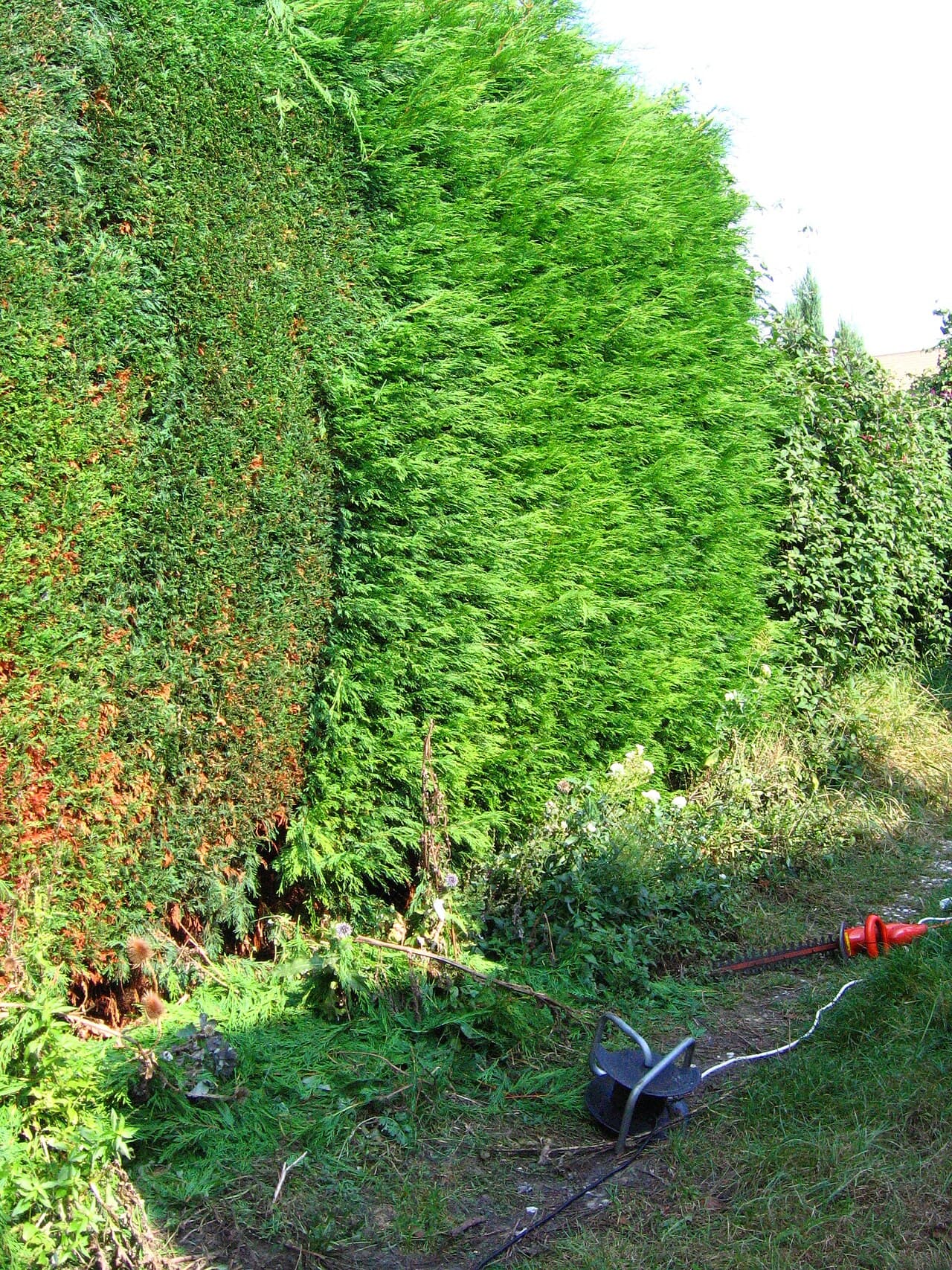
Whatever the plant, always trim so the base is wider than the top.[4][5] A hedge with a wide top shades its own lower branches, and the bottom goes thin and leggy. Once a hedge is at the height you want, prune new growth back whenever it grows another 6 to 8 inches, to within 2 inches of the last cut.[5] That keeps it creeping outward slowly instead of jumping a foot a year. Stretching a string between two stakes gives you a straight top line to follow.
Keep boxwood blight out
Boxwood blight spores can travel on pruning tools, clothing and equipment,[3] so Virginia Tech's advice is to sanitize tools between boxwood plantings and avoid working in boxwood when the foliage is wet.[3] If your boxwood are already browning, read why boxwoods turn brown before you prune them.
Stop and call a pro if
- There is an overhead wire anywhere near the shrub. Virginia's Overhead High Voltage Line Safety Act bars anyone working in a trade or business from causing a person, tool or ladder to come within 10 feet of an overhead high voltage line,[6][7] which the law defines as a line over 600 volts.[7] That rule is written for crews, but the hazard to a homeowner with a trimmer is the same. Call the power company or a pro.
- You would have to hold a powered trimmer over your head on a ladder to reach the top. A tall hedge is a job for someone with the right staging.
- The stems are trunks. If the work needs a chainsaw, or the "shrub" has become a tree, it is tree work, not hedge trimming.
- The boxwood shows leaf spots, black stem streaks or sudden leaf drop. Get it diagnosed before anyone prunes and spreads it.
If the job is bigger than a weekend, see whether it is worth hiring someone to trim your shrubs and what hedge trimming costs in Virginia. Browse more lawn and landscaping answers, see hedge and shrub trimming services, or look up lawn and landscaping businesses around Blacksburg. To get quotes, describe the job once and local businesses quote it.
Common questions
- Can I cut an overgrown shrub all the way back in one go?
- Only some shrubs take it. Multi-stemmed deciduous shrubs such as spirea and forsythia can be cut close to the ground in early spring and regrow. Junipers and arborvitae usually cannot regrow from bare wood, so cutting into the bare center can leave permanent holes. When unsure, remove about a third of the old stems a year instead.
- Why is the bottom of my hedge bare?
- Usually because the top has become wider than the base and shades it. Trimming so the base stays wider than the top lets light reach the lower branches. On deciduous hedges, renewal cuts at the base encourage new low growth; on arborvitae, bare lower sections may not fill back in.
- Should I use hedge shears or hand pruners?
- Hedge shears or a powered hedge trimmer are for formal hedges and shaped plants. For informal shrubs, thinning and renewal cuts with hand pruners, loppers and a pruning saw keep the natural shape and let light into the center.
- How often does a formal hedge need trimming?
- Often several times a season. A common rule is to trim new growth each time it grows another 6 to 8 inches, taking it back to within about 2 inches of the last cut, so the hedge creeps outward slowly instead of jumping in size.
- Do I need to clean my tools between shrubs?
- It matters most with boxwood. Boxwood blight spreads on pruning tools, clothing and equipment, so clean and sanitize tools between boxwood plantings, avoid working in boxwood when the leaves are wet, and ask any crew you hire how it prevents spread from yard to yard.
Sources
- [1] Shrubs: Functions, Planting, and Maintenance (426-701), Virginia Cooperative Extension, Virginia Tech. Checked October 27, 2026.
- [2] Selecting Landscape Plants: Boxwoods (426-603), Virginia Cooperative Extension, Virginia Tech. Checked October 27, 2026.
- [3] Best Management Practices for Boxwood Blight in the Virginia Home Landscape (PPWS-29NP), Virginia Cooperative Extension, Virginia Tech. Checked October 27, 2026.
- [4] Pruning Ornamental Shrubs (G6870), University of Missouri Extension. Checked October 27, 2026.
- [5] Pruning trees and shrubs, University of Minnesota Extension. Checked October 27, 2026.
- [6] Va. Code § 59.1-408, Prohibited activities (Overhead High Voltage Line Safety Act), Code of Virginia, Virginia General Assembly. Checked October 27, 2026.
- [7] Va. Code § 59.1-407, Definitions (Overhead High Voltage Line Safety Act), Code of Virginia, Virginia General Assembly. Checked October 27, 2026.
Want a pro to handle it?
Describe the job once. Licensed local businesses send quotes, and you pay only when you book one.
Get a quote from a local pro