How much does it cost to fix a water leak in Virginia?
No Virginia agency publishes a standard price, so the real number comes from a written quote. A loose fitting or worn toilet flapper costs little; a leak inside a wall, under a slab or in the yard line costs far more, because of finding it, opening finishes and drying. Leaving it costs money too: a faucet dripping once a second wastes more than 3,000 gallons a year.
Free to ask. Local shops send quotes, and you pay only when you book one.
By Kasra Taheri, Founder, LoclisPublished
Researched and drafted with AI, then checked claim by claim against the sources listed below before it was published. Prices and rules change; the dates beside each source say when it was last checked.
Step by step
Read when to stop and call a pro, further down this page, before you start.
Step 1: Stop the water
Close the fixture's own valve, or the house's master valve if you cannot isolate the leak; it is usually in the crawl space, basement or utility room, not in the meter box.[3]
Step 3: Fix the small ones yourself
Worn toilet flappers and dripping faucets are often easy fixes that need only a few tools and parts, which pay for themselves in water savings.[1]
Step 4: Photograph everything
Take photos of the leak, the meter reading and anything wet before cleanup starts, for the plumber, your insurer and the utility.
Step 5: Start drying quickly
Dry wet materials within 24 to 48 hours, since in most cases mold will not grow if they are dried that fast.[10]
Step 6: Get written bids
For anything beyond a quick repair, get at least three written bids that describe the same work, and question any bid far below the others.[8]
Step 7: Check the licence
Verify each contractor's licence with Virginia's Board for Contractors before signing, and keep the deposit small.[8]
The short answer
There is no official price list for leak repairs in Virginia, and any figure quoted without seeing the leak is a guess. What you can predict is what moves the price: where the leak is, how hard it is to find, how much has to be opened up to reach it, and how much got wet. A loose trap nut and a leak under a concrete slab are both "a leak", and they are priced like different jobs.
The cheapest leaks are the ones you catch and stop early, because the water bill and the water damage keep growing while a leak runs.
What drives the price
Where the leak is. A dripping joint under a sink or at a toilet is a short visit. A pipe inside a finished wall or ceiling means cutting drywall to reach it, then patching and painting. A leak under a slab floor or in the buried line to the street means breaking concrete or digging. Who pays for the buried line depends on your utility. In Chesterfield County: Leaks at the plumber's connection on the house side of the meter box, in the service line to the house and in all the house plumbing are the customer's to repair; the county repairs leaks in the meter box and on the street side.[3]
Finding it. Some leaks are obvious. Others need a plumber's time with dye, cameras or listening equipment before anyone opens a wall. Ask whether leak location is billed separately from the repair.
When you call. Ask whether nights, weekends and holidays are charged differently, and, if you can close a valve and stop the water, what a visit on the next working day would cost instead.
Permits. Under the Uniform Statewide Building Code, a permit is required before installations or alterations involving the water supply and distribution system, sanitary drainage system, or vent system.[6] Emergency work can start first: applications for emergency construction, alterations, or equipment replacement shall be submitted by the end of the first working day that follows the day such work commences.[6] The code also lists ordinary repairs that need no permit, including "Replacement of plumbing fixtures and well pumps in all groups without alteration of the water supply and distribution systems, sanitary drainage systems, or vent systems."[6] The cleanup is usually exempt as well: installing or replacing floor finishes, replacing interior wall and ceiling finishes in a house, installing or replacing cabinetry or trim, and painting are all listed as ordinary repairs that need no permit.[6]
Water damage. Drying and rebuilding are separate from the plumbing repair, so ask for them as their own lines. If wet materials are dried 24-48 hours after a leak or spill happens, in most cases mold will not grow.[10] Drywall, insulation and cabinet bases that stay wet longer often have to be cut out and replaced. If there has been a lot of water damage, or mold covers more than 10 square feet, the cleanup should follow the EPA's Mold Remediation in Schools and Commercial Buildings, and a contractor hired for it should have experience cleaning up mold.[10] Ask for mold cleanup to be priced as its own line.
What a leak costs if you leave it
A small leak is cheap to fix and expensive to ignore. A leaky faucet that drips at the rate of one drip per second can waste more than 3,000 gallons per year.[1] An old or worn flapper can cause your toilet to flush on its own or silently leak thousands of gallons a year.[1] Across the country, the average household's leaks can account for more than 9,300 gallons of water wasted every year, and nine percent of homes have leaks that waste 50 gallons or more per day.[1]
Pipe leaks are bigger: a pipe leak through a hole 1/32 inch across wastes 6,300 gallons a month at 60 pounds of water pressure, and a 1/8-inch hole wastes 100,000 gallons.[2] Leaked water still goes through the meter. Prince William Water, for example, reminds customers that they are responsible for all water passing through the water meter,[5] so a leak on the house side is water paid for and never used.
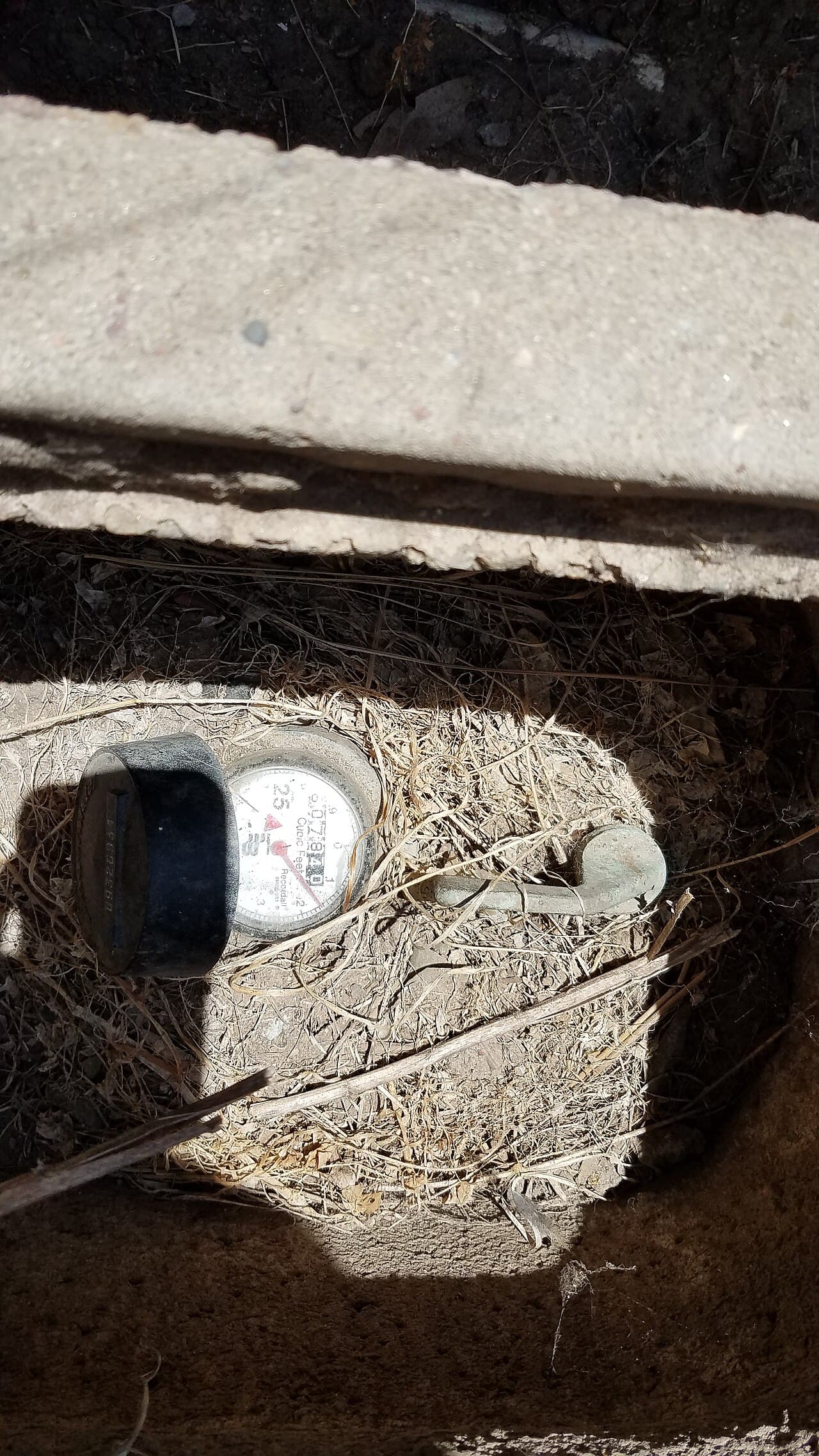
To see whether water is still running, Chesterfield County tells customers to lift the meter box cover and watch the sweep hand or the red triangle leak detector.[3] Not every utility wants you in the box: in Montgomery County, "the meter box and meter are PSA property and should be entered by PSA personnel only."[9] Ask yours first.
Getting money back on the water bill
Christiansburg, Chesterfield County and Prince William Water each have a way to lower the bill after a leak on the customer's side of the meter,[4][3][5] with conditions. Policies differ from one utility to the next, so ask yours for its rules.
Tell the utility as soon as you find the leak, not after the repair: Christiansburg's policy says "The Town shall be notified by the property owner of such leaks as soon as discovered."[4]
- Christiansburg adjusts when a customer uses in one billing period an excess of 25% and 3,000 gallons more than their average consumption for the previous three billing periods,[4] from a leak on the customer's side. To qualify, the leak has to be repaired within 10 days after it is discovered, and the Town given documentation of the repair within 15 days of the repair.[4] One limit: "Bills will not be adjusted for garden hoses breaking nor for spigots left open or turned on by accident."[4]
- Chesterfield County: you must repair the leak within 30 days after first learning of it and send documentation: a copy of the plumber's invoice for a professional repair, or sales receipts for the parts if you fixed it yourself.[3]
- Prince William Water: a customer with a leak on their side of the meter may be eligible for a courtesy adjustment.[5]
Who you are paying
Plumbing is licensed trade work in Virginia: "The Board shall require a master tradesmen license as a condition of licensure for electrical, plumbing, and heating, ventilation, and air conditioning contractors."[7] The contractor's licence class also has to fit the size of the job; the smallest, Class C, covers a single contract valued over $1,000 but less than $30,000.[7]
Getting a fair quote
For a running leak you may only have time for one call. For a planned repair or the rebuild after one, slow down. Get at least three written bids or estimates using identical plans and specifications,[8] and "Beware of any bid substantially lower than the others."[8] Virginia law requires all licensed contractors to provide a written contract for residential work.[8] For the deposit, Virginia's Board for Contractors suggests an initial deposit of no more than 10% of the total price or $1,000, whichever is less.[8]
A useful leak quote spells out:
- the service or emergency call charge, and the hourly rate after it;
- how the plumber will find the leak, and whether that is priced separately;
- what will be repaired or replaced, and with what pipe or parts;
- whether opening and patching walls, ceilings or floors is included, or left to you;
- drying and rebuild, priced separately if needed;
- any permit and inspection fee.
Stop and call a pro if
- The leak is inside a wall, ceiling or floor, under a slab, or in the buried service line.
- The water meter keeps moving with the main valve closed.
- Water reached outlets, the electrical panel, the furnace or the water heater.
- A ceiling is sagging with water. Keep people out from under it.
- Materials are still wet after two days, or you can see or smell mold.
Next steps
First find out where the water is going: how to find a hidden water leak. If it is under a sink, fixing a leaking pipe under the sink may save the call, and when you need a plumber for a water leak covers the rest. A pipe that has split open is its own emergency: see burst pipe repair. You can find plumbers in Blacksburg, see how Loclis pricing works, or read more plumbing answers.
To compare real numbers, describe the leak once and licensed local plumbers quote it.
Common questions
- Is there a standard price to fix a leak in Virginia?
- No. No state agency publishes one, and leak repairs vary too much for one figure. Ask for a written quote that separates the service call, finding the leak, the repair itself, any opening and patching of walls or floors, and any permit fee.
- Who pays for a leak between the street and my house?
- It depends on your utility, so ask where its responsibility ends before you hire anyone. Chesterfield County, for example, repairs leaks in the meter box and on the street side, and leaves the plumber's connection, the service line to the house and all the house plumbing to the customer.
- Will my water utility lower the bill after a leak?
- Ask yours as soon as you find the leak; some do, with conditions. Christiansburg asks to be told as soon as a leak is discovered, requires the repair within 10 days of discovery and proof within 15 days of the repair, and does not adjust bills for broken garden hoses or spigots left open. Chesterfield County allows 30 days and accepts a plumber's invoice or receipts for parts. Prince William Water may give a courtesy adjustment for a leak on the customer's side of the meter.
- Does a leak repair need a permit?
- It can. Virginia's building code requires a permit for alterations to the water supply and drainage systems, and lets emergency work start first with the application filed by the end of the next working day. Replacing a fixture without altering the piping, and patching wall and floor finishes, are listed as ordinary repairs that need none. Ask whether the quote includes any permit fee.
- What does Loclis charge?
- Plumbers on Loclis quote the job itself. Loclis's own fees are listed on the pricing page.
Sources
- [1] Fix a Leak Week, U.S. Environmental Protection Agency, WaterSense. Checked October 26, 2026.
- [2] Virginia Energy Savers Handbook, Chapter 9: Fixing Water Leaks, Virginia Tech, Virginia Energy Savers program. Checked October 26, 2026.
- [3] High Usage and Leaks, Chesterfield County, Virginia, Department of Utilities. Checked October 26, 2026.
- [4] Water and Sewer Leak Adjustment Policy, Town of Christiansburg, Virginia. Checked October 26, 2026.
- [5] How to check for a leak, Prince William Water. Checked October 26, 2026.
- [6] 13VAC5-63-80. Section 108 Application for permit (Virginia Uniform Statewide Building Code), Virginia Administrative Code, Virginia General Assembly. Checked October 26, 2026.
- [7] Code of Virginia § 54.1-1100. Definitions, Code of Virginia, Virginia General Assembly. Checked October 26, 2026.
- [8] What You Should Know Before You Hire a Contractor, Virginia Board for Contractors, DPOR. Checked October 26, 2026.
- [9] Water/Sewer: PSA frequently asked questions, Montgomery County, Virginia, Public Service Authority. Checked October 26, 2026.
- [10] A Brief Guide to Mold, Moisture and Your Home, U.S. Environmental Protection Agency. Checked October 26, 2026.
Want a pro to handle it?
Describe the job once. Licensed local businesses send quotes, and you pay only when you book one.
Get a quote for Plumbing Repair