When do I need a plumber for a water leak?
Call a plumber when the leak is in a pipe rather than a fitting you can reach, when it is inside a wall, ceiling or slab, when the meter keeps moving with the main valve closed, or when it comes from the water heater or a shut-off valve. A worn toilet flapper, faucet washer or loose trap nut is usually a homeowner fix. Check any plumber's licence with DPOR.
Free to ask. Local shops send quotes, and you pay only when you book one.
By Kasra Taheri, Founder, LoclisPublished
Researched and drafted with AI, then checked claim by claim against the sources listed below before it was published. Prices and rules change; the dates beside each source say when it was last checked.
Step by step
Read when to stop and call a pro, further down this page, before you start.
Step 1: Stop the water
Close the valve at the leaking fixture, or the house's main valve if you cannot isolate it, before you call anyone.[4]
Step 2: Check the meter
With nothing running, watch the meter: if it still moves with the main closed, tell the plumber the leak is probably in the underground line.[4]
Step 3: Call the utility for meter leaks
If water is coming up in or around the meter box or the street, call your water utility first; Chesterfield County, for one, repairs leaks in the meter box and on the street side.[4]
Step 4: Photograph and start drying
Photograph the leak and anything wet, then start drying, since materials dried within 24 to 48 hours usually do not grow mold.[12]
Step 5: Describe it clearly
Note where the water appears, whether it leaks all the time or only when a fixture is used, and how long it has been going on.
Step 6: Verify the licence
Check the plumbing contractor's licence with Virginia's Board for Contractors online or by phone before work starts.[11]
Step 7: Get it in writing
Get the price, the scope of work and the payment terms in a written contract, and keep the deposit small.[11]
Step 8: Ask who pulls the permit
If the repair alters the piping, have the contractor obtain any permit in the contractor's own name.[11]
The short answer
You need a plumber when the leak is in the piping itself, when it is somewhere you cannot see or reach, or when it will not stop with the valves you have. You can often handle the small, common ones yourself. The dividing line is less about how much water is coming out and more about where it is coming from.
Leaks you can usually fix yourself
Most household leaks are small parts wearing out. Common types of leaks found in the home are worn toilet flappers, dripping faucets, and other leaking valves.[1] They are often easy to fix with a few tools and parts that pay for themselves in water savings.[1]
- A worn toilet flapper. If the flapper at the bottom of the tank does not close completely after a flush, water leaks from the tank into the bowl.[4] A worn flapper is one of the simple fixes.[2]
- A dripping faucet. A faucet leak is usually down to old or broken parts inside the valve, and replacement washers and valves from a hardware store may solve it without replacing the whole fixture.[4]
- A dripping showerhead. A leaky showerhead can sometimes be fixed by tightening its connection to the pipe stem with pipe tape on the threads.[1]
- A drip at a reachable joint under a sink, such as a loose trap nut or a worn washer.
Nobody has to do these themselves: if you are not comfortable repairing a toilet or faucet, call a plumber of your own choice.[4]
Signs the leak is a plumber's job
A worn toilet flapper, a loose pipe connection or a showerhead with stray spray is a simple fix. A toilet that keeps running, broken sprinklers, water heater drips and malfunctioning water supply lines are leaks you may want a licensed plumber to stop.[2]
Call one when:
- The pipe itself leaks: a pinhole, a crack or a corroded joint. A leaking pipe that might need replacing or re-soldering is a job worth paying a plumber for.[3]
- You see the leak's effects but not the leak. Moisture or mold on walls, ceilings or floors could mean a pipe is leaking behind the scenes and needs a professional's attention.[2]
- The meter keeps moving with everything off. Close the main valve and check. If the meter keeps registering with the main valve closed, the leak is probably underground between the meter box and the valve.[4]
- It smells of sewage. A strong sewage odor may suggest a leak in the drainage system.[7]
- The toilet is a pressure-assisted model. "Tuning up a pressure-assisted toilet is best left to a professional plumber."[3]
- The water heater, a shut-off valve or the main valve is leaking, or a valve will not close.
- You have tried the simple fix and it still leaks.
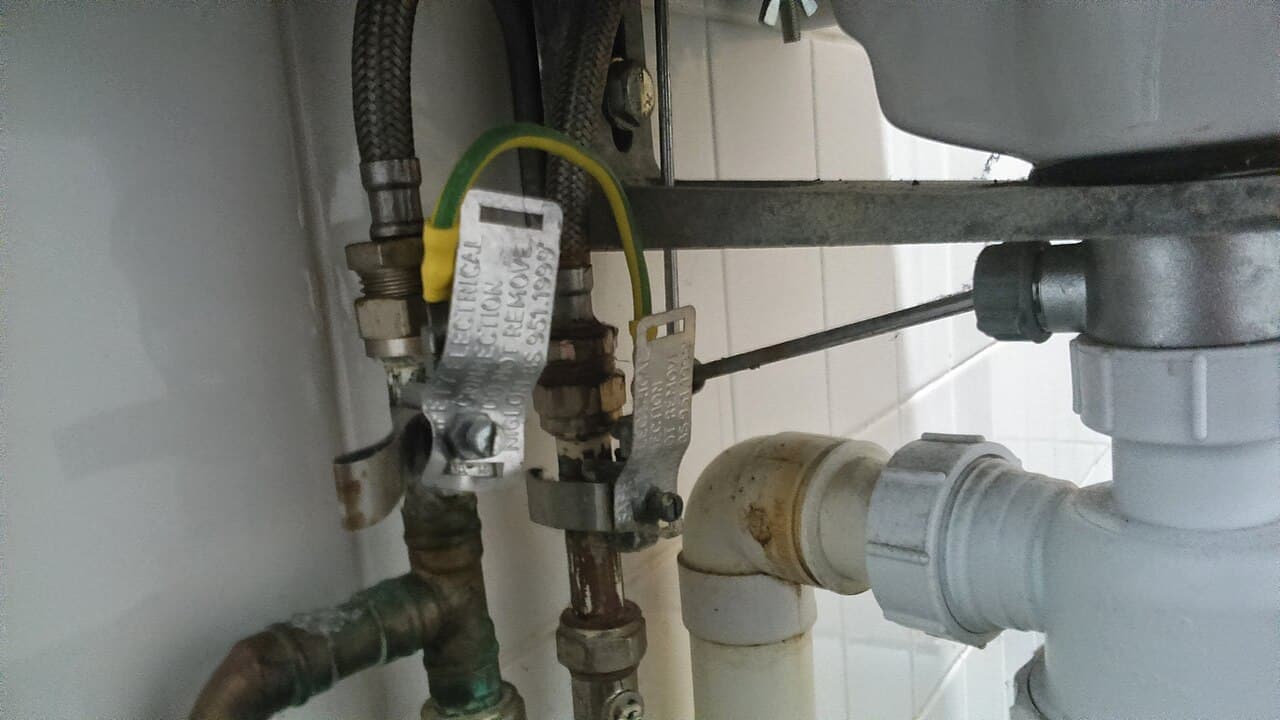
Leaks that belong to the utility
Some leaks are not yours to fix. Chesterfield County Utilities repairs leaks in the meter box and on the street side of it; leaks at the plumber's connection on the house side, the service line to the house and all other house plumbing are the customer's.[4] If you are served by another utility, ask where its side ends before you pay a plumber. Charlottesville asks residents who see a water leak in the road or street to report it to the city's Water Utility Department at 434-970-3800.[5]
Some utilities help you find the leak, too. If you cannot find the cause of high water use, Prince William Water's customer service can arrange for a technician to visit and help identify it.[6]
Licences and permits in Virginia
Plumbing is licensed trade work: "The Board shall require a master tradesmen license as a condition of licensure for electrical, plumbing, and heating, ventilation, and air conditioning contractors."[8] The contractor's class must also fit the job; the smallest, Class C, covers a single contract valued over $1,000 but less than $30,000.[8]
Homeowners have an exemption from the contractor licensing chapter. It covers "Any person who performs or supervises the construction, removal, repair, or improvement of no more than one primary residence owned by him and for his own use during any 24-month period".[9] That does not lift the building code. Under the Uniform Statewide Building Code, a permit is required before installations or alterations involving the water supply and distribution system, sanitary drainage system, or vent system,[10] and for urgent repairs the permit application for emergency work is due by the end of the first working day after the work starts.[10]
When you hire, check the licence yourself: "A license number in an advertisement or on a business card does not necessarily mean the contractor's license is valid."[11] You can check the licence online at the Board for Contractors or by calling (804) 367-8511, where past complaints and disciplinary actions are also available.[11] Virginia law requires all licensed contractors to provide a written contract for residential work.[11]
On permits: "Licensed contractors should apply for and obtain all building permits, not the consumer."[11] The permit holder becomes the general contractor and assumes responsibility for the overall job,[11] which is a reason not to pull a permit for a contractor's work in your own name.
Stop and call a pro if
- Water is spreading and closing the nearest valve, or the main, does not stop it.
- Water is near outlets, the electrical panel, the furnace or the water heater.
- A ceiling is sagging or bulging with water. Keep people out from under it.
- The leak smells of sewage or is coming from a drain or cleanout.
- Walls, ceilings or floors are stained, soft or moldy.
Next steps
Before you call, find where the water is going and read what fixing a leak costs in Virginia. If it turns out to be under a sink, fixing a leaking pipe under the sink may save the call, and a split pipe is covered in what to do when a pipe bursts. Loclis lists DPOR-licensed plumbing businesses with their licence number and class: find plumbers in Blacksburg or browse leak repair. On Loclis, plumbing work needs a licence at any job size, and an unlicensed quote is refused.
When you are ready, describe the leak once and licensed local plumbers quote it.
Common questions
- Is a dripping faucet worth a plumber's visit?
- Usually not at first. A faucet leak is usually down to old or broken parts inside the valve, and replacement washers and valves from a hardware store may fix it without a new faucet. Call a plumber if you are not comfortable doing it, the valve will not shut off, or the faucet is old enough that parts are hard to find.
- Does a plumber in Virginia need a licence?
- Yes. The Code of Virginia requires a master tradesman licence as a condition of licensure for plumbing contractors, and the contractor needs a licence class that fits the size of the job. Check the licence with the Board for Contractors before work starts; a number on a business card does not prove it is valid.
- Can I fix a leak in my own house without a licence?
- Virginia's contractor licensing law exempts a person who repairs no more than one primary residence they own and live in during any 24-month period. That exemption does not remove the building code: a permit is still required for alterations to the water supply or drainage piping. If you are unsure whether your repair counts, ask your local building official.
- Who fixes a leak at the water meter?
- It depends on the utility, so call yours first when water is coming up at the meter or in the street. Chesterfield County repairs leaks in the meter box and on the street side, while the line from the meter to the house is the customer's.
- Is a leak an emergency?
- It is when water is spreading and you cannot stop it with a valve, when it is near electrical equipment, when a ceiling is sagging, or when it smells of sewage. If closing a valve stops it and nothing is spreading, a next-day visit is usually fine.
Sources
- [1] Fix a Leak Week, U.S. Environmental Protection Agency, WaterSense. Checked October 26, 2026.
- [2] Detect and Chase Down Leaks at Home checklist, U.S. Environmental Protection Agency, WaterSense. Checked October 26, 2026.
- [3] Virginia Energy Savers Handbook, Chapter 9: Fixing Water Leaks, Virginia Tech, Virginia Energy Savers program. Checked October 26, 2026.
- [4] High Usage and Leaks, Chesterfield County, Virginia, Department of Utilities. Checked October 26, 2026.
- [5] Water Conservation Indoors, City of Charlottesville, Virginia. Checked October 26, 2026.
- [6] How to check for a leak, Prince William Water. Checked October 26, 2026.
- [7] How to Perform an Emergency Repair on a Leaky Pipe, Oatey. Checked October 26, 2026.
- [8] Code of Virginia § 54.1-1100. Definitions, Code of Virginia, Virginia General Assembly. Checked October 26, 2026.
- [9] Code of Virginia § 54.1-1101. Exemptions, Code of Virginia, Virginia General Assembly. Checked October 26, 2026.
- [10] 13VAC5-63-80. Section 108 Application for permit (Virginia Uniform Statewide Building Code), Virginia Administrative Code, Virginia General Assembly. Checked October 26, 2026.
- [11] What You Should Know Before You Hire a Contractor, Virginia Board for Contractors, DPOR. Checked October 26, 2026.
- [12] A Brief Guide to Mold, Moisture and Your Home, U.S. Environmental Protection Agency. Checked October 26, 2026.
Want a pro to handle it?
Describe the job once. Licensed local businesses send quotes, and you pay only when you book one.
Get a quote for Plumbing Repair