How much does it cost to paint a ceiling in Virginia?
Virginia has no single price for painting a ceiling. A quote depends on preparation and stains, texture, ceiling height, primer and coats, the paint and, in a pre-1978 home, lead-safe rules. Get three written bids for the same list of work, check the license for jobs of $1,000 or more, and keep the deposit to 10% of the price or $1,000, whichever is less.
Free to ask. Local shops send quotes, and you pay only when you book one.
By Kasra Taheri, Founder, LoclisPublished
Researched and drafted with AI, then checked claim by claim against the sources listed below before it was published. Prices and rules change; the dates beside each source say when it was last checked.
Step by step
Read when to stop and call a pro, further down this page, before you start.
Step 1: Measure and list the ceilings
Write down each ceiling's size, height, texture and condition, including stains and cracks.
Step 2: Look for leaks
Find and fix the source of any water stain before painting.[2]
Step 3: Check the age of the house
If it was built before 1978, ask any painter whether they are lead-safe certified.[7]
Step 4: Check the texture
If a ceiling in an older home is sprayed or popcorn textured, do not sand or scrape it, and have a trained, accredited professional test it first.[6]
Step 5: Check the license
For work valued at $1,000 or more, check the contractor's Virginia license.[8]
Step 6: Get written bids
Ask for at least three written bids using the same list of work and the same paint.[8]
Step 7: Keep the deposit small
Keep the deposit to no more than 10% of the total price or $1,000, whichever is less.[8]
The short answer
There is no single Virginia price for painting a ceiling that is worth quoting here. A number without a date or an official source behind it would mislead you. What you can do is understand what moves the price and get it in writing. Two ceilings of the same size can quote very differently, because painters price the preparation, the height and the coats as much as the area.
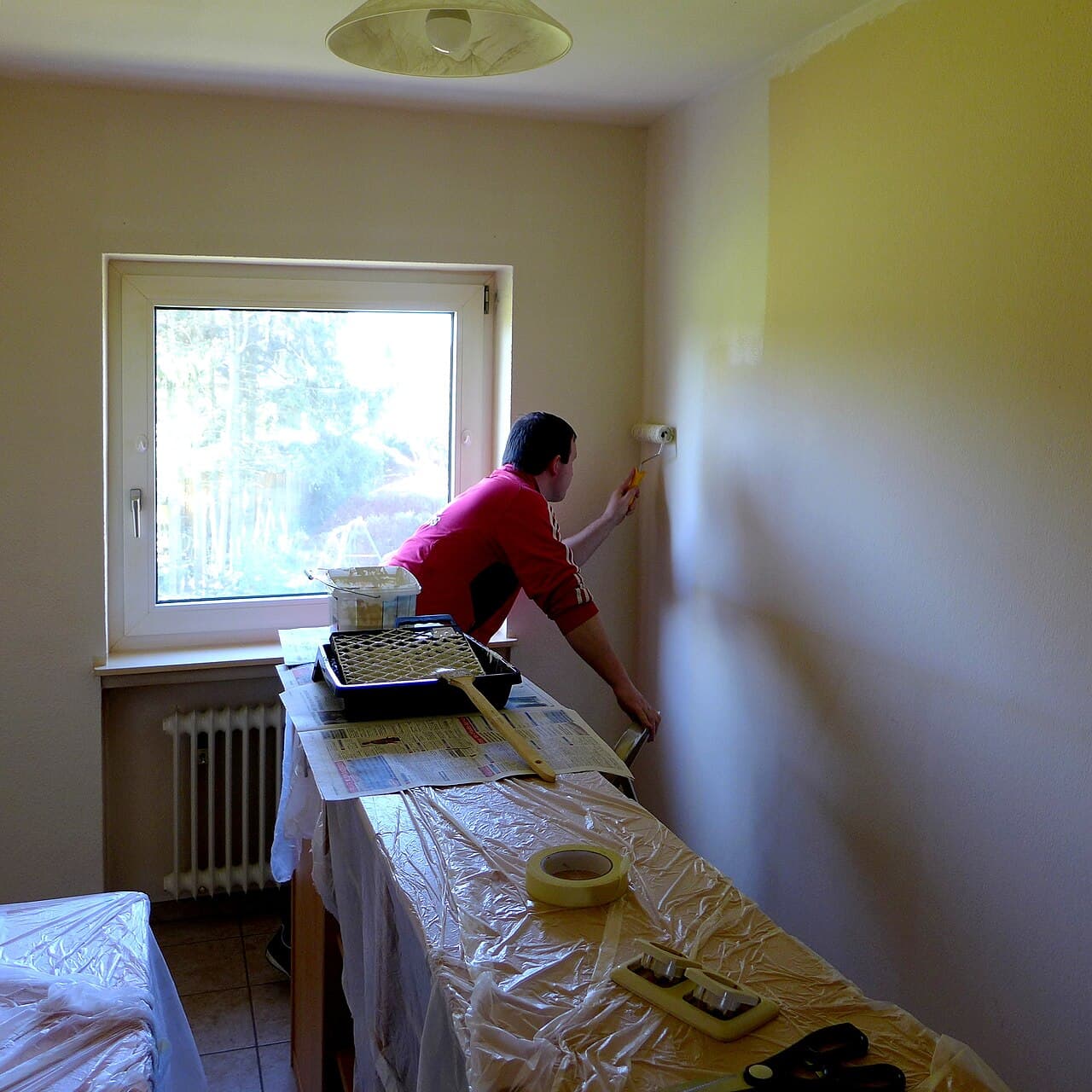
What decides the price of a ceiling
Preparation. This is where quotes diverge. Benjamin Moore says: "Painting over cracked paint is a bad idea; it is important to remove any flakes from the surface via sanding or scraping before repainting."[1] Scraping, patching cracks and nail pops, and washing a greasy kitchen ceiling all add hours before any paint goes on.
Stains and leaks. Sherwin-Williams' repair steps for a water stain begin with "Find and repair the source of water." and continue with removing peeling paint and sealing the stain with a primer.[2] A painter who primes stains will charge for the extra coat, and one who offers to paint over a wet stain is leaving you a problem. The leak repair itself is a separate job and a separate quote.
Color, primer and coats. A white ceiling over a white ceiling is the cheapest case. Benjamin Moore says to "ask your local Benjamin Moore store for a deep base primer if painting a darker hue", and recommends at least two coats of a top coat for good hide and color.[3] A quote for one coat is not comparable to a quote for two.
Texture. Rough surfaces take a thicker roller sleeve, which Benjamin Moore puts at 1/2- or 3/4-inch for rough, textured walls, and use more paint.[3] A heavily textured or popcorn ceiling is also slower to paint than a smooth one. Before anyone disturbs one in an older home, note that EPA lists "Textured paint and patching compounds used on walls and ceilings" among the places where asbestos may be found.[4] Ask any painter what they plan to do about it, and see how to find out whether a popcorn ceiling has asbestos.
Paint and sheen. Ceilings are usually flat, which Benjamin Moore says "is more forgiving of flaws and allows for excellent hide, creating a uniform surface."[5] The quote should name the brand, product line and sheen, and say who buys it.
Height and access. A ceiling you can reach from a stepladder is quick. A stairwell, a vaulted ceiling or a double-height entry needs taller ladders, planks or scaffolding, more setup time and a second person, and the quote rises accordingly. See whether to hire a painter for high ceilings.
Furniture, fixtures and protection. Moving and covering furniture, masking lights and fans, and protecting floors are labor. Ask whether they are included.
Walls in the same room. Adding the ceiling to a room that is already being painted usually costs less than painting it alone, because the setup is shared. For the whole room see how much it costs to paint a room in Virginia.
Age of the house. EPA says: "In general, anyone paid to perform work that disturbs paint in housing and child-occupied facilities built before 1978 must be certified in lead-safe work practices."[7] Scraping or sanding old paint in a pre-1978 house therefore calls for a lead-safe certified firm, and that can change the price. Rolling over sound paint is different.
Doing it yourself
A ceiling is a reasonable do-it-yourself job if it is within reach of a stepladder and the paint is sound. Your cost is paint, a primer if there are stains, tape, drop cloths, a roller on an extension pole and your time, and the usual mistake is skipping preparation. How to roll paint on a ceiling walks through the method.
Getting a fair quote in Virginia
The Board for Contractors says: "If the work you are considering is valued at $1,000 or more, a valid Virginia contractor's license is required for the license category in which the contractor is to work."[8] A ceiling on its own may fall under that figure; a whole-house paint job often will not. Check the licence class and number with the licence lookup on the DPOR website, and see whether a painter needs a license in Virginia.
The Board also says "It is advisable to get at least three written bids or estimates using identical plans and specifications so you can compare prices and contractors."[8] On deposits, its rule of thumb is "an initial deposit of no more than 10% of the total price or $1,000, whichever is less", and it says to "never sign a blank or partially blank contract".[8]
Write one list and give it to every painter: the rooms and ceiling heights, the texture, the stains, the prep, the primer, the number of coats, the paint brand and sheen, who moves furniture, the start and finish dates and what happens if a touch-up is needed. If one quote is far lower than the rest, find out which line it leaves out.
Stop and call a pro if
- The ceiling has a stain, bubble or sag. A leak above it has to be found and fixed first.[2]
- The paint is flaking in a house built before 1978. EPA recommends that homeowners hire a lead-safe certified contractor who is certified and trained in lead-safe work practices.[7]
- The ceiling is textured or sprayed and the house is old. Leave it alone. EPA says "A trained and accredited asbestos professional should take samples for analysis" and "Don't saw, sand, scrape, or drill holes in asbestos-containing materials."[6]
- It cannot be reached from a stepladder. Get quotes rather than improvising with boxes or a borrowed ladder.
Next steps
Browse painting answers or the painting category to find licensed local painters.
To get written quotes, describe the ceiling and local painters will quote it.
Common questions
- Why can't I get an exact price for painting a ceiling?
- Because the price depends on the ceiling, not just its area: preparation, stains, texture, height, the number of coats, the paint and whether walls are being painted too. A painter can give a firm figure after seeing the room, and it should be in writing.
- Is it cheaper to paint the ceiling along with the walls?
- Usually, since the setup, covering and cleanup are shared. A ceiling quoted on its own tends to cost more for the area than one added to a room that is already being painted.
- Does a ceiling quote include primer?
- Only if it says so. Stains and a move from a dark color to a light one may need a primer coat, and Benjamin Moore recommends at least two coats of a top coat. Ask for primer and coats as separate lines in a written quote.
- Does a painter need a license to paint one ceiling?
- Virginia's Board for Contractors says a license is required when the work is valued at $1,000 or more. A single ceiling can fall below that, but you should still ask for a written contract.
- How much deposit should I pay a painter?
- The Board for Contractors gives a rule of thumb of no more than 10% of the total price or $1,000, whichever is less, with more only for custom-made or special-order items.
Sources
- [1] How to Prepare Walls for Painting, Benjamin Moore. Checked October 27, 2026.
- [2] How to Fix Water, Smoke and Other Paint Stains, Sherwin-Williams. Checked October 27, 2026.
- [3] How To Paint Interior Walls In 7 Easy Steps, Benjamin Moore. Checked October 27, 2026.
- [4] Learn About Asbestos, U.S. Environmental Protection Agency. Checked October 27, 2026.
- [5] How to Choose a Paint Finish, Benjamin Moore. Checked October 27, 2026.
- [6] Protect Your Family from Exposures to Asbestos, U.S. Environmental Protection Agency. Checked October 27, 2026.
- [7] Lead Renovation, Repair and Painting Program, U.S. Environmental Protection Agency. Checked October 27, 2026.
- [8] What You Should Know Before You Hire a Contractor, Virginia Board for Contractors, DPOR. Checked October 27, 2026.
Want a pro to handle it?
Describe the job once. Licensed local businesses send quotes, and you pay only when you book one.
Get a quote from a local pro