How do I clean a painted ceiling?
Dust it first with a dry vacuum brush or a long-handled duster, then wipe lightly with a barely damp non-abrasive sponge or microfiber cloth and warm water, working in small sections. Add mild dish soap only for grime, rinse, and dry. Ceilings are usually flat paint, which needs a gentle touch, so do not scrub.
Free to ask. Local shops send quotes, and you pay only when you book one.
By Kasra Taheri, Founder, LoclisPublished
Researched and drafted with AI, then checked claim by claim against the sources listed below before it was published. Prices and rules change; the dates beside each source say when it was last checked.
Step by step
Read when to stop and call a pro, further down this page, before you start.
Step 1: Protect the room
Lay towels or drop cloths over the floor and furniture, because drips and dust will fall straight down.
Step 2: Set up the ladder or pole safely
Use a flat, level surface for the ladder, never stand on its top two steps, and keep your body between the side rails.[7] A sponge mop or extension pole lets you clean most of a ceiling from the floor.
Step 3: Dust first
Use the brush attachment on a vacuum or a dry long-handled duster to gently remove surface dust and cobwebs.[1]
Step 4: Try warm water
Gently rub lighter marks with a non-abrasive sponge or microfiber cloth dampened with warm water, wrung out well.[1]
Step 5: Move to mild soap if needed
For grime that water will not lift, use warm water with a little mild dish soap, working a small section at a time and rinsing the area with a second cloth.[1]
Step 7: Dry the ceiling
Pat each section with a soft, absorbent cloth so no moisture is left on the paint.[1]
Step 8: Check for a stain that is not dirt
If a mark is brown or yellow, comes back, or the ceiling feels damp, treat it as a water problem and not a cleaning one.[3]
The short version
Dust first, then wipe lightly with a barely damp cloth and warm water, one small section at a time. Most ceilings are painted with flat paint, which is the easiest sheen to damage, so the goal is to lift dust and grime, not scrub. If water alone does not do it, add a little mild dish soap, rinse, and dry as you go.
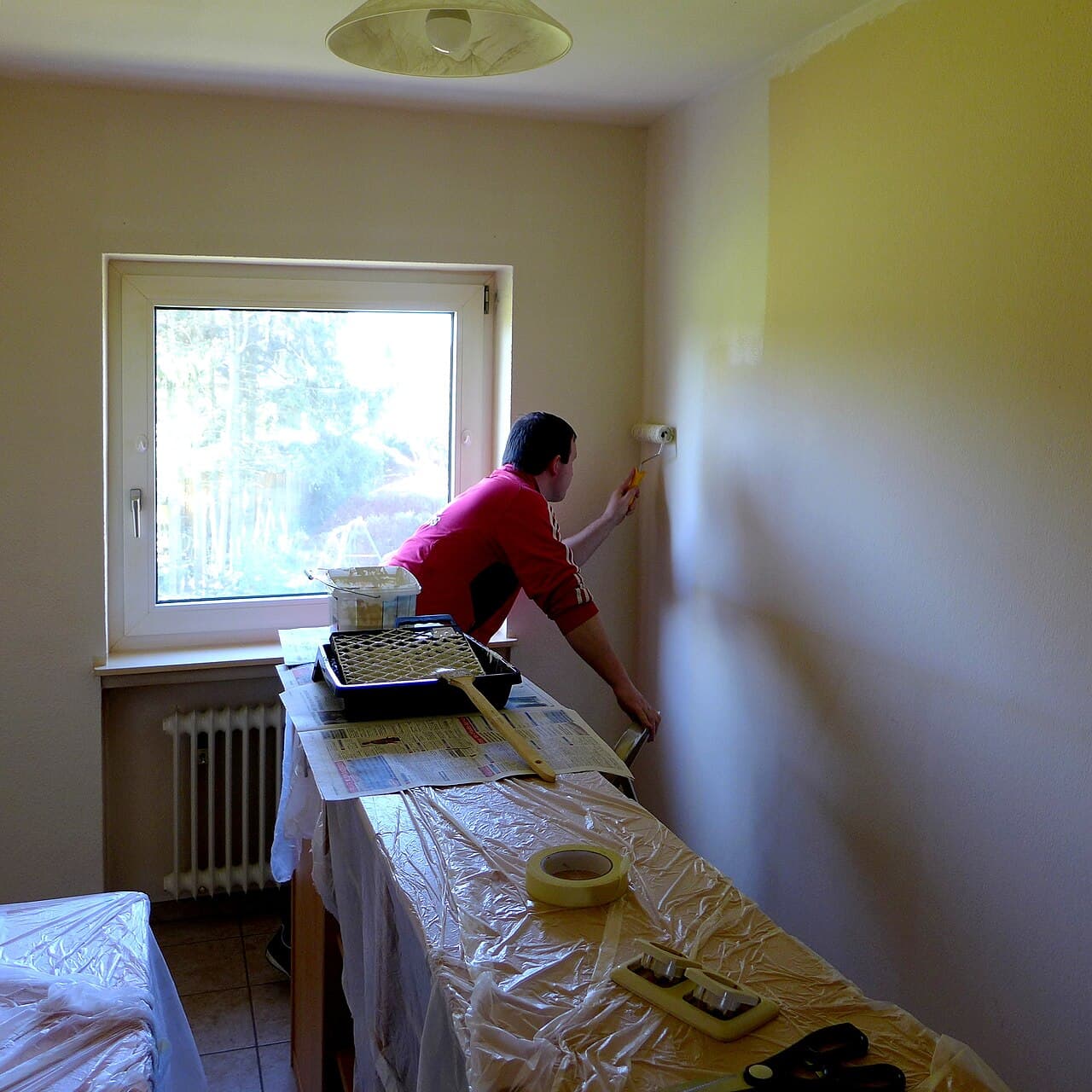
Know your paint before you wet it
Benjamin Moore explains the trade-off: the higher the gloss, the easier a paint is to clean, and "Lower sheens like flat, matte, and eggshell require a gentler touch."[1] Flat is the usual ceiling finish, and it has a weakness: "Stains are harder to remove from low-sheen paint, and constant rubbing or cleaning can result in burnishing."[2] Burnishing is the shiny or lighter patch you see where flat paint has been rubbed. It cannot be wiped away, only repainted, so start gentle and stop when the mark lifts.
Get set up safely
Cover the floor and furniture first. Gravity sends every drip and speck of dust straight down.
Cleaning a ceiling is overhead work, so set up before you start. A sponge mop or a cloth-wrapped extension pole keeps you on the floor for most of it. If you use a ladder, Virginia Commonwealth University's ladder program says it must be set up as follows: "Ladders shall be set-up on a flat, level surface" and "The top two steps of a stepladder and the top two rungs of a straight or extension ladder shall not be used for standing." It adds, "Do not overreach or lean too far to one side."[7] Move the ladder as you go. For a very high ceiling, read whether to hire a painter for high ceilings.
Step by step method
Dust. Benjamin Moore's advice for painted walls carries over: "Before washing a wall, be sure to dust it first. Use the brush attachment on your vacuum to gently remove surface dust and dirt."[1] A dry long-handled duster takes cobwebs. Dust turns to mud the moment it meets a wet cloth, so this step does most of the work.
Wipe with water. "Gently rub lighter stains and scuffs with a large, non-abrasive sponge dampened with warm water."[1] Wring the sponge or microfiber cloth out until it is barely damp, and clean one section about the size of a table at a time. A dripping cloth leaves streaks and puts too much water into the paint.
Add soap only if water fails. Benjamin Moore's next step is to "advance to a mixture of warm water and mild dish detergent."[1] Use a second clean damp cloth to rinse each section so no soap film is left behind, then dry it with a soft towel. Benjamin Moore wants walls "nice and dry to prevent moisture damage or mildew" and the same holds overhead.[1]
Leave the strong cleaners on the shelf. Benjamin Moore: "Never use glass cleaner or a heavy-duty household spray cleaner on a painted wall. They contain strong solvents that can damage the finish."[1]
Smoke, grease and kitchen ceilings
Over a stove or in a home where people smoke, the film is greasy, so water alone just smears it. Sherwin-Williams says to "Use an appropriate cleaner to clean any tobacco smoke stains, fire smoke and soot, and grease and oil as much as possible from the surface."[3] On flat paint, a degreasing wash often leaves a clean patch that shows against the rest of the ceiling. If that happens, repaint the whole ceiling, edge to edge, rather than spotting it. Our guide to why ceiling paint looks blotchy explains why.
Mold and mildew spots
Black, green or gray freckles in a bathroom or over a shower are usually mold, and the cause is moisture, not dirt. EPA's advice is to "Scrub mold off hard surfaces with detergent and water, and dry completely."[4] EPA says "If the moldy area is less than about 10 square feet" (roughly a 3 ft. by 3 ft. patch) you can in most cases handle it yourself, and it warns "Never mix chlorine bleach solution with other cleaning solutions or detergents that contain ammonia because toxic fumes could be produced."[4] Cleaning is not the finish line: "You must have completely fixed the water or moisture problem before the cleanup or remediation can be considered finished."[4]
Stop and call a pro if
- Brown or yellow rings, bubbling, or a damp or sagging ceiling. That is a leak, not dirt. Sherwin-Williams' first step is "Find and repair the source of water."[3] Call a plumber or roofer before anyone cleans or paints.
- The mold covers more than about 10 square feet, keeps coming back, or you think it is hidden above the ceiling.[4]
- The ceiling is textured, crumbly or old. EPA lists "Textured paint and patching compounds used on walls and ceilings" among materials that may contain asbestos.[5] Its advice is "Don't saw, sand, scrape, or drill holes in asbestos-containing materials."[6] Dust it lightly and do not scrub it.
- The ceiling is above a stairwell or higher than you can reach safely.
Getting help in Virginia
If cleaning shows the paint has failed, read the best way to roll paint on a ceiling and how much it costs to paint a ceiling in Virginia. Browse painting answers or find painting contractors on Loclis.
When you would rather hand it off, describe the ceiling once and local painters will quote it.
Common questions
- How often should I clean a painted ceiling?
- Dusting now and then is usually enough, more often over a kitchen stove, in a smoker's home or in a damp bathroom. Wash only when marks show, because every wash wears flat paint a little.
- Can I use a spray cleaner on a ceiling?
- Not a strong one. Benjamin Moore says never to use glass cleaner or a heavy-duty household spray cleaner on a painted wall, because they contain strong solvents that can damage the finish. Warm water, then warm water with mild dish detergent, is the safe order.
- How do I get rid of black spots on a bathroom ceiling?
- Black or green spots are usually mold. EPA says to scrub mold off hard surfaces with detergent and water and dry completely, and that you can usually handle an area under about 10 square feet yourself. Fix the moisture source first or the spots will return.
- Why did washing leave a clean streak that looks different?
- Flat and low-sheen paint can burnish where it is rubbed, leaving a shinier or lighter patch. A gentle touch, barely damp cloths and cleaning a whole section edge to edge reduce it. If a patch stays visible, repainting the whole ceiling blends it.
- Is it safe to wash a textured ceiling?
- Only dust it lightly. Textured ceilings can hold asbestos, and EPA says not to saw, sand, scrape or drill into asbestos-containing materials. Rubbing a damp cloth over crumbly texture can also pull it off, so if it flakes, stop.
Sources
- [1] How to Clean Walls Without Damaging Paint, Benjamin Moore. Checked October 28, 2026.
- [2] Choosing an Interior Paint Finish: Sheen and Gloss 101, Benjamin Moore. Checked October 28, 2026.
- [3] How to Fix Water, Smoke and Other Paint Stains, Sherwin-Williams. Checked October 28, 2026.
- [4] A Brief Guide to Mold, Moisture and Your Home, U.S. Environmental Protection Agency. Checked October 28, 2026.
- [5] Learn About Asbestos, U.S. Environmental Protection Agency. Checked October 28, 2026.
- [6] Protect Your Family from Exposures to Asbestos, U.S. Environmental Protection Agency. Checked October 28, 2026.
- [7] Portable Ladder Safety Program, Virginia Commonwealth University, Safety and Risk Management. Checked October 28, 2026.
Want a pro to handle it?
Describe the job once. Licensed local businesses send quotes, and you pay only when you book one.
Get a quote from a local pro