Should I hire a painter for high ceilings?
Yes, if you cannot reach the whole ceiling from a stepladder standing on a flat floor, as with a stairwell, a vaulted or two-storey ceiling. The risk is the fall, not the paint. A standard-height ceiling is a reasonable do-it-yourself job. For pro work, get three written bids and check the license once the job is worth $1,000 or more.
Free to ask. Local shops send quotes, and you pay only when you book one.
By Kasra Taheri, Founder, LoclisPublished
Researched and drafted with AI, then checked claim by claim against the sources listed below before it was published. Prices and rules change; the dates beside each source say when it was last checked.
Step by step
Read when to stop and call a pro, further down this page, before you start.
Step 1: Measure the height
Measure the ceiling at its highest point and note where a ladder would have to stand.
Step 2: Check the floor
Confirm the floor is flat and level where the ladder would go, and not in front of a door.[1]
Step 3: Check your reach
Decide whether an extension pole and a stepladder reach the whole ceiling without standing on the top two steps.[1]
Step 5: Get written bids
Ask for at least three written bids using the same list of work and the same paint.[6]
Step 6: Check the license
For work valued at $1,000 or more, check the contractor's Virginia license.[6]
The short answer
Hire a painter when you cannot reach the ceiling safely from a stepladder standing on a flat floor: a stairwell, a vaulted or two-storey ceiling, or a room where you would have to stack something to get up. A standard-height ceiling you can reach with a stepladder and an extension pole is a reasonable job to do yourself. The risk with a high ceiling is not the paint. It is the fall.
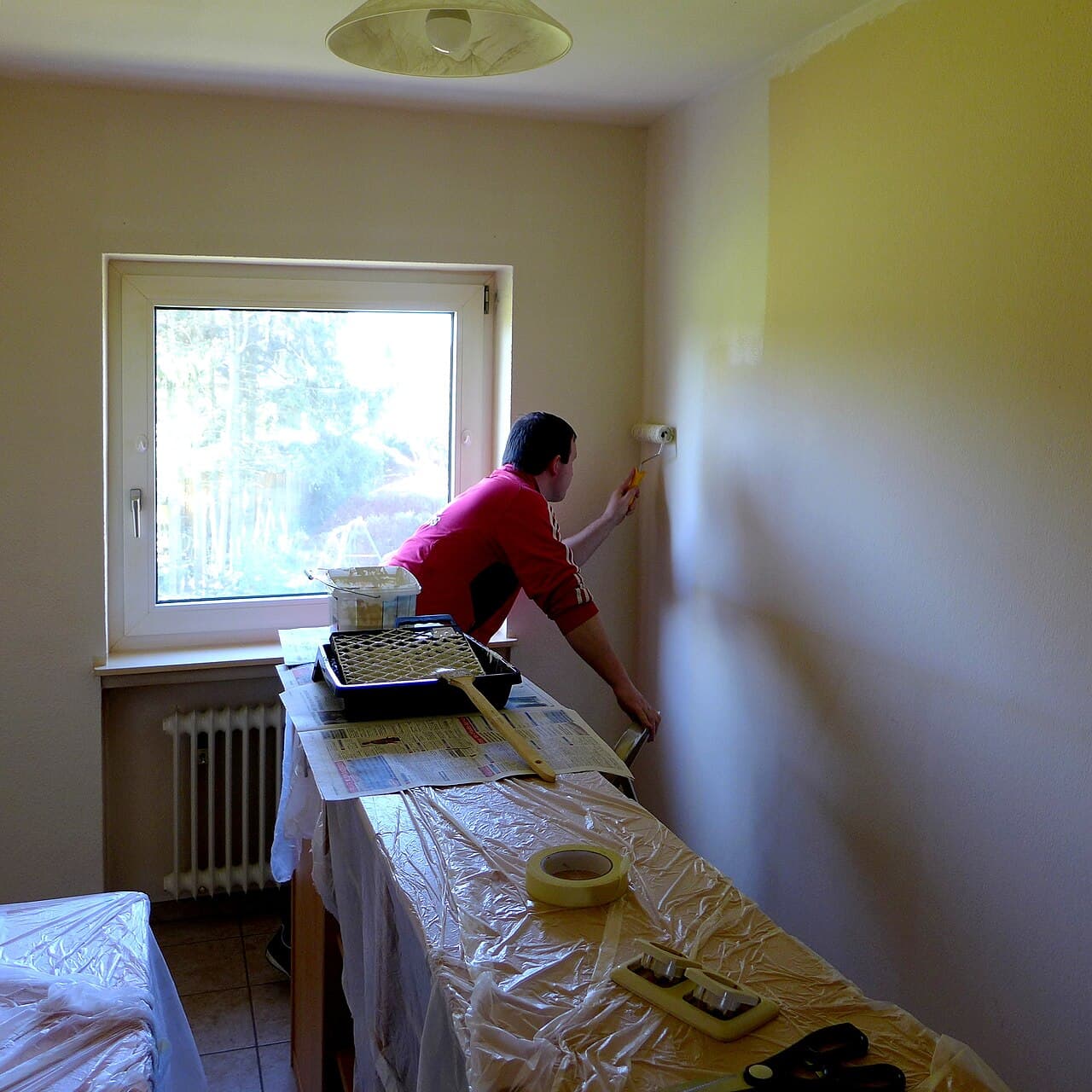
Why height changes the job
Painting overhead means spending time on a ladder with both hands busy. The ladder rules Virginia Commonwealth University applies to its own staff show how much a safe setup asks for.
The ladder must carry you and your gear: the program says users must "ensure that the ladder has an adequate duty rating to support the combined weight of the user and the material."[1] It must stand on level ground, and it is not to be raised on improvised bases: "Ladders shall not be placed on boxes, barrels, or other unstable bases to obtain additional height."[1] You must not stand on the top two steps of a stepladder.[1] You must keep at least three points of contact when climbing, and "At least one hand must be free to grasp the ladder at all times."[1] That is awkward when the work is a paint tray in one hand and a roller in the other, and the program adds that "Supplies or equipment shall not be hand carried by the worker on the ladder."[1]
A professional crew handles this with equipment you do not own: taller ladders or planks and trestles, a second person, and a method that keeps the paint at the work. If the only way you can reach is to lean, stretch or balance, it is a pro job.
DIY or hire: how to decide
Do it yourself when all of these are true:
- You can reach the whole ceiling with an extension pole from the floor or from a stepladder you can stand on safely below its top two steps.
- The floor is flat and clear, and the ladder is not in front of a door.
- The paint is sound, not flaking, and the ceiling is smooth. If so, read how to roll paint on a ceiling.
Hire when any of these is true:
- It is a stairwell, a vaulted ceiling, a two-storey entry or a ceiling over stairs. The ladder has to stand on a slope or step, or needs a platform.
- The paint is a high gloss. Benjamin Moore says high gloss paints "require careful application and preparation best left to a professional painter".[2]
- The house was built before 1978 and the paint is cracking or peeling. EPA recommends that homeowners hire a lead-safe certified contractor who is certified and trained in lead-safe work practices.[4]
- The ceiling is a textured or sprayed finish in an older home. EPA lists "Textured paint and patching compounds used on walls and ceilings" among the places where asbestos may be found.[5] See how to find out whether a popcorn ceiling has asbestos.
- You do not have a helper or a second ladder. Overhead work is hard to do well alone, and a fall alone is worse.
What to ask a painter for a high ceiling
Ask how they will reach it, because the method decides the price: ladders, planks, a rolling tower or a lift. Ask who is on site, whether they carry insurance, and who covers the floor and furniture. Ask the number of coats, the primer, and the brand and sheen of the paint. The Board for Contractors recommends getting "at least three written bids or estimates using identical plans and specifications so you can compare prices and contractors."[6]
Give each painter the actual height, a photo of the room and the stair, and any stains or cracks. A high ceiling quoted from a phone call is a guess. For what moves the price, see how much it costs to paint a ceiling in Virginia.
Licence, contract and deposit in Virginia
The Board for Contractors says: "If the work you are considering is valued at $1,000 or more, a valid Virginia contractor's license is required for the license category in which the contractor is to work."[6] A high ceiling in a large room, or a whole-house job, may reach that figure. Look the painter up with the licence lookup on the DPOR website, and read whether a painter needs a license in Virginia.
Virginia law requires all licensed contractors to provide a written contract for residential work.[6] The Board's rule of thumb for a deposit is "an initial deposit of no more than 10% of the total price or $1,000, whichever is less", and it says to "never sign a blank or partially blank contract".[6]
Stop and call a pro if
- You would need to stand on the top two steps, or on anything other than a ladder, to reach.[1]
- The ladder cannot stand on a flat, level surface, as on a stair.[1]
- You feel dizzy or unsteady on the ladder. Come down slowly and hire someone.
- The paint is peeling in a pre-1978 home, or the texture is untested. [4] EPA says "A trained and accredited asbestos professional should take samples for analysis" and "Don't saw, sand, scrape, or drill holes in asbestos-containing materials."[3]
Next steps
Browse painting answers or the painting category for licensed local painters.
When you are ready, describe the ceiling and its height and local painters will quote it.
Common questions
- How high is too high to paint a ceiling myself?
- There is no official number. The test is whether you can reach the whole ceiling from a stepladder standing on a flat floor, without using the top two steps and without leaning. If not, hire a painter.
- Can I use a taller ladder or stack something to reach?
- No. Virginia Commonwealth University's ladder program says ladders shall not be placed on boxes, barrels, or other unstable bases to obtain additional height.
- Does a painter need a license for a high ceiling?
- Virginia's Board for Contractors says a license is required when the work is valued at $1,000 or more. A single high ceiling may be under that, but ask for a written contract anyway.
- Why does a high ceiling cost more to paint?
- Because of access: taller ladders, planks or a tower, more setup time and a second person. Ask each painter how they plan to reach it, and get the answer in the quote.
- Is a pole enough for a high ceiling?
- A pole lets you paint the open ceiling from the floor if your arms can reach it comfortably, but you still have to cut in the edges and work around fixtures, which usually needs a ladder.
Sources
- [1] Portable Ladder Safety Program, Virginia Commonwealth University, Safety and Risk Management. Checked October 27, 2026.
- [2] How to Choose a Paint Finish, Benjamin Moore. Checked October 27, 2026.
- [3] Protect Your Family from Exposures to Asbestos, U.S. Environmental Protection Agency. Checked October 27, 2026.
- [4] Lead Renovation, Repair and Painting Program, U.S. Environmental Protection Agency. Checked October 27, 2026.
- [5] Learn About Asbestos, U.S. Environmental Protection Agency. Checked October 27, 2026.
- [6] What You Should Know Before You Hire a Contractor, Virginia Board for Contractors, DPOR. Checked October 27, 2026.
Want a pro to handle it?
Describe the job once. Licensed local businesses send quotes, and you pay only when you book one.
Get a quote from a local pro