How much does it cost to replace a section of drywall in Virginia?
There is no single Virginia price: a section is usually quoted by the job, and its size, a ceiling or high wall, texture matching, water damage behind the board and the painting all move it. Get at least three written bids on the same specifications. DPOR says a contractor's licence is required at $1,000 or more of work.
Free to ask. Local shops send quotes, and you pay only when you book one.
By Kasra Taheri, Founder, LoclisPublished
Researched and drafted with AI, then checked claim by claim against the sources listed below before it was published. Prices and rules change; the dates beside each source say when it was last checked.
Step by step
Read when to stop and call a pro, further down this page, before you start.
Step 1: Measure and photograph the damage
Note the size of the section, whether it is a wall or ceiling, the room height and any texture, and take clear photos in daylight.
Step 2: Find the cause
If the section is wet or stained, have the leak fixed first; a quote for a patch does not cover a source that is still running.
Step 3: Decide what finish you expect
Say whether you want a patch painted to match, the whole wall repainted, or texture matched, because each is priced differently.
Step 4: Ask three licensed businesses for written bids
DPOR advises at least three written bids using identical specifications, and not automatically accepting the lowest.[4]
Step 5: Check the licence
DPOR says a valid Virginia contractor's licence is required for the licence category of the work if it is valued at $1,000 or more, so check that the contractor holds one.[4]
Step 6: Compare the line items
Match what each bid includes: board, tape and compound, number of coats, primer, paint, texture, cleanup, haul-away and who opens the wall to check behind it.
Step 7: Keep the deposit small
DPOR's rule of thumb is an initial deposit of no more than 10% of the total price or $1,000, whichever is less; put the scope and price in the written contract.[4]
Virginia has no standard price list for replacing a section of drywall, and a number quoted without a date and a scope is a guess. A section is usually quoted as a job, and the quote depends on a handful of factors you can control or at least describe: how big the section is, where it is, what is behind it, how the finish has to match, and who does the painting. The practical way to find your price is to describe the job precisely and ask three licensed businesses for a written bid.
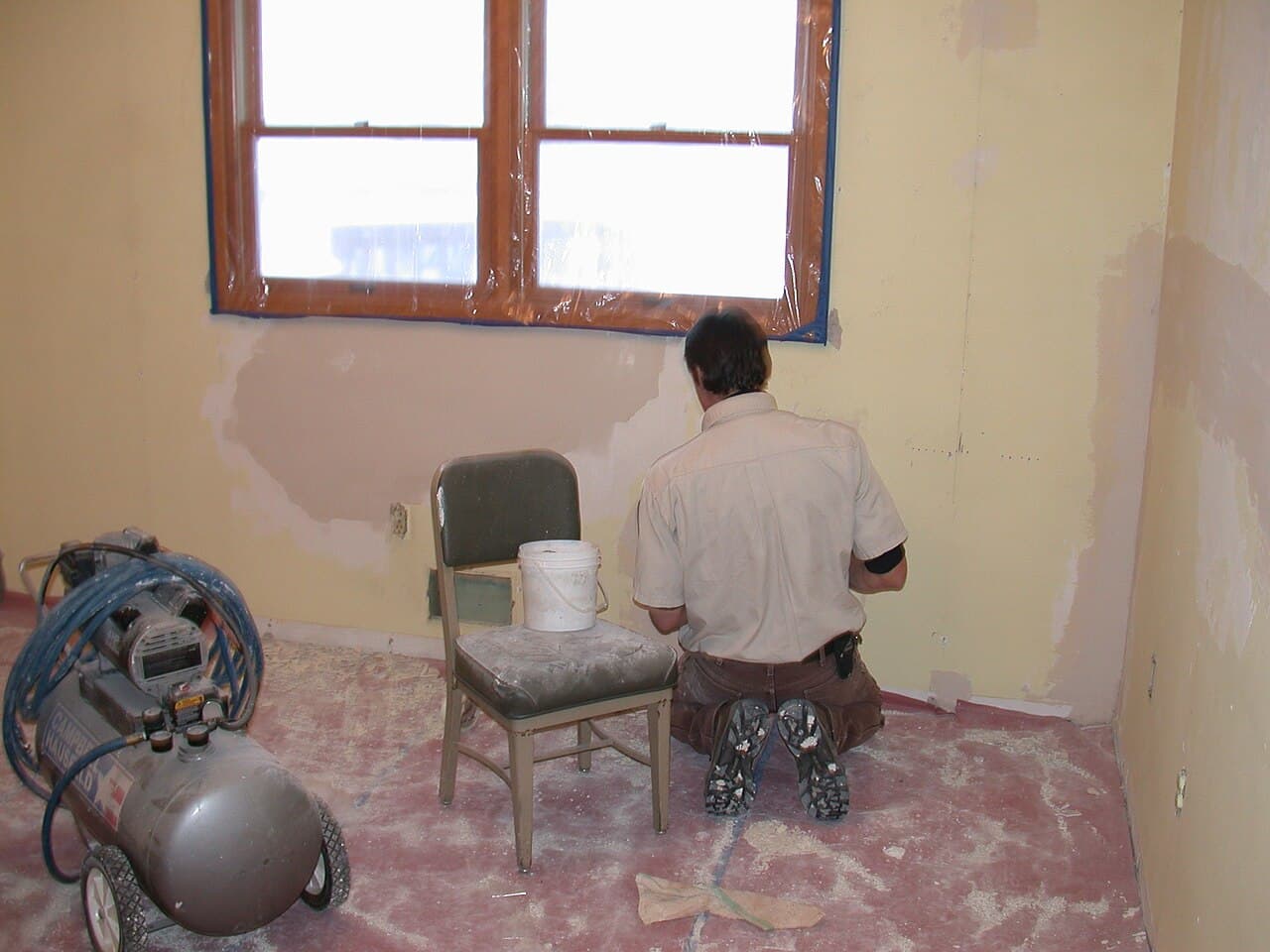
What moves the price
Size and position. Board is the cheap part. A section on a low wall in an empty room is a quick job, while a ceiling section or a high stairwell wall adds scaffolding, a second person and slower work. Several small patches in different rooms usually cost more than one patch of the same total area, because each one has its own setup, drying time and cleanup.
What is behind the board. Replacing board over a leak means checking the insulation and framing, and sometimes stopping for a plumber or a mold specialist. A quote written before the wall is opened often says so in the exclusions. If the damage is water, see how to repair water-damaged drywall and what water damage repair costs in Virginia.
Finish. Taping and coating takes several coats with drying time between them, so even a small section often means more than one visit. Texture matching, such as orange peel or knockdown, takes skill and affects price. USG says the standard Level 4 drywall finish is not recommended under non-flat or dark paints or where critical lighting is present,[5] and that skim coating the entire surface, a Level 5 finish, minimizes those imperfections.[5] Asking for that finish, or for the whole wall to be repainted so the patch does not show, costs more than painting only the patch.
Older homes and fire-rated walls. In an older house, EPA says anyone paid to do work that disturbs paint in housing built before 1978 must be certified in lead-safe work practices, and that includes sole proprietorships.[6] Expect that to appear in the quote. A fire-rated wall, such as the one between an attached garage and the house, needs matching board and a permit: Virginia's building code requires a permit for the repair or replacement of any required component of a fire or smoke rated assembly.[7]
What Virginia requires of the person you hire
No one may engage in contracting work in Virginia without a licence,[2] and the Class C licence covers a single job worth over $1,000 but less than $30,000.[1] DPOR's hiring guide puts the point at which a contractor's licence is required at work valued at $1,000 or more, and a repair plus repaint of several rooms can cross that line quickly.[4]
The licence should carry a specialty that fits. The Board for Contractors has a drywall contracting (DRY) specialty for installing, taping and finishing drywall, and a painting and wallcovering (PTC) specialty that includes the surface preparation, caulking and sanding before paint.[3] Look the business up in DPOR's licence lookup rather than trusting a number on a card.[4]
How to compare bids
DPOR's guide says it is advisable to get at least three written bids or estimates using identical plans and specifications, and not to automatically accept the lowest.[4] Give every business the same description and photos, then check that each bid names:
- the size of the section and whether the wall or only the patch is repainted
- the number of coats, the primer and the paint
- whether texture is matched
- what happens if the wall is opened and water damage or mold is found
- dust control, cleanup and haul-away
A bid well below the others usually leaves something out. DPOR's rule of thumb for the initial deposit is no more than 10% of the total price or $1,000, whichever is less,[4] and the price and scope belong in a written contract.
Do it yourself to cut the cost
A hand-sized patch on a dry wall is a reasonable weekend job: see how to patch a small hole in drywall. Buying a sheet of board and a bucket of compound costs far less than a visit, but the finish is where homeowners most often see the difference, and a poorly finished patch may cost more to fix than it would have cost to hire.
Stop and call a pro if
- The drywall is wet, sagging or stained from above. Fix the source first, then price the repair.
- You see mold, or the section is large enough that you are looking at a whole wall or ceiling.
- The wall is fire-rated or the work means moving wiring, a pipe or a duct inside the wall.
- The house was built before 1978 and the job means sanding or cutting old paint or texture.
- A bid is far lower than the others or asks for a large payment up front.
Getting help in Virginia
Read whether replacing drywall needs a permit and browse drywall patching businesses or more home repair answers.
When you are ready, describe the drywall repair once and local businesses quote it.
Common questions
- Is replacing a section of drywall priced by the square foot?
- Sometimes, but a small section is more often a flat price for the visit, because the work is mostly setup, drying time between coats, painting and cleanup rather than the board itself. Ask each business whether the quote is per job or per square foot and what the minimum charge is.
- Why do two quotes for the same hole differ so much?
- The scope usually differs. One bid may repaint only the patch, another the whole wall; one may match texture, another leave it smooth; one may include opening the wall to check for water damage. Line the bids up item by item before comparing the totals.
- Does a contractor need a licence for a small drywall job?
- Generally not for very small jobs. DPOR says a valid Virginia contractor's licence is required if the work is valued at $1,000 or more, and the licence must cover the kind of work, such as drywall contracting, painting or home improvement. Look up the licence on DPOR's licence lookup.
- Will insurance pay to replace the drywall?
- That depends on your policy and on what caused the damage. Read the policy or ask your insurer before work starts, and keep photos of the damage, because the cause usually matters more than the size of the section.
- Does a drywall patch need a permit?
- Usually not; replacing interior wall finishes is an ordinary repair in the Virginia building code. A required fire-rated wall or ceiling, such as the one between an attached garage and the house, is the common exception.
Sources
- [1] Va. Code § 54.1-1100, Definitions (Contractors), Code of Virginia, Virginia General Assembly. Checked October 27, 2026.
- [2] Va. Code § 54.1-1103, Necessity for license, Code of Virginia, Virginia General Assembly. Checked October 27, 2026.
- [3] 18VAC50-22-30, Definitions of specialty services (Board for Contractors Regulations), Virginia Administrative Code, Virginia General Assembly. Checked October 27, 2026.
- [4] What You Should Know Before You Hire a Contractor, Virginia Department of Professional and Occupational Regulation. Checked October 27, 2026.
- [5] Finishing & Decorating Gypsum Panels, White Paper (J2010), United States Gypsum Company. Checked October 27, 2026.
- [6] Lead Renovation, Repair and Painting Program, U.S. Environmental Protection Agency. Checked October 27, 2026.
- [7] 13VAC5-63-80, Section 108 Application for permit (Virginia Uniform Statewide Building Code), Virginia Administrative Code, Virginia General Assembly. Checked October 27, 2026.
Want a pro to handle it?
Describe the job once. Licensed local businesses send quotes, and you pay only when you book one.
Get a quote for Home Repair