How do I patch a small hole in drywall?
Clean the hole, trim loose paper, then press spackling or patching compound in with a putty knife, leaving it slightly proud. Holes deeper than about 1/8 inch go in thin layers. Once dry, sand it flush, prime the patch so it does not soak up paint, and repaint. Holes up to a few inches need a self-adhesive patch or paper tape behind the compound.
Free to ask. Local shops send quotes, and you pay only when you book one.
By Kasra Taheri, Founder, LoclisPublished
Researched and drafted with AI, then checked claim by claim against the sources listed below before it was published. Prices and rules change; the dates beside each source say when it was last checked.
Step by step
Read when to stop and call a pro, further down this page, before you start.
Step 1: Check the age of the house
If the house was built before 1978, treat the old paint as possible lead paint: sand as little as you can and pick up dust with a damp paper towel.[7]
Step 2: Clean the hole
Brush or vacuum out crumbs and dust so the surface is clean, dry and free of loose material before you fill it.[1]
Step 5: Press the filler in
Press spackling into the hole with a putty knife, then draw the blade firmly across the surface to take off the excess.[1]
Step 6: Build deep fills in layers
For a fill deeper than 1/8 inch, apply several thin layers and let each one dry fully before the next.[1]
Step 7: Leave the last coat a little high
Overfill the final layer slightly so it can be sanded down to a flat, smooth finish.
Step 9: Sand it smooth
Smooth the patch with a damp sponge or 150-grit or finer sandpaper, taking care not to scuff the paper around it.[3]
Step 10: Wipe off the dust
Wipe the area with a barely damp cloth and let it dry so primer and paint stick to the patch, not to dust.
Step 11: Prime the patch
Prime the repaired spot so the filler does not soak up the paint and show as a dull or flat patch.[5]
Step 12: Paint to match
Paint with the same color, sheen and roller or brush as the wall, working from the center out; repaint the whole wall if the spot still shows.[6]
A small hole in drywall is one of the easiest repairs in a house. Clean it out, fill it in thin layers, sand it flat, prime it and paint it. The two things that make a patch disappear rather than show are patience between coats and a coat of primer before the paint.
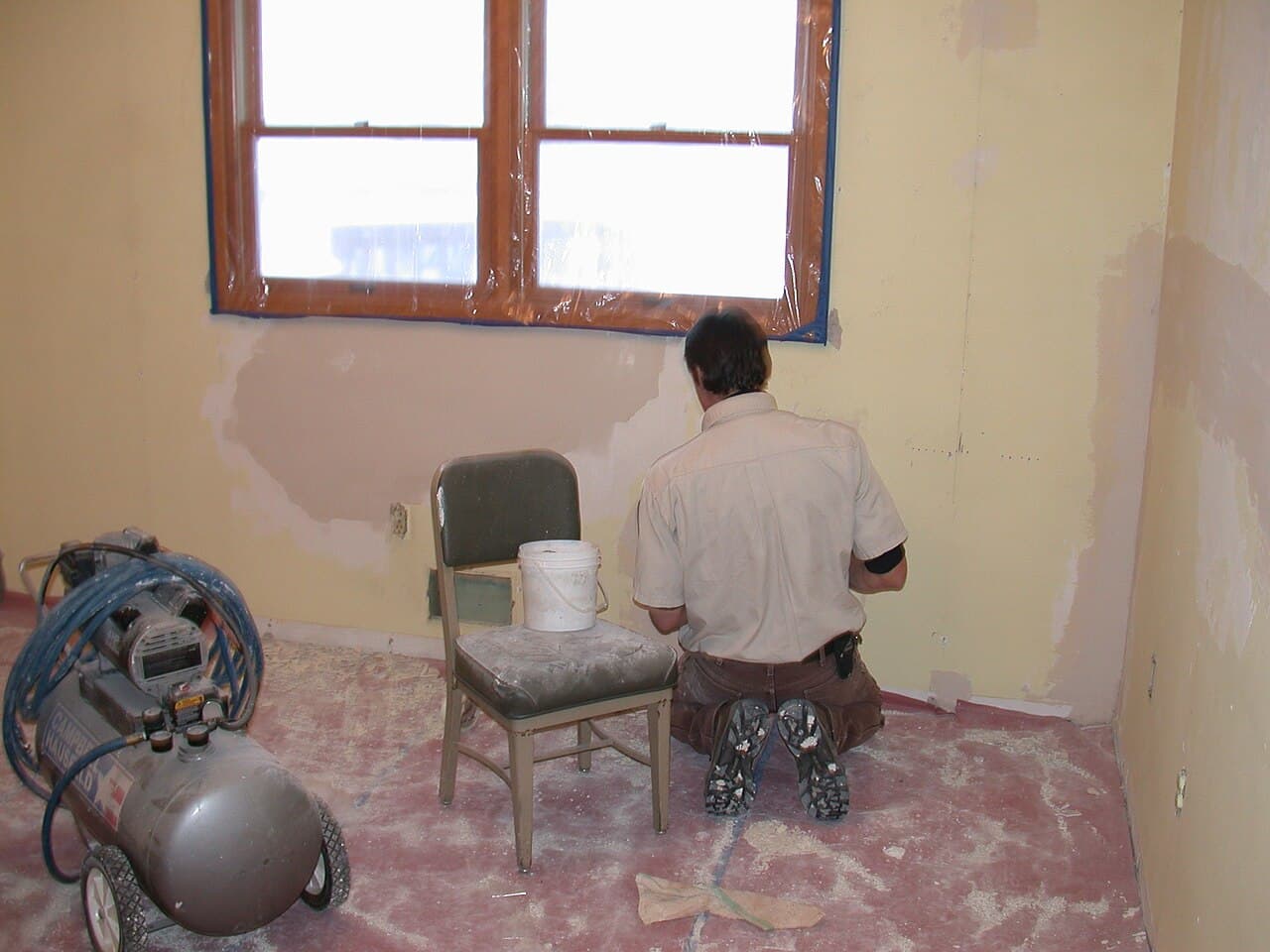
What you need
A tub of lightweight spackling or patching compound, a 2 to 6 inch putty knife, a utility knife, a sanding sponge or fine sandpaper, a damp cloth, a small can of primer and the wall paint. For anything bigger than a screw hole, add a self-adhesive repair patch or a roll of paper joint tape. Lay a drop cloth or old towel under the work.
Match the repair to the hole
Nail holes, screw holes and dents. Filler alone is enough. DAP says one application is usually enough for small repairs less than 1/8 inch deep,[1] so a picture-hanger hole often takes a single pass.
Holes up to a few inches, such as a doorknob dent or a pulled-out anchor. The filler needs something to bridge the gap. DAP's Eclipse self-adhesive patches come in 2, 4 and 6 inch sizes, for damage up to 1, 2 and 3 inches across,[2] and DAP says the 6-inch size is designed to withstand doorknob impact.[2] That kind of patch skips the compound: you paint over it straight away, pull off the clear protective layer after the first coat, then apply two more thick coats.[2] The traditional method works just as well: USG's repair instructions coat the edges of the hole with compound, criss-cross two or three strips of paper joint tape over the opening, embed them, and then cover the tape with two more coats.[3]
Anything bigger. A hole the size of a fist or larger is usually repaired by cutting the damage out square and fitting a new piece of drywall on wood backing strips, and the new piece must be the same thickness as the existing drywall.[4] That is still a homeowner job for many people, but it takes more tools and a day or two of drying.
Filling and drying
Work the filler into the hole, then pull the knife across the wall at a low angle so the surface is nearly flat. Thin coats dry faster and shrink less than one thick one. Leave the final coat a hair high so the sanding takes it flush rather than leaving a dip.
Temperature and humidity matter more than most people expect. DAP DryDex is meant to be applied between 50°F and 100°F,[1] and the formula turns from pink to white when it is ready to sand or paint, in about 1 to 5 hours depending on temperature, humidity and depth.[1] Joint-compound-style patching is slower: USG allows about 24 hours between coats of its patching compound at 75°F and 50% humidity, and asks for a working temperature of at least 55°F until it is completely dry.[3] A cold, damp basement in a Virginia winter can take much longer.
Sanding without making it worse
Sand only the filler. Rubbing the paper face of the drywall around the patch raises fuzzy fibers that show through paint. DAP recommends wet sanding to avoid making dust,[1] which also tends to leave a cleaner edge: wring out a sponge well and rub the patch in small circles until the edges blend. If you dry sand, USG suggests 150-grit sandpaper, 220-grit abrasive mesh or finer.[3] Run your fingertips across the patch with your eyes closed. A ridge you can feel will show once the paint goes on.
Prime, then paint
This is the step people skip, and it is the usual reason a patch shows. Priming seals the filler and helps keep it from absorbing the new paint,[5] and USG calls for a prime coat of a drywall primer or undiluted, high-solids latex flat wall paint before painting.[3] Benjamin Moore advises priming any touch-up where the drywall itself was damaged.[6]
Then paint with the same color and sheen, using the same kind of roller or brush as the rest of the wall, and feather the paint out from the center. Benjamin Moore's touch-up guidance is that flat and matte finishes touch up more easily than glossier ones.[6] On an eggshell or satin wall, or paint that has aged for years, repainting the wall from corner to corner often looks better than a spot touch-up. If your patch still shows, see why a drywall patch shows through paint.
Older houses: lead and asbestos
If your home was built before 1978, it is more likely to have lead-based paint.[7] If you hire the work out, anyone paid to do work that disturbs painted surfaces in a pre-1978 home must be certified in lead-safe work practices,[8] though the rule generally does not apply to homeowners working on their own home.[8] Either way, keep sanding to a minimum and clean up with damp cloths.
The EPA lists textured paint and patching compounds used on walls and ceilings among the places asbestos may be found,[9] and says you generally cannot tell whether a material contains asbestos just by looking at it.[10] Filling a nail hole does not disturb much, but sanding or cutting old textured walls in an older house is a reason to test first.
Stop and call a pro if
- The hole is in a wall you know or suspect is part of a fire-rated assembly (ask your building department if you are not sure). Virginia's building code requires a permit for the repair or replacement of any required component of a fire or smoke rated assembly.[11]
- The drywall around the hole is soft, stained or damp. That is a leak to find before any patch.
- You can see wires, a pipe or a duct right behind the hole, or you would need to cut into the wall near them.
- The wall has old texture or layers of old patching you would need to sand or cut, and you do not know whether it contains asbestos.
- The same crack keeps reopening, or cracks run from the corners of doors and windows. That points to movement in the house, not the patch.
Getting it done
A few small holes are a quick job. If you would rather hand it off, read what drywall repair costs in Virginia and whether to hire a handyman or a drywall contractor, browse drywall and paint services or drywall repair, find handyman businesses around Blacksburg, or read the other handyman answers.
When you would rather not do it yourself, describe the drywall repair once and local businesses quote it.
Common questions
- Should I use spackling or joint compound for a small hole?
- For nail holes, screw holes and dents, a ready-mixed spackling is the simpler choice: it goes on from a small tub and many brands dry in a few hours. Joint compound is meant for taping seams and larger patches and usually dries more slowly. Either works on a small hole if you build it up in thin layers.
- Do I really need to prime a drywall patch?
- Usually yes. Bare filler absorbs paint differently from the painted wall around it, so an unprimed patch often shows as a dull or flat spot. Benjamin Moore advises priming any touch-up where the drywall itself was damaged, and USG calls for a primer or a high-solids flat latex paint as the first coat.
- How big a hole can I fix without cutting in new drywall?
- Self-adhesive patches cover damage up to about 3 inches across, and paper tape bedded in compound bridges similar holes. Beyond that, the usual repair is to cut the damaged area square and fit a new piece of drywall the same thickness as the wall, backed by wood strips, which is a bigger job.
- Why did my patch sink or crack after it dried?
- Filler shrinks as the water leaves it, and a thick fill shrinks more. DAP calls for thin layers on anything deeper than 1/8 inch, each dried before the next. A patch that cracks along the same line again and again usually points to movement in the wall rather than the filler.
- Is it safe to sand old patches in an older house?
- Be careful. Homes built before 1978 are more likely to have lead paint, and the EPA lists textured paint and patching compounds used on walls and ceilings among materials that may contain asbestos. If you are unsure, keep sanding to a minimum, use a damp sponge instead of dry sandpaper, and ask an accredited asbestos professional to test the material rather than disturbing it yourself.
Sources
- [1] DryDex Spackling Technical Data Sheet, DAP Global. Checked October 27, 2026.
- [2] Eclipse Rapid Wall Repair Patch Technical Data Sheet, DAP Products. Checked October 27, 2026.
- [3] Sheetrock Brand Patch and Repair Pack Plus 3 Application Tips (J1805), United States Gypsum Company. Checked October 27, 2026.
- [4] How to Fix a Large Hole in Drywall, Benjamin Moore. Checked October 27, 2026.
- [5] How to Fix Cracks and Holes in Walls, Benjamin Moore. Checked October 27, 2026.
- [6] How to Touch Up Paint, Benjamin Moore. Checked October 27, 2026.
- [7] Protect Your Family from Sources of Lead, U.S. Environmental Protection Agency. Checked October 27, 2026.
- [8] Lead Renovation, Repair and Painting Program, U.S. Environmental Protection Agency. Checked October 27, 2026.
- [9] Learn About Asbestos, U.S. Environmental Protection Agency. Checked October 27, 2026.
- [10] Protect Your Family from Exposures to Asbestos, U.S. Environmental Protection Agency. Checked October 27, 2026.
- [11] 13VAC5-63-80, Section 108 Application for permit (Virginia Uniform Statewide Building Code), Virginia Administrative Code, Virginia General Assembly. Checked October 27, 2026.
Want a pro to handle it?
Describe the job once. Licensed local businesses send quotes, and you pay only when you book one.
Get a quote from a local pro