How much does an outdoor kitchen cost in Virginia?
There is no honest single figure, because an outdoor kitchen can be a grill set in a block island or a full kitchen with refrigeration, a sink and a vent hood. The price is set by the appliances, the island material, how far gas, power and water must run, and the permits. Get at least three written, itemized bids on the same plan.
Free to ask. Local shops send quotes, and you pay only when you book one.
By Kasra Taheri, Founder, LoclisPublished
Researched and drafted with AI, then checked claim by claim against the sources listed below before it was published. Prices and rules change; the dates beside each source say when it was last checked.
This is a job for a licensed pro in Virginia
This page explains what the work involves, the permits, what a licensed pro does and what drives the cost. It does not give step-by-step instructions, because this work needs a licence, a permit or both, and doing it wrong can injure someone. Before you hire, check the licence on Virginia's DPOR record.
An outdoor kitchen in Virginia can cost a little more than a good grill or as much as a room addition, and the same words describe both. The useful answer is what sets the price, so you can decide what you want and compare bids that price the same thing.
What drives the cost
The appliances. The grill, refrigerator, ice maker, side burner, warming drawer or pizza oven each add their own price and their own utility needs. Size changes everything downstream. Lynx, for example, rates the total gas demand of its grills from 65,000 BTU for its L27 and L30 grills to 130,000 BTU for its L54,[2] and a bigger load needs a bigger gas line.
The gas line. Pipe size and run length are a large part of the utility cost. In Lynx's sizing table, a half-inch pipe carries 170,000 BTU over a 10-foot run but only 80,000 BTU over 40 feet, while a three-quarter-inch pipe carries 169,000 BTU at 40 feet.[2] A kitchen at the far end of the yard can need the larger pipe, a longer trench and more labor. The same maker requires a pressure regulator on all gas equipment and an accessible shut-off valve on every hard-plumbed installation.[2] A grill on a portable propane cylinder avoids the line altogether. What it costs to run a gas line in Virginia covers that part on its own.
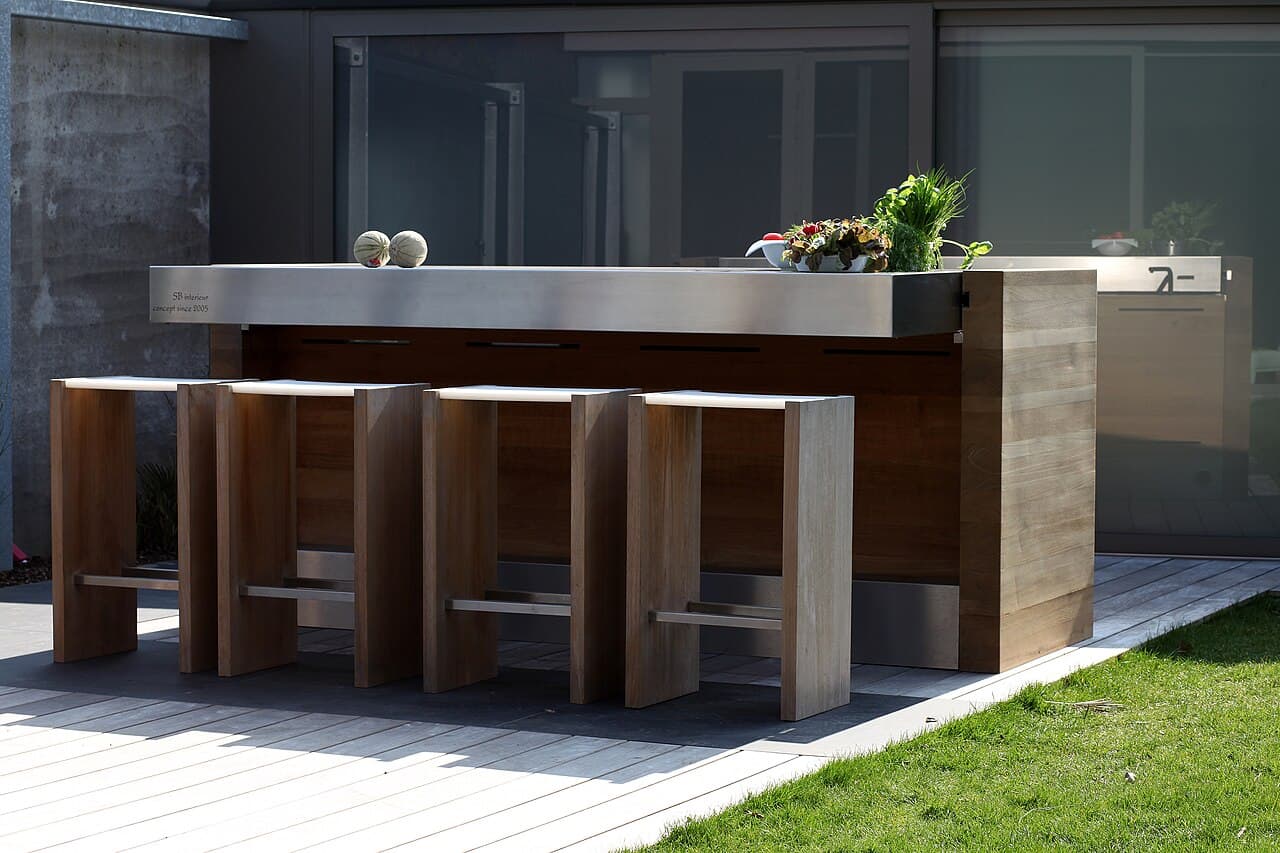
The island. Block or stone on a non-combustible base is the common build. A wood-framed or combustible cabinet costs extra in a different way: Lynx says installation in a combustible enclosure requires an insulated jacket accessory[1] for its grills. Countertop material, veneer, the number of access doors and drawers, and the length of the island all move the price.
A roof over the grill. A pergola or pavilion is its own project, and a combustible cover over a grill adds equipment. Lynx calls for an exhaust hood of no less than 1,200 CFM with its own GFCI-protected branch circuit[1] when its grill sits under combustible construction.
Power. Lights, igniters, refrigerators and hoods need an outdoor circuit, and grill makers specify it. Lynx calls for a 120-volt, 15-amp GFI outlet installed by a qualified electrician[1] for its grills. Distance from the panel, trenching and any panel upgrade set the electrical price.
Water and drains. A sink needs a supply line and a drain, and both have to be drainable for winter. An ice maker adds its own drain, and Lynx's needs a drain pump if the drain is more than 6 inches up.[3] Skipping the sink is one of the easiest ways to cut the cost.
The patio and site. If there is no sound patio to build on, add the slab or pavers, excavation and base. Slope, soil, access for machines and how far materials must be carried all count. What a paver patio costs in Virginia explains that side.
Permits and fees
Gas, electrical and plumbing work needs trade permits, and the fees vary by locality. When we checked on October 27, 2026, Montgomery County's posted schedule listed electrical, plumbing and mechanical trade permits for residential work, including accessory structures, at $0.03 per square foot with a $45 minimum,[4] plus a 2% Virginia state levy and a 2% technology fee with a $10 minimum.[4] Check your own county or city before you budget. Trenching for gas or power means a utility locate, and using Virginia 811 is always free.[5] Do I need a permit for an outdoor kitchen in Virginia covers which parts need one.
When to call a licensed pro
DPOR says the Board for Contractors regulates individual tradesmen who engage in the trades of electrical; plumbing; heating, ventilation, and air conditioning (HVAC); gas fitting,[7] so the gas line, the wiring and the plumbing go to licensed people, and the builder needs a contractor licence sized to the job. A single job worth over $1,000 but less than $30,000 is in the Class C contractor range, and one worth $30,000 or more but less than $150,000 is Class B.[6] A large outdoor kitchen can cross into Class B, so check that the licence on DPOR's lookup covers the contract value.
DPOR's consumer guide says to get at least three written bids or estimates using identical plans and specifications.[8] It suggests an initial deposit of no more than 10% of the total price or $1,000, whichever is less, rising to as high as 30% of the total contract value[8] for custom or special-order items. It also warns: "Beware of any bid substantially lower than the others".[8]
What to ask for in a written quote
- The appliance list with brands and model numbers, and whether you or the contractor buys them.
- The island: length, frame and veneer, countertop, doors and drawers, and the grill maker's clearances it meets.
- Gas: fuel type, pipe size and route, regulator, shut-off location, and the licensed gas fitter doing it.
- Electrical: circuits, outlets, lighting, any hood, and the electrician's licence.
- Plumbing: supply and drain lines, how they drain for winter, and any ice-maker drain pump.
- The patio or slab under the island, trenching and restoration of the lawn.
- Who pulls each permit and calls 811, the schedule, the payment plan and the warranty.
An itemized quote lets you see what each feature costs and trim the plan before you sign. What building an outdoor kitchen involves explains each part of the job. Browse outdoor kitchen businesses, concrete and hardscaping businesses in Blacksburg, or more concrete and hardscaping answers.
Describe your outdoor kitchen once and licensed local businesses send quotes you can compare.
Common questions
- What is the cheapest way to get an outdoor kitchen?
- Keep the utilities short and simple. A grill on a portable propane cylinder in a ventilated, non-combustible island on an existing patio avoids a gas line, an electrical circuit and plumbing. Every utility you add, and every foot it has to run, adds cost and usually a permit.
- Is natural gas or propane cheaper for an outdoor kitchen?
- It depends on the house. A portable propane cylinder needs no gas line at all. Natural gas or a bulk propane tank needs a line sized for the appliances and run length, a licensed gas fitter and a permit, but saves refilling cylinders. Ask for both options priced if you are unsure.
- Why are bids for the same outdoor kitchen so different?
- Usually because they are not for the same job. One bid may assume a shorter gas run, a smaller pipe, no new circuit, a different enclosure material or that you buy the appliances. Give every bidder the same plan and model list, and ask what each one left out.
- Do permits add much to the cost?
- Permit fees are one line in the budget, and inspections also set the schedule. When we checked on October 27, 2026, Montgomery County listed residential trade permits at $0.03 per square foot with a $45 minimum, plus a state levy and a technology fee.
- How much deposit should I pay?
- DPOR's rule of thumb is no more than 10 percent of the total or $1,000, whichever is less, rising to as much as 30 percent when the job needs custom or special-order items. Outdoor appliances and stone are often special orders, so ask what the deposit buys.
Sources
- [1] Lynx Professional Grills (Pro Models) Care & Use / Installation Manual, Lynx Grills. Checked October 27, 2026.
- [2] Gas Plumbing Requirements, Lynx Grills. Checked October 27, 2026.
- [3] LN15ICE Ice Machine Care & Use / Installation, Lynx Grills. Checked October 27, 2026.
- [4] Permit & Inspection Fees, Montgomery County, Virginia, Building Permits & Inspections. Checked October 27, 2026.
- [5] Homeowners FAQ, Virginia 811. Checked October 27, 2026.
- [6] § 54.1-1100. Definitions (contractor classes), Code of Virginia. Checked October 27, 2026.
- [7] Tradesmen, Virginia Department of Professional and Occupational Regulation. Checked October 27, 2026.
- [8] What You Should Know Before You Hire a Contractor, Virginia Board for Contractors (DPOR). Checked October 27, 2026.
Want a pro to handle it?
Describe the job once. Licensed local businesses send quotes, and you pay only when you book one.
Get a quote from a local pro