How much does a paver patio cost in Virginia?
It depends mostly on size, how much digging and base the soil needs, the pavers you choose, the pattern and number of cuts, and site access. There is no current dated statewide price, so get at least three written bids on the same specification: base depth, compaction, edge restraint, sand, pavers and joint fill.
Free to ask. Local shops send quotes, and you pay only when you book one.
By Kasra Taheri, Founder, LoclisUpdated
Researched and drafted with AI, then checked claim by claim against the sources listed below before it was published. Prices and rules change; the dates beside each source say when it was last checked.
Step by step
Read when to stop and call a pro, further down this page, before you start.
Step 1: Measure the patio
Measure the length and width, sketch any curves, steps or cut-outs, and note where it meets the house, so every bidder prices the same area.
Step 2: Note the site conditions
Write down how the ground slopes, where water goes in heavy rain, and how a skid loader or wheelbarrow would reach the spot.
Step 3: Write a short specification
Ask each bidder for base depth and material, compaction in layers, edge restraint type, bedding sand, paver make and thickness, and joint fill.
Step 4: Get three written bids
Ask at least three contractors to bid on the same plans and specifications, and ask them to explain any large differences.[4]
Step 7: Keep the deposit small
Agree a deposit of no more than 10 percent or $1,000, whichever is less, unless special-order materials justify more.[4]
Step 8: Get it in a written contract
Make sure the contract lists the specification, price, schedule, clean-up, haul-off and warranty before work starts.[4]
There is no single price for a paver patio in Virginia, and no current statewide figure from a public source to quote. What a patio costs depends on its size, how much digging and base your soil needs, the pavers and pattern you choose, and how easy the site is to reach. The useful way to price one is to fix the specification, then get three written bids on it, so you are comparing the same patio.
What drives the price
Size and shape. Area is the starting point, but shape matters too. Curves, steps, borders, inlays and cut-outs around trees or posts all add cutting time. A busy outline means many more cut pavers than a rectangle.
Excavation and haul-off. The crew has to dig out and haul away enough soil for the base, sand and pavers, plus a margin, because the base should extend past the paved edge by as much as it is deep.[1] A site that a small loader can reach costs less than one where everything goes in and out by wheelbarrow.
The base, which is where cheap bids save. The paver maker Unilock gives 4 to 6 inches of base as its guideline for pedestrian walkways and 8 to 12 inches for driveways, with no absolute rule, and says clay soils generally need to be dug deeper to drain.[1] If a patio bid is far below the others, compare base depth first. More base means more stone, more compaction time and more soil to remove, and it is the part you cannot see once the patio is finished.
Edge restraint. Spiked plastic or aluminum paver edging, a precast edge or a poured concrete curb all cost differently. Unilock says all paver projects need edge restraint, because unrestrained pavers slowly creep into softer surrounding material and open gaps around the edge, and recommends an invisible edge system spiked into the base.[2] A bid with no edge restraint is cheaper for a reason.
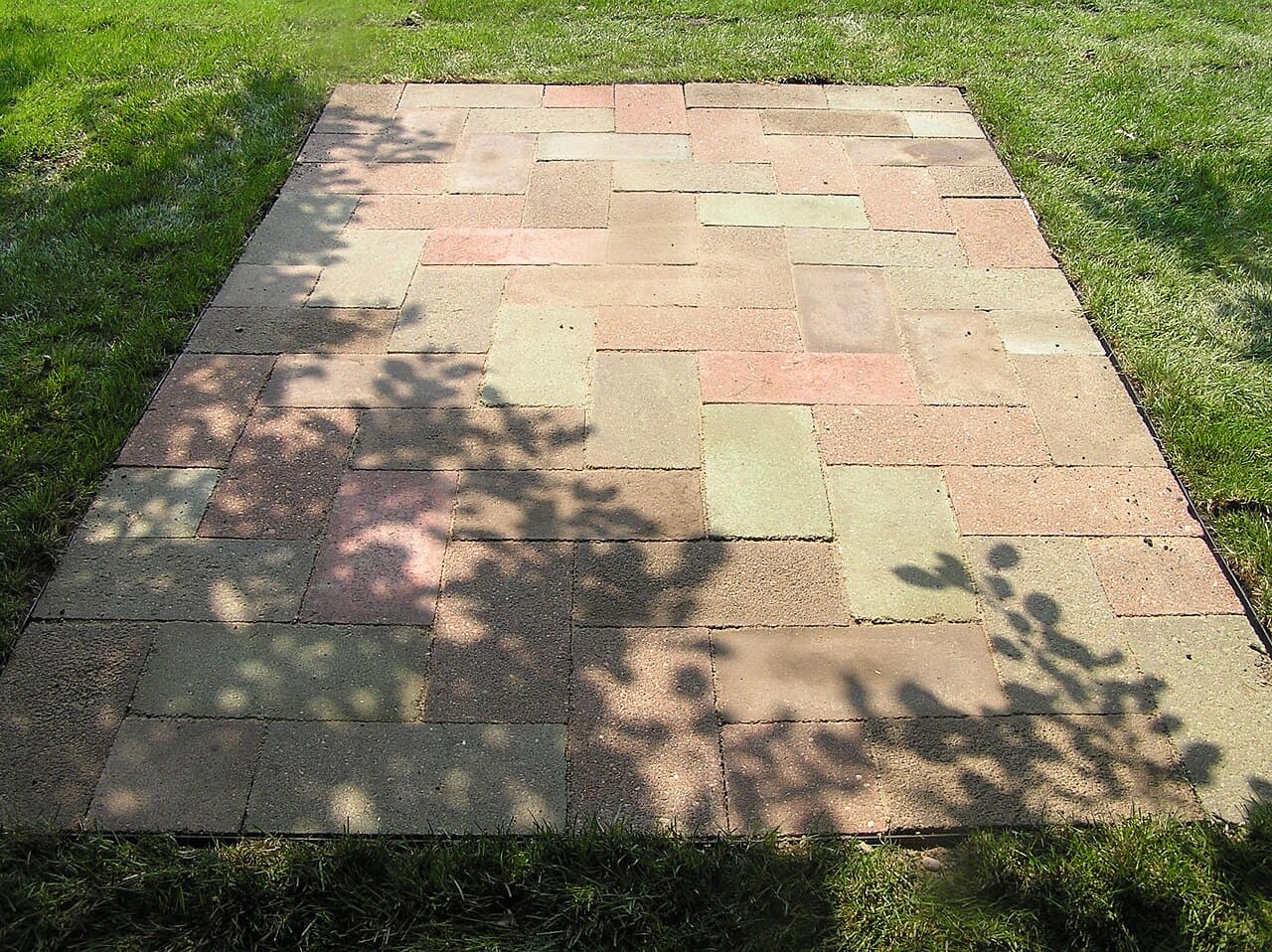
The pavers. Concrete pavers range from plain rectangles to tumbled, textured and large-format slabs, and natural stone and clay brick are further options to price. Whatever you pick, ask the bid to name the make and product line so you can read the manufacturer's own specifications. Pattern matters as well: herringbone and mixed-size patterns take longer to lay than a running bond.
Joints and finish. Plain joint sand is the basic fill. Polymeric sand is another option, so ask which one the bid includes and which product. A sealer is an optional extra, now or later.
Permeable pavers. If the patio must soak up runoff, permeable pavers sit on layers of gravel and larger stones that form a storage reservoir, and its depth and materials are set by the amount of stormwater, the type and amount of traffic, and the soil.[3] Virginia Cooperative Extension's 2024 homeowner fact sheet calls permeable pavement an expensive stormwater management practice when compared to other practices,[3] meaning the other ways a homeowner can manage runoff, such as rain barrels and rain gardens, not ordinary pavers. It gives permeable pavement of all kinds an average of $4.00 to $50.00 per square foot depending on the type, based on 2017 cost estimates,[3] and warns that many other associated costs could make the final amount much higher.[3] It also notes that some cities and counties offer rebates, utility bill credits or cost sharing[3] for stormwater practices, so ask your locality.
What to ask for in a written quote
A good quote reads like a short specification. Ask for:
- base material and compacted depth, and how many layers it is compacted in;
- whether a geotextile or drain pipe is included;
- the edge restraint type;
- bedding sand type and depth (Unilock says to avoid stone dust and limestone screenings, which trap water[1]);
- paver make, color, thickness and pattern;
- joint fill (sand or polymeric) and whether sealing is included;
- slope and which way water will drain;
- excavation, haul-off, clean-up and lawn repair;
- the warranty, in writing.
Some paver manufacturers run authorized-installer programs, and asking whether the crew is authorized for the make you chose is a fair question.
Licences, contracts and approvals
In Virginia, a business doing paver work should hold a contractor licence with a specialty that covers it. The masonry (BRK) specialty's definition includes mortarless type masonry products,[6] and the home improvement contracting (HIC) specialty, which covers patios that do not require a permit under the USBC,[6] is another common fit. The licence class must cover the contract price: Class C contractors work on a single contract or project over $1,000 but less than $30,000,[5] Class B covers $30,000 or more, but less than $150,000,[5] and Class A covers $150,000 or more.[5]
DPOR's consumer guide is direct: Virginia law requires all licensed contractors to provide a written contract for residential work.[4] It also suggests an initial deposit of no more than 10% of the total price or $1,000, whichever is less.[4]
Using Virginia 811 is free, and when you hire the job out, your contractor is responsible for contacting Virginia 811.[7] Permit and approval rules are your locality's to answer. Prince William County, for example, lists concrete patio slabs on grade among work with no building permit, but notes that zoning and/or watershed approval will be required.[8] Its list does not mention pavers, so ask your own county or city, ask the contractor who will handle any approval, and check HOA rules yourself.
Stop and call a pro if
- The patio needs a retaining wall or steps to make the ground level.
- Water already pools where the patio will go or runs toward the house.
- It will carry a hot tub, a roof, an outdoor kitchen or vehicles, which need a heavier design and other trades.
- A bid has no base depth, compaction or edge restraint in it. Ask for them in writing before comparing prices.
Next steps
If you are weighing the work yourself, how to lay a paver patio shows what the job involves, and pavers or poured concrete compares the two. Slab prices are in what a concrete slab costs in Virginia. Browse patio and paver businesses, look up concrete and hardscaping businesses in Blacksburg, or read more concrete and hardscaping answers.
Describe your patio once and licensed local businesses quote it.
Common questions
- Why do paver patio quotes vary so much?
- Bids often describe different patios. One may include a thicker compacted base, a drain pipe, a concrete or spiked edge restraint and polymeric joint sand; another may skip some of them. Ask every bidder to price the same written specification so the numbers can be compared.
- Is a paver patio cheaper than poured concrete?
- It depends on the site and the design, so get written bids for both. Pavers take more hand labor to lay, while a slab needs forms, a pour and finishing in one go; pavers in a slightly low spot can often be lifted and relaid. The trade-offs are in our answer on pavers versus poured concrete.
- What does a permeable paver patio cost?
- Virginia Cooperative Extension's 2024 homeowner fact sheet gives permeable pavement an average of $4.00 to $50.00 per square foot by type, based on 2017 estimates, and warns that other costs can push it much higher. The stone reservoir is sized to the stormwater, traffic and soil, and an underdrain may be needed where water does not soak in quickly. Some localities offer rebates or credits.
- What licence should a paver contractor have in Virginia?
- A Virginia contractor licence whose class fits the contract amount (Class C for a single project over $1,000 and under $30,000) and a specialty that covers the work, such as home improvement (HIC) or masonry (BRK). Look the business up on DPOR's licence lookup before you sign.
- How much deposit should I pay for a patio?
- DPOR's consumer guide suggests no more than 10 percent of the total or $1,000, whichever is less, with a higher deposit only for custom or special-order items. Pay the balance as work is completed, not in advance.
Sources
- [1] Do's and Don'ts of Paver Installation: Base Preparation, Unilock. Checked October 26, 2026.
- [2] Do's and Don'ts of Paver Installation: Step 3 of 3 - Installing the Pavers, Unilock. Checked October 27, 2026.
- [3] Stormwater Management for Homeowners Fact Sheet 3: Permeable Pavement (SPES-610P), Virginia Cooperative Extension, Virginia Tech. Checked October 26, 2026.
- [4] What You Should Know Before You Hire a Contractor, Virginia Board for Contractors, DPOR. Checked October 26, 2026.
- [5] Va. Code § 54.1-1100, Definitions (contractors), Code of Virginia, Virginia General Assembly. Checked October 26, 2026.
- [6] 18VAC50-22-30, Definitions of specialty services, Virginia Administrative Code, Board for Contractors. Checked October 26, 2026.
- [7] Homeowners FAQ, Virginia 811. Checked October 26, 2026.
- [8] Do I Need a Permit?, Prince William County Building Development Division. Checked October 26, 2026.
Want a pro to handle it?
Describe the job once. Licensed local businesses send quotes, and you pay only when you book one.
Get a quote from a local pro