What does building an outdoor kitchen involve?
An outdoor kitchen is four trades in one project: a base and island built to the grill maker's clearance rules, a gas line sized for the appliances, a GFCI-protected electrical circuit, and often water and a drain for a sink or ice maker. The gas, wiring and plumbing need permits and licensed tradespeople in Virginia, so plan and hire it as a small construction job.
Free to ask. Local shops send quotes, and you pay only when you book one.
By Kasra Taheri, Founder, LoclisPublished
Researched and drafted with AI, then checked claim by claim against the sources listed below before it was published. Prices and rules change; the dates beside each source say when it was last checked.
This is a job for a licensed pro in Virginia
This page explains what the work involves, the permits, what a licensed pro does and what drives the cost. It does not give step-by-step instructions, because this work needs a licence, a permit or both, and doing it wrong can injure someone. Before you hire, check the licence on Virginia's DPOR record.
Building an outdoor kitchen means putting four kinds of work in one place: a base and island that meet the appliance maker's fire-safety rules, a gas supply, electrical power and, if you want a sink or ice maker, water and a drain. The masonry is the part you see. The utilities are where the permits, the licensed trades and most of the planning go.
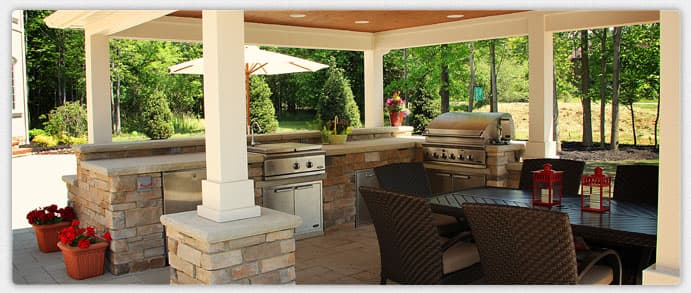
The design comes from the appliances
Pick the grill and the other appliances before anyone draws the island. Each one comes with an installation manual that sets the cutout size, clearances, ventilation and utility locations, and the island is built to those pages.
Enclosure material. Lynx, for example, says its built-in grills are made either for an enclosure of non-combustible materials or for a combustible enclosure fitted with the maker's insulated jacket.[1] Concrete block and stone are the usual non-combustible choices. A wood-framed island is not automatically ruled out, but it needs the jacket and the clearances.
Clearances. The same manual calls for a minimum clearance of 12 inches from the sides and 6 1/4 inches from the back to adjacent combustible construction.[1] Siding, wood posts, a wooden pergola and cabinet doors all count. Other makers' numbers differ, which is why the manual for your model governs.
Ventilation. Lynx says the enclosure should have ventilation holes to prevent gas build-up in the event of a leak.[1] That matters most with propane, because propane is heavier than air and may accumulate in low spaces.[6] Vents near the floor of the island let leaked gas out instead of pooling inside the cabinet.
A roof overhead. A grill under a pergola, pavilion or porch roof brings extra rules. If the cover is combustible, Lynx requires an exhaust hood with 3 inches of overhang on all exposed sides, no less than 1,200 CFM, and its own GFCI-protected branch circuit.[1] Its manual also says a shelter counts as outdoors only if it has no overhead cover and no more than three sidewalls, or an overhead cover and no more than two sidewalls,[1] with a narrow exception for a roofed space that stays largely open. A screened porch does not count, because screened openings are not permanent openings.[1]
The gas supply
You can run a built-in grill from a portable propane cylinder in a ventilated cabinet, or hard-pipe it to natural gas or a bulk propane tank. Hard piping is the more convenient option and the bigger job.
Pipe size matters more than people expect. In Lynx's sizing table, a half-inch pipe carries 170,000 BTU over a 10-foot run but only 80,000 BTU over 40 feet,[2] and a big grill plus a side burner can need more than that. The same maker requires a pressure regulator on all gas equipment and an accessible gas shut-off valve for every hard-plumbed natural gas or propane installation.[2]
If you have natural gas service, the utility may need to confirm the meter can carry the extra load. Columbia Gas of Virginia, for example, says it can check that you have enough gas pressure for new appliances.[7] Gas lines to an island are usually trenched across the yard, which means a locate first: you must contact Virginia 811 at least 3 working days before you dig.[10] Using Virginia 811 is always free.[10]
Power, water and drains
Electrical. Grill lights, igniters, rotisseries, refrigerators and hoods all need power. Lynx calls for a 120-volt, 15-amp GFI outlet installed by a qualified electrician[1] for its grills. Usually that means a new outdoor circuit from the panel.
Refrigeration. Outdoor-rated refrigerators are built for the weather, but within limits. Lynx gives a recommended installation temperature range of 55 to 100°F,[3] so shade and airflow around the unit matter, and the refrigerator needs winter care (how to winterize an outdoor kitchen).
Sinks and ice makers. A sink needs a supply line and a drain through a trap, and Lynx says its sinks should be installed by a qualified technician in accordance with all local plumbing and building codes.[5] Its ice machine needs drain plumbing, and a drain pump if the drain is more than 6 inches up.[4] Water lines outdoors also have to be drainable for winter, which is easier to plan now than to add later.
Permits and inspections
Virginia's Uniform Statewide Building Code requires a permit for work on electric wiring, fuel supply systems, the water supply and the sanitary drainage system.[8] It exempts concrete or masonry walls no more than six feet above finished grade,[8] so a plain block island with no utilities may need no building permit, but an outdoor kitchen almost never stops there.
Each locality applies the code. Fairfax County, for example, lists sinks, hose bibs and wet-bars among the plumbing and gas fixtures that need a permit, and on-grade paver and concrete patios among the work that does not.[9] Zoning setbacks and HOA rules can apply even when no building permit does. Do I need a permit for an outdoor kitchen in Virginia goes through the rules in detail.
When to call a licensed pro
Bring in licensed people for every utility. The Code of Virginia defines a liquefied petroleum gas fitter's work as the installation, repair, improvement, alterations or removal of piping, liquefied petroleum gas tanks and appliances,[11] and electrical and plumbing work done for hire has its own tradesman licences. Who can install a gas line in Virginia covers the gas side.
The builder needs a contractor licence sized to the job. A single job worth over $1,000 but less than $30,000 falls in the Class C contractor range, and one worth $30,000 or more, but less than $150,000, is Class B.[12] Check every licence on DPOR's lookup.
Ask for a written plan that names the appliances and models, the island material, the gas fuel and pipe size, the electrical circuits, any water and drain lines, who pulls each permit, and who calls 811. What an outdoor kitchen costs in Virginia explains how those choices drive the price, and what a paver patio costs helps if the kitchen needs a new patio under it.
Browse outdoor kitchen businesses, concrete and hardscaping businesses in Blacksburg, or more concrete and hardscaping answers.
Describe your outdoor kitchen once and licensed local businesses send quotes you can compare.
Common questions
- Can I build the island myself and hire out the rest?
- Many owners do some of the non-utility work, such as a block or stone island on an existing patio, but the gas line, wiring and plumbing are licensed trade work when you hire it out, and they need permits. Agree in writing who builds what before anyone starts, because the island has to meet the grill maker's clearance and ventilation rules before the gas and electrical work is finished.
- Does an outdoor kitchen need a gas line, or can I use a propane tank?
- Either can work. Many built-in grills, Lynx's among them, can run from a 20-pound propane cylinder in a ventilated cabinet, or be hard-piped to natural gas or a bulk propane tank. A hard-piped line needs a regulator, an accessible shut-off valve, pipe sized for the run, and a licensed gas fitter and permit.
- Do I need a new electrical circuit?
- Usually. Built-in grills with lights or rotisseries, refrigerators, ice makers and vent hoods all need power, and grill makers call for a GFCI-protected outlet installed by a qualified electrician. A vent hood over a grill under a roof may need its own circuit. New circuits and outlets need an electrical permit.
- Can I put an outdoor kitchen under my covered porch?
- Only if the space still counts as outdoors under the grill maker's rules and you have the clearances and, under combustible framing, a rated exhaust hood. A porch with three walls and a roof often fails the test. Ask the designer to show the manufacturer's installation page for your exact grill.
- Who should I hire to build an outdoor kitchen?
- A licensed contractor who builds outdoor kitchens, working with or employing a licensed gas fitter, electrician and plumber. Check each licence on DPOR's lookup, get at least three written bids on the same design, and make sure the contractor pulls the permits in its own name.
Sources
- [1] Lynx Professional Grills (Pro Models) Care & Use / Installation Manual, Lynx Grills. Checked October 27, 2026.
- [2] Gas Plumbing Requirements, Lynx Grills. Checked October 27, 2026.
- [3] Outdoor Refrigeration Use and Care Manual / Installation, Lynx Grills. Checked October 27, 2026.
- [4] LN15ICE Ice Machine Care & Use / Installation, Lynx Grills. Checked October 27, 2026.
- [5] Sinks Care & Use Manual (LSK18 / LSK24 / LSK30), Lynx Grills. Checked October 27, 2026.
- [6] Propane Safety, Columbia Gas of Virginia. Checked October 27, 2026.
- [7] Safe Appliance Installation, Columbia Gas of Virginia. Checked October 27, 2026.
- [8] 13VAC5-63-80, Section 108 Application for permit (Virginia Uniform Statewide Building Code), Virginia Administrative Code, Legislative Information System. Checked October 27, 2026.
- [9] Does My Project Require a Permit?, Fairfax County Land Development Services. Checked October 27, 2026.
- [10] Homeowners FAQ, Virginia 811. Checked October 27, 2026.
- [11] § 54.1-1128. Definitions (tradesmen and gas fitters), Code of Virginia. Checked October 27, 2026.
- [12] § 54.1-1100. Definitions (contractor classes), Code of Virginia. Checked October 27, 2026.
Want a pro to handle it?
Describe the job once. Licensed local businesses send quotes, and you pay only when you book one.
Get a quote from a local pro