How do I keep weeds from growing between pavers?
Keep the joints full and clean. Weeds between pavers grow from seeds that land in the joints, mostly in dirt and debris that collects on top, so sweep the patio in spring and fall, pull weeds while they are small, keep joint sand topped up, and consider polymeric sand. Plastic sheeting under the pavers does not help.
Free to ask. Local shops send quotes, and you pay only when you book one.
By Kasra Taheri, Founder, LoclisUpdated
Researched and drafted with AI, then checked claim by claim against the sources listed below before it was published. Prices and rules change; the dates beside each source say when it was last checked.
Step by step
Read when to stop and call a pro, further down this page, before you start.
Step 1: Sweep twice a year
Sweep the patio in spring to clear leftover deicer and winter sand, and in fall to clear dirt and leaves.
Step 2: Pull weeds while small
Pull weeds by hand or with a crack-weeding knife before they set seed, ideally when the joints are damp and roots slide out.
Step 3: Check the joint sand
Look at the joints after sweeping and top them up with dry sand if the sand has dropped well below the paver surface.
Step 4: Top up with dry sand
On a dry day, sweep dry joint sand back and forth until the joints are full, then sweep off the rest.
Step 6: Blow off the dust
After sweeping polymeric sand in and compacting it, blow every trace of dust off the pavers before wetting, or it can stain.[2]
Step 8: Follow any weedkiller label
If you use a herbicide, choose one labelled for patios and paths, follow its label exactly, and keep it off nearby beds and lawn.[4]
Keep the joints full, firm and clean, and weeds have little to grow in. Weeds between pavers do not grow up from the bedding sand or the base; they start from seeds that land in dirt and debris collecting in the joints. So the fight is at the surface: sweep, pull early, keep the joint sand topped up, and if you want more protection, use polymeric sand.
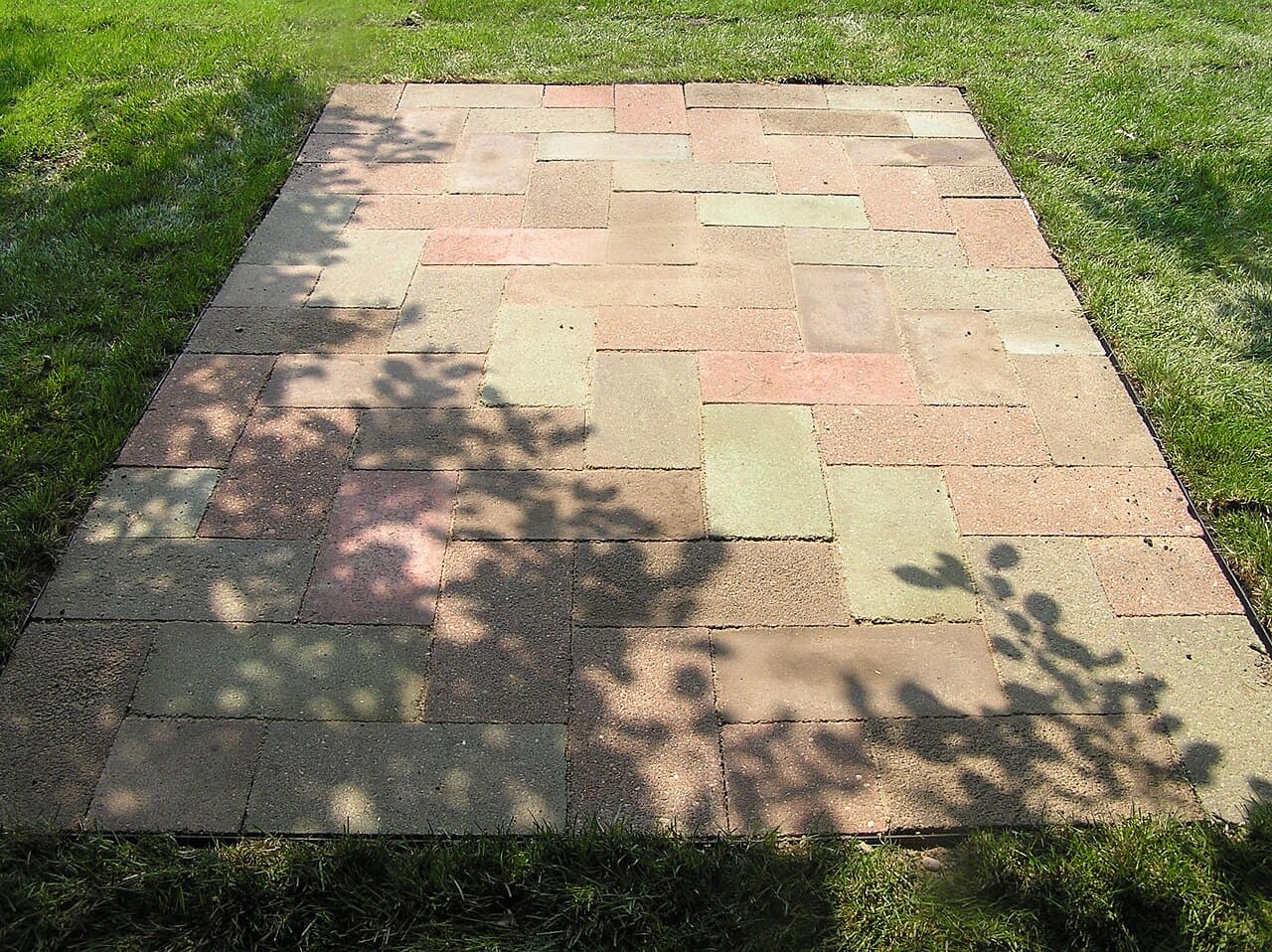
Why weeds show up
Unilock puts it simply: in most cases, seeds start from the top of the cracks and work their roots down.[1] Dust, leaf litter and grit settle into the top of the joints, seeds land in it, and moisture does the rest. Shady, damp patios and joints that have lost sand get the most.
That is also why plastic sheeting under the patio does not work. Unilock warns: "Plastic will entrap water"[1] under the pavers, which can cause other problems, and it does nothing about seeds landing on top.
Routine care that keeps weeds down
Sweep in spring and fall. A spring sweeping clears leftover deicer and winter sand, and a fall sweeping clears dirt and leaves. A leaf blower or a gentle rinse works too, but be careful not to blow or wash out the joint sand. Sweeping also clears the grit and leaf litter that seeds settle into.
Pull weeds early. A crack-weeding knife or a stiff brush along the joints gets seedlings out before they root deeply or set seed. It is easiest after rain, when the joints are damp.
Keep the joints full. If the joint sand has dropped well below the surface, top it up. Wait for a dry surface, then sweep dry joint sand back and forth until it fills the joints, and sweep off the excess. Do not top up with polymeric sand over old sand; it is for a full refill, as below.
Polymeric sand
Polymeric sand is sand blended with a binder that hardens when wetted. Unilock's advice is a good polymeric sand with the joints filled to within 1/8 inch (3 mm) of the surface,[1] and Sakrete's Paver Set, for example, lists reduced weed growth among its features.[2] It only works if it goes in right:
- Joint width. Check the bag's range against your joints before you buy. Sakrete's Paver Set lists a minimum joint width of 1/4 inch,[2] while Sika's Evolution is made for joints from 1/8 inch wide.[3] Measure your joints first.
- Conditions. Sakrete's product should be applied when temperatures are above 40°F and no rain is forecast within 24 hours,[2] and the pavers must be completely dry.[2] Sika's Evolution wants the air and surface to stay above 41°F for at least 48 hours after installation, with no rain expected for 24 hours, or 48 hours for joints wider than 1/2 inch.[3]
- Full depth. For a refill on an existing patio, Sika tells you to remove existing sand to full joint depth or at least 1.5 inches before re-sanding.[3] A narrow joint scraper or a pick gets the old sand out.
- Clean surface. After sweeping it in and compacting, blow every bit of dust off the paver faces, because dust left on the surface can stain[2] once it is wetted.
- Wet places. Sika's product is not to be used where joints are submerged or permanently wet,[3] so fix drainage first.
Sealers and joint stabilizers. Liquid joint stabilizers and sealers are sold to bind ordinary joint sand. Follow the product's label for surface preparation, ventilation and protective gear, because some sealers are solvent-based. If you have just put in polymeric sand, Sika says to wait at least 30 days before applying sealers or cleaners.[3]
If weeds are already established
Weeds can be pulled by hand, killed with steam or boiling water, or killed with a herbicide. With any weedkiller, keep it off adjacent beds and lawn, since runoff from pavers flows straight into them. Choose a product labelled for patios, walks and driveways, and follow it to the letter: the U.S. Environmental Protection Agency points out that pesticide labels are legally enforceable, and "the label is the law."[4] Kill or pull the weeds first, then clean and refill the joints, or new seeds will move straight in.
Stop and call a pro if
- Pavers rock, sink or have wide gaps. Weeds in wide joints often mean the patio has moved; see why pavers sink.
- The joints stay wet or green all year, which points to a drainage problem that polymeric sand will not fix.
- Old polymeric sand is crumbling across a large patio and the whole surface needs cleaning, re-sanding and possibly resetting.
- The weeds are tree seedlings or vines rooting under the pavers from a nearby bed.
Related answers
Building a new patio? How to lay a paver patio covers joint filling from the start, and pavers or poured concrete compares upkeep. Browse patio and paver businesses, look up concrete and hardscaping businesses in Blacksburg, or read more concrete and hardscaping answers.
Describe your patio once and licensed local businesses quote the cleaning or re-sanding.
Common questions
- Will landscape fabric or plastic under pavers stop weeds?
- Plastic will not, and it causes trouble: Unilock warns that it traps water under the pavers. Weeds in paver joints grow from seeds that land on top, not from the soil below. A geotextile under the gravel base is used to keep clay from mixing into the stone, not to stop weeds.
- Does polymeric sand stop weeds completely?
- No, but it helps. Once wetted it hardens and resists washout, and manufacturers such as Sakrete list reduced weed growth among its features. Seeds can still sprout in dirt that collects on top of the joints, so regular sweeping still matters.
- Can I put polymeric sand on top of old joint sand?
- Not as a top-up. Sika wants old sand removed to full joint depth or at least 1.5 inches before re-sanding, so the new product can harden to the full depth. Use ordinary dry joint sand for simple top-ups.
- Can I kill weeds between pavers without a herbicide?
- Yes. Pull them by hand, or kill them with steam or boiling water, or use a herbicide labelled for the purpose. Whichever you choose, clear out the dead weeds and the dirt they grew in, then refill the joints, since new weeds start from seeds that land in the joints.
- Will a pressure washer clear weeds from paver joints?
- It will, but it also blows out the joint sand that holds the pavers together. If you use one, keep the pressure moderate, stay off the joints where you can, and refill them with sand afterwards.
Sources
- [1] Do's and Don'ts of Paver Installation: Base Preparation, Unilock. Checked October 26, 2026.
- [2] Paver Set Polymeric Sand installation instructions, Sakrete. Checked October 26, 2026.
- [3] Evolution Polymeric Sand product data sheet, Sika. Checked October 26, 2026.
- [4] Introduction to Pesticide Labels, U.S. Environmental Protection Agency. Checked October 26, 2026.
Want a pro to handle it?
Describe the job once. Licensed local businesses send quotes, and you pay only when you book one.
Get a quote from a local pro