Are pavers or poured concrete better for a patio?
Neither is better everywhere. Pavers are many small units on a compacted base, so a low spot can be lifted and relaid without a patch, but the joints need sand upkeep and the edges need a restraint. A poured slab is one continuous surface with less routine care, but it is prone to cracking, so joints are cut to control where.
Free to ask. Local shops send quotes, and you pay only when you book one.
By Kasra Taheri, Founder, LoclisUpdated
Researched and drafted with AI, then checked claim by claim against the sources listed below before it was published. Prices and rules change; the dates beside each source say when it was last checked.
Step by step
Read when to stop and call a pro, further down this page, before you start.
Step 1: Decide what the patio must do
Note its size, what will sit on it, whether it touches the house, how wet the spot gets and whether you may need to dig under it later.
Step 2: Look at work that has aged
Ask each contractor for addresses of paver and slab patios several winters old, and look for low spots, cracks and lost joint sand.
Step 4: Get both options specified
For pavers ask for base depth, compaction, edge restraint and the paver make; for concrete ask for thickness, mix, joint spacing and curing.
Step 5: Compare three written bids
Get at least three written bids on the same specification for whichever material you choose, and ask about large differences.[8]
Step 6: Ask who handles approvals
Ask who will contact Virginia 811 and who will get any zoning or watershed approval your locality requires.[9]
Neither is better for every yard. Pavers can be taken up and relaid, at the cost of more labor up front and some joint upkeep. A poured slab is one continuous surface that needs less routine care, but it is prone to cracking. Pick the one whose trade-offs suit how you will use the patio, then compare installers on their aged work and their written specifications.
How they compare
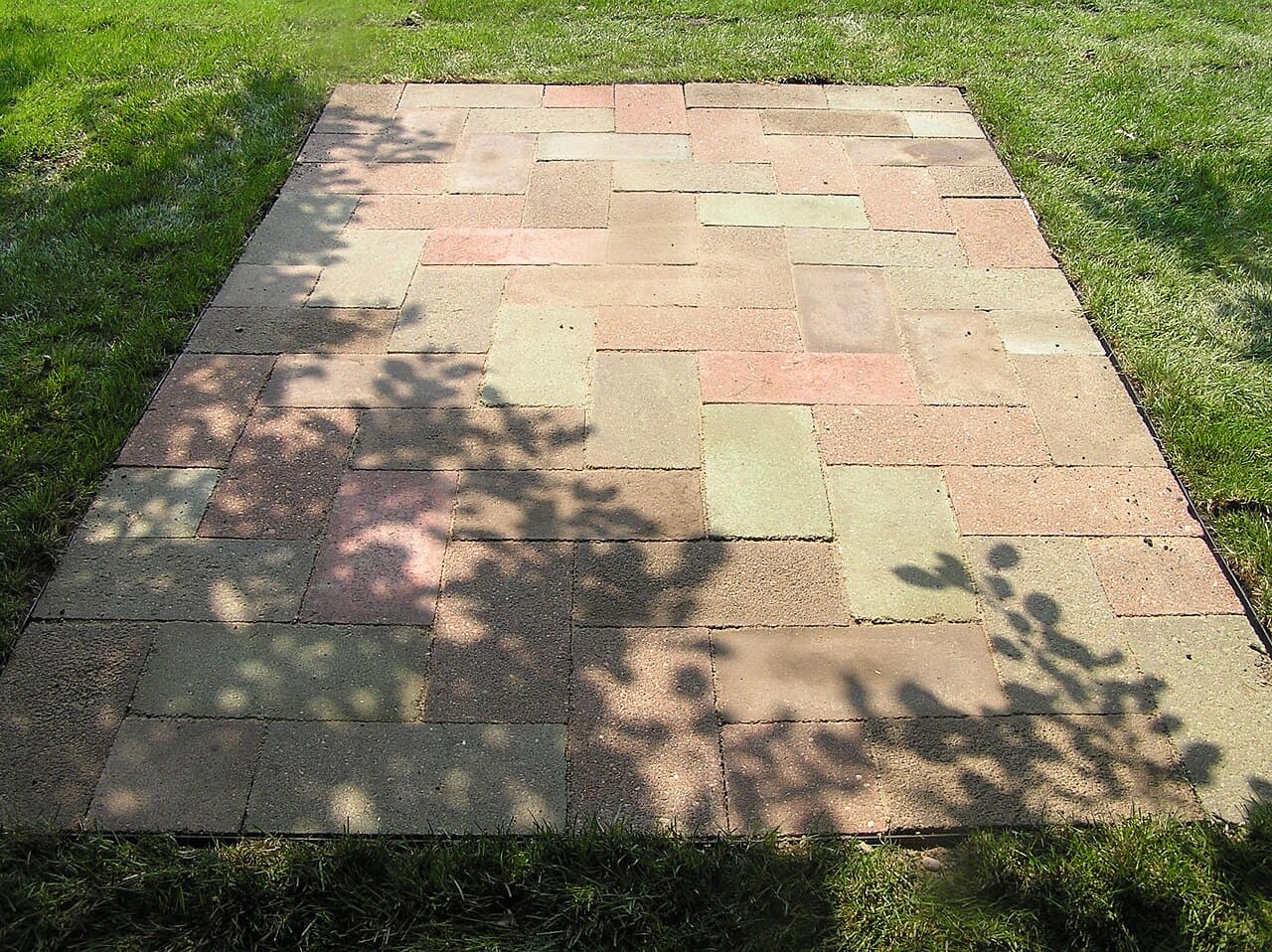
Construction. A paver patio is layers: compacted soil, a compacted crushed-stone base (the paver maker Unilock gives 4 to 6 inches of base as its guideline for pedestrian areas[1]), a bed of loose sand, the pavers, and joint sand, all held in by an edge restraint. Without that restraint, unrestrained pavers slowly creep into the softer surrounding material and gaps open around the edge.[2] A poured patio is simpler to describe: Quikrete, a concrete maker, says a 4-inch thick slab set 2 inches above ground level is suitable for a typical patio,[5] on a prepared subgrade, with forms, a pour, finishing and curing.
Drainage. Both need to shed water. Other than permeable pavers, only a small amount of water (2-5%) gets through the joints of a paver patio, so it needs a slope like any other surface.[3] Quikrete's patio guidance is to slope away from the house at the rate of 1/8 inch per running foot.[5]
Cracking. This is the biggest difference. A concrete slab has low tensile strength and is subject to cracking unless steps are taken to prevent it.[4] Control joints induce cracking at the base of the control joint, rather than across the face of the slab,[4] and Quikrete says they should penetrate roughly 1/4 of the slab thickness and be spaced every 6 to 8 feet in 4-inch-thick slab work.[4] Joints reduce the chance of a random crack; they cannot promise a crack-free slab. A paver patio is already divided into hundreds of joints, so movement tends to show up as a slightly uneven surface rather than a crack across the middle.
Settling and repairs. Pavers sit on a compacted base, and the base is where they succeed or fail. Most ordinary plate compactors will not compact more than about 4 inches of base at once, so a thicker base has to be built in layers or the bottom will settle later.[1] If a section does sink, the usual repair is to lift the pavers, correct the base or sand and relay the same units, with no patch to show. A slab repair is a patch, a resurfacing or a replacement, and new concrete rarely matches old. If you may need to dig under the patio later, for a drain line or a new service, that is a real advantage for pavers.
Maintenance. Pavers ask for a little more routine care: sweeping, checking the joint sand and topping it up when it drops. Unilock notes that weed seeds start from the top of the joints and work down, and that the best prevention is a good polymeric sand with filled joints to within 1/8 inch of the surface;[1] see how to keep weeds from growing between pavers. A plain slab needs little beyond cleaning; a sealed or stamped one also needs its sealer renewed on the schedule its maker gives.
Winter. Use deicers sparingly on either, and follow the paver or sealer maker's guidance on which products are safe for your surface.
Cost and time. Neither is reliably cheaper; it depends on size, soil, access and finish. Pavers take more hand labor, while concrete needs forms, a pour, finishing and curing time before use. Get bids for both on your own site; what a paver patio costs and what a concrete slab costs list what to put in the specification.
A quick way to choose
Pavers tend to suit you if you want a patterned or mixed-color look, expect to dig under the patio one day, have ground that moves with frost, or want to do much of the work yourself (how to lay a paver patio). A slab tends to suit you if you want the least upkeep, a smooth surface for furniture, or a decorative finish such as stamped concrete.
Hiring for either one
Check the licence first. In Virginia, the masonry (BRK) specialty's definition includes mortarless type masonry products;[6] the concrete (CEM) specialty includes finishing, coloring, curing, repairing, testing, sawing, grinding, grouting, placing of film barriers, sealing, and waterproofing;[6] and home improvement contractors (HIC) may build decks, patios, driveways and utility outbuildings that do not require a permit per the USBC.[6] The class must cover the price: Class C contractors work on a single contract or project over $1,000 but less than $30,000.[7] Ask a paver or concrete contractor which specialty and class it holds, then confirm both on DPOR's licence lookup.
DPOR's advice is to get at least three written bids using identical plans and specifications.[8] Before you sign, read questions to ask a concrete contractor. On approvals, Prince William County lists concrete patio slabs on grade that are not designed to support a future building addition among work with no building permit, and notes that zoning and/or watershed approval will be required;[9] ask your own county or city.
Stop and call a pro if
- The patio will carry a hot tub, a roof, an outdoor kitchen or a future room. That needs a designed foundation and other licensed trades.
- The site slopes enough to need a retaining wall or steps.
- Water already runs toward the house or pools where the patio will go.
- There are buried lines, a septic field or a drain under the area. Have them located before any digging.
Find a contractor
Browse patio and paver businesses, look up concrete and hardscaping businesses in Blacksburg, or read more concrete and hardscaping answers.
Describe your patio once and licensed local businesses quote it.
Common questions
- Do pavers crack less than concrete?
- A paver patio is made of many small units with joints between them, so the ground can move without a crack running across the surface; an individual paver can still chip or crack. A concrete slab has low tensile strength and is prone to cracking, and joints are cut to control where it happens. Either way, a well-compacted base matters most.
- Which is easier to repair?
- Usually pavers. A shallow low spot or a damaged area can be lifted out, the base or sand corrected and the same pavers relaid. A cracked or damaged slab is patched, resurfaced or replaced, and the repair will rarely match the original color exactly.
- Which needs more maintenance?
- Pavers need their joints looked after: sweeping, topping up joint sand and pulling the odd weed. Concrete needs less routine care, though a sealed or stamped slab needs its sealer renewed as the sealer maker directs.
- Which handles Virginia winters better?
- Both can, if built right. Pavers sit on a compacted, well-drained base and the joints let the surface move; a slab needs a proper mix for outdoor freezing conditions, which the concrete supplier and contractor can specify. Ask each bidder in writing what they will use, and avoid harsh deicers on either.
- Do I need a permit for either kind of patio?
- Ask your own county or city. Prince William County, for example, lists concrete patio slabs on grade that are not designed to support a future building addition among work with no building permit, while noting that zoning and/or watershed approval will be required. Its list does not mention pavers, so check before either kind of patio goes in.
Sources
- [1] Do's and Don'ts of Paver Installation: Base Preparation, Unilock. Checked October 26, 2026.
- [2] Do's and Don'ts of Paver Installation: Step 3 of 3 - Installing the Pavers, Unilock. Checked October 27, 2026.
- [3] Do's and Don'ts of Paver Installation: Step 1 of 3 - Pre-installation and Planning, Unilock. Checked October 27, 2026.
- [4] Concrete Sidewalks and Small Slabs (project instructions), The QUIKRETE Companies. Checked October 27, 2026.
- [5] Concrete Patios (project instructions), The QUIKRETE Companies. Checked October 27, 2026.
- [6] 18VAC50-22-30, Definitions of specialty services, Virginia Administrative Code, Board for Contractors. Checked October 26, 2026.
- [7] Va. Code § 54.1-1100, Definitions (contractors), Code of Virginia, Virginia General Assembly. Checked October 26, 2026.
- [8] What You Should Know Before You Hire a Contractor, Virginia Board for Contractors, DPOR. Checked October 26, 2026.
- [9] Do I Need a Permit?, Prince William County Building Development Division. Checked October 26, 2026.
Want a pro to handle it?
Describe the job once. Licensed local businesses send quotes, and you pay only when you book one.
Get a quote from a local pro