How much do pool chemicals cost per season in Virginia?
No Virginia agency publishes a dated price for a season of pool chemicals, so there is no honest single number. Your cost follows pool volume, the strength of the chlorine you buy, sun and swimmers, and how well the water stays balanced. Price the products you will use, then compare with written quotes for the same season.
Free to ask. Local shops send quotes, and you pay only when you book one.
By Kasra Taheri, Founder, LoclisPublished
Researched and drafted with AI, then checked claim by claim against the sources listed below before it was published. Prices and rules change; the dates beside each source say when it was last checked.
Step by step
Read when to stop and call a pro, further down this page, before you start.
Step 1: Find your pool's volume
Get the volume in gallons from the builder's papers or a pool company, because chemical doses are set per 10,000 gallons.[1]
Step 2: List what you use
List the sanitizer, pH and alkalinity products, stabilizer and test supplies you used last season, with the price per container.
Step 3: Price a dose
Use the label dose, or about 1.3 oz per 10,000 gallons for 1.0 ppm, to see what each adjustment costs.[1]
Step 4: Compare chlorine by strength
Compare products by cost per ppm delivered, not per container, because liquid chlorine, calcium hypochlorite and bleach differ in strength.[1]
Step 5: Add a buffer
Add a test kit refill and a buffer for a storm, a party or a heat wave.
Step 6: Get written quotes
Ask two or three pool companies for written quotes for the same season and chemicals.[3]
There is no single Virginia price for a season of pool chemicals, and no state agency publishes one, so any figure you see is a guess. What you spend comes down to your pool's volume, the kind of chlorine you use, how hard the sun and the swimmers work the water, and how well you keep the balance. The practical way to get a number is to price the products you will actually use, then compare that with written quotes from pool companies for the same season.
What you actually buy
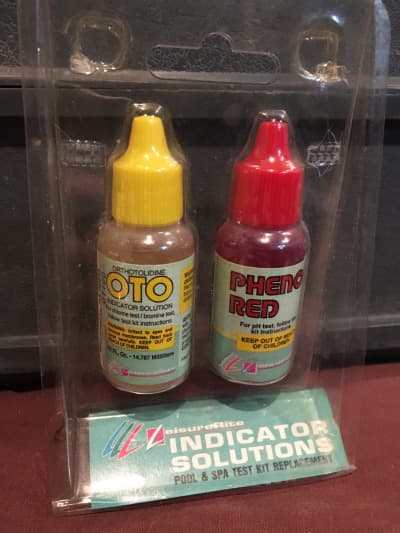
A season of chemicals is usually five things. A sanitizer such as chlorine tablets, liquid chlorine or granular shock. Products to raise or lower pH and alkalinity. A stabilizer. A calcium product if your water is soft. And test supplies: reagents or strips for your kit.
The chlorine you pick changes both the price per pound and how much you need. Liquid chlorine sold for pools is about 15 percent available chlorine, three times stronger than household bleach, which is only 5 percent.[1] Calcium hypochlorite provides approximately 70 percent available chlorine.[1] A cheaper bottle is not cheaper if you need three times as much of it, so compare cost per ppm of chlorine delivered, not cost per container.
What drives the quantity
Pool volume. Dosing is based on gallons. The Portsmouth Health Department's guide gives a no-label rule of thumb: 1.0 ppm equals about 1.3 oz of chemical per 10,000 gallons.[1] A pool four times bigger needs four times as much for the same change.
Chlorine strength. To get the amount of a weaker product, divide by its percent: at 12 percent available chlorine, the guide's worked example comes to 10.8 oz of sodium hypochlorite to produce 1 ppm of free chlorine for 10,000 gallons.[1]
Sun and bather load. Sunlight and heat can degrade chlorine quickly, and on a hot sunny day with a high bather load the free chlorine in the pool is consumed rapidly.[1] A hot Virginia July costs more than a cool May.
The target. Virginia's standard for regulated pools keeps free chlorine between 1.0 and 3.0 ppm and pH between 7.2 and 7.8.[2] Running a home pool in the same range is the aim, and chasing a higher number wastes product.
Balance. Chemicals you do not need to add are the cheapest ones. Water with low alkalinity swings in pH from small additions, and water with high alkalinity takes much more product to move.[1] Keeping alkalinity in range makes every other chemical go further.
Water loss and stabilizer. Cyanuric acid stays in the pool until water is lost through backwashing or other water loss, and a pool with too much of it, called over-stabilized, can trap chlorine.[1] Stabilized chlorine tablets keep adding it, so test it rather than assuming it is low.
Pool type and cover. A covered pool that is closed early and opened late has a shorter season than one open from April to October.
How to work out your own number
- Find your pool's volume in gallons from the builder's papers, or ask a pool company to calculate it.
- List the chemicals you used last season, or the ones you will use, and their price per container.
- Use the label's dose per 10,000 gallons, or the 1.3 oz rule above, to see how much each adjustment costs.
- Add a test kit refill and a buffer for a bad week, such as a storm or a pool party.
- Ask two or three pool companies for a written quote covering the same season and the same chemicals, so you can compare.[3]
The Virginia Board for Contractors advises getting at least three written bids using identical specifications, and not automatically accepting the lowest.[3] For a chemicals-only or weekly service visit, that means asking whether chemicals are included, billed at cost or marked up, and what a visit covers.
Where homeowners lose money
Buying more than a season of granular chlorine is a risk, not a saving. Calcium hypochlorite reacts with moisture and many other substances, and must be stored and handled with care.[1] Overshooting a dose and then correcting it with another chemical costs twice. And ignoring a small imbalance can end in a large repair: low calcium can etch plaster, and high calcium can scale pipes, heaters and filters.[1]
Stop and call a pro if
- Your numbers will not hold and you are adding product every day. Something else is wrong, such as a leak, a failing filter or a very imbalanced pool, and a pool company can test and diagnose it.
- Calcium hardness is very high. The only way to lower it is to drain some water and refill with water of lower hardness,[1] which is a bigger job than a chemical purchase. Stabilizer that stays high despite your testing is worth a pool company's advice.
- A product has been stored wet, leaked or mixed. Calcium hypochlorite exposed to a small amount of water can react explosively and release poisonous gas.[1] Keep away from it and call 911.
- A repair is on the table. The Virginia Board for Contractors says work valued at $1,000 or more requires a valid Virginia contractor's licence for the licence category involved.[3]
Getting help in Virginia
For the method, see how to balance pool chemicals. To decide between doing it and hiring it, read whether paying a pool service for chemicals is worth it, and for the weekly price of a service, what weekly pool service costs in Virginia. Browse pool and spa services or more pool and spa answers.
When you want quotes, describe your pool and local pool companies bid on it.
Common questions
- How much do pool chemicals cost for a Virginia season?
- No Virginia agency publishes a dated figure, so this page does not quote one. The cost depends on your pool's volume, the chlorine product, sun and swimmers, and how balanced the water stays. Price the products you use and compare with written quotes.
- Why is liquid chlorine sometimes cheaper than tablets?
- Because strength differs. Pool liquid chlorine is about 15 percent available chlorine and calcium hypochlorite about 70 percent, per the Portsmouth Health Department guide. Compare cost per ppm of chlorine delivered, not cost per container.
- How much chemical does my pool need?
- Follow the product label. With no label, the Portsmouth guide gives about 1.3 oz of chemical per 10,000 gallons to raise chlorine by 1.0 ppm, then divides by the product's percent of available chlorine.
- Does a hot summer cost more?
- Yes. Sunlight and heat degrade chlorine quickly, and on a hot sunny day with many swimmers the free chlorine is consumed rapidly, so you add more.
- Can too much stabilizer raise my costs?
- It can. Cyanuric acid stays in the pool until water is lost, and an over-stabilized pool can trap chlorine so it does not work. Test it before you add more.
Sources
- [1] Pool Operation and Maintenance Guide (compiled 2018), Portsmouth Health Department, Virginia Department of Health. Checked October 27, 2026.
- [2] 12VAC5-462-290. Water quality standards, Virginia Administrative Code, Virginia General Assembly. Checked October 27, 2026.
- [3] What You Should Know Before You Hire a Contractor, Virginia Board for Contractors, DPOR. Checked October 27, 2026.
Want a pro to handle it?
Describe the job once. Licensed local businesses send quotes, and you pay only when you book one.
Get a quote from a local pro