Why is my pool turning green?
A green pool is almost always algae, which grows when free chlorine drops below Virginia's 1.0 ppm minimum, pH or alkalinity drifts out of range, or the water barely circulates. Test first, fix circulation, brush the walls and floor, then bring chlorine and pH back into range and run the filter until the water clears.
Free to ask. Local shops send quotes, and you pay only when you book one.
By Kasra Taheri, Founder, LoclisPublished
Researched and drafted with AI, then checked claim by claim against the sources listed below before it was published. Prices and rules change; the dates beside each source say when it was last checked.
Step by step
Read when to stop and call a pro, further down this page, before you start.
Step 1: Test the water
Take the sample 12 to 18 inches below the surface, away from corners and return lines, and test free chlorine, pH and total alkalinity.[1]
Step 2: Empty the baskets
Empty the skimmer and pump baskets so the water can flow, then run the pump continuously until the water clears.
Step 3: Brush every surface
Brush the walls, steps and floor, including corners and behind ladders, so algae is loose in the water where chlorine can reach it.
Step 5: Raise the chlorine
Add chlorine as the product label directs to raise free chlorine, adding it in the pool water and never mixing products together.[1]
Step 6: Keep the filter running
Run the filter around the clock and clean or backwash it when its gauge pressure has risen 3 to 5 psi on a rapid sand filter, or as its manual says.[1]
Step 7: Vacuum out the dead algae
When the water turns from green to cloudy blue, vacuum slowly to the filter or to waste so the dead algae leaves the pool.
Step 8: Retest and keep testing
Retest daily until free chlorine holds between 1.0 and 3.0 ppm and the water is clear.[2]
It is algae, and chlorine fell behind
Green pool water is nearly always algae. Chlorine acts as an oxidizer that chemically burns away compounds such as bacteria, fungi, viruses and algae,[1] so when the free chlorine runs out, algae spores that were always in the water start to multiply. Virginia's water quality standard for pools keeps free chlorine between 1.0 and 3.0 ppm and pH between 7.2 and 7.8.[2] That standard governs regulated pools, but it is a sensible target at home, and a pool that has turned green has usually slipped below it.
Four things usually combine: a chlorine residual that was spent by heat, sun, rain or a crowd; a pH or alkalinity that drifted out of range; a pump that ran too few hours; and a dirty filter or full baskets.
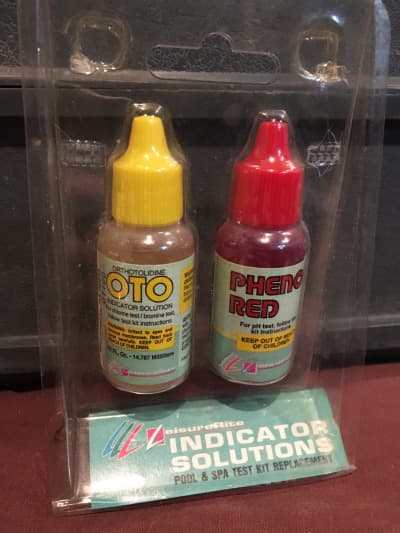
What the chemistry is telling you
Low pH. A pH below 7.0 will also encourage algae to grow.[1]
Algae pushing pH up. An algae bloom can itself push the pH of the water up,[1] so a green pool with a high pH reading often has the bloom as both cause and effect, and chlorine works less effectively as pH climbs.[1]
Low alkalinity. Total alkalinity that is too low can cause rapid changes in pH, corrosion, staining and possibly green water.[1]
Poor circulation. Dead spots, where circulation is poor, can leave water poorly disinfected and may promote the growth of bacteria and algae.[1] Behind ladders, in corners and below steps are the usual places a bloom starts.
How to test, and what to do
Take water samples from 12 to 18 inches below the surface, and not from corners or directly in front of return lines.[1] Pool test kits are not 100% accurate, so use fresh reagents and replace them at the start of each season.[1] If your kit is old, take a water sample to a pool supply store for a test.
Then work in this order. Circulation first: empty the baskets and run the pump around the clock. Brush every surface, because algae stuck to a wall is protected from chlorine and cannot reach the filter. Correct pH and alkalinity before adding chlorine, then raise chlorine as the product label directs. Never mix anything with chlorine except water,[1] and add each product separately. For the details on correcting pH and alkalinity, see how to balance pool chemicals.
One catch for pools that use stabilized tablets all summer: on stabilized pools, the guide recommends non-chlorine products for superchlorination, because chlorine can become trapped in the water when cyanuric acid builds up.[1] The recommended cyanuric acid level is 40 to 60 ppm.[1] If a test shows it far above that, a pro or your pool supplier can advise on partial draining and refilling.
Keeping the filter working
The filter now has a heavy load. Check its gauge every day and clean or backwash it as its manual says. If your filter has a cartridge, see how to clean a pool cartridge filter. As the water goes from green to cloudy, the cause shifts to dead algae in suspension, which is why clearing cloudy pool water is often the second half of this fix.
When it is clear
Portsmouth's pool code requires the water of an open public pool to be clear enough that a six-inch black-and-white disc on the bottom at the deepest point is clearly visible from the deck at distances up to ten yards.[1] If you cannot see the main drain from the deck, stay out. After the water clears, test often for a week and then settle into a routine; how often to test your pool water sets one out.
Stop and call a pro if
- The pool stays green after a week with chlorine and pH in range and the filter clean. The cause is probably the filter, circulation or a stabilizer level far above range.
- The pump will not prime, leaks, or makes a grinding noise. Pump and plumbing repair belongs to a professional.
- Anything electrical or gas is involved: a pool light, an automation panel, a heater or a buzzing motor. Do not open or rewire them yourself.
- The repair would cost $1,000 or more. If the work you are considering is valued at $1,000 or more, a valid Virginia contractor's license is required.[3]
- You would rather not handle strong chemicals. Is it worth paying a pool service to handle the chemicals weighs that choice.
Getting help in Virginia
Browse pool and spa services or more pool and spa answers.
When you want a pro to clear it, describe your pool and local pool companies quote it.
Common questions
- Is a green pool safe to swim in?
- No. Green water means the chlorine has not kept up, so the water is not properly disinfected, and you often cannot see the bottom or the main drain. Portsmouth's pool code requires a six-inch black-and-white disc on the bottom to be clearly visible from the deck, and a green pool fails that test long before it clears.
- How long does it take to clear a green pool?
- Often several days of continuous filtering, brushing and correct chlorine for a light bloom, and longer for a heavy one. The filter needs frequent cleaning because it catches the dead algae, so check its gauge daily.
- Why did my pool turn green overnight?
- Usually a hot spell, a heavy rain or a crowded weekend used up the chlorine, and algae took over once free chlorine fell below the minimum. Sunlight and heat use chlorine up quickly, which is why outdoor pools use a stabilizer (cyanuric acid), recommended at 40 to 60 ppm in the Portsmouth guide.
- Can I just add more shock and skip the testing?
- It is a poor bet. If pH has drifted high, chlorine is slow to work, and if the pool is over-stabilized, extra chlorine can get trapped in the water. Test first so you know which problem you are treating.
- Does green water mean the pump is broken?
- Not necessarily, but poor circulation is a common contributor. If the baskets are clear and the pump runs but the pressure gauge is low or the pump loses prime, see the pump and filter guides linked below.
Sources
- [1] Pool Operation and Maintenance Guide (compiled 2018), Portsmouth Health Department, Virginia Department of Health. Checked October 28, 2026.
- [2] 12VAC5-462-290. Water quality standards, Virginia Administrative Code, Virginia General Assembly. Checked October 28, 2026.
- [3] What You Should Know Before You Hire a Contractor, Virginia Board for Contractors, DPOR. Checked October 28, 2026.
Want a pro to handle it?
Describe the job once. Licensed local businesses send quotes, and you pay only when you book one.
Get a quote from a local pro