Is it worth paying a pool service to handle the chemicals?
It is worth it if you travel, are new to pools, or your pool keeps drifting out of balance, and not if you will test weekly and handle strong chemicals carefully. No Virginia agency publishes a dated price for chemical service, so compare three written quotes for the same scope, including whether chemicals are included, at cost or marked up.
Free to ask. Local shops send quotes, and you pay only when you book one.
By Kasra Taheri, Founder, LoclisPublished
Researched and drafted with AI, then checked claim by claim against the sources listed below before it was published. Prices and rules change; the dates beside each source say when it was last checked.
Step by step
Read when to stop and call a pro, further down this page, before you start.
Step 1: Decide what you want handled
Write down testing, balancing, chlorine supply, algae treatment, opening and closing.
Step 2: Ask for three written quotes
Request written quotes for the same scope from at least three companies.[3]
Step 3: Clarify chemical billing
Ask whether chemicals are included, billed at cost or marked up.
Step 4: Ask about records
Ask how readings are recorded and what happens if the water turns between visits.
Step 5: Check the licence for repairs
If the company also repairs equipment or surfaces, look it up on the DPOR licence lookup.[4]
Step 6: Limit what you pay ahead
Keep any deposit to no more than 10 percent of the total price or $1,000, whichever is less.[3]
Paying a pool service for chemicals is worth it if you want the water right without learning the chemistry, or if your pool keeps drifting out of balance. Doing it yourself is realistic if you will test every week and handle strong chemicals carefully. The honest test is time and risk, not price: no Virginia agency publishes a dated price for chemical service, so compare written quotes rather than trusting a number on a website.
What the work actually is
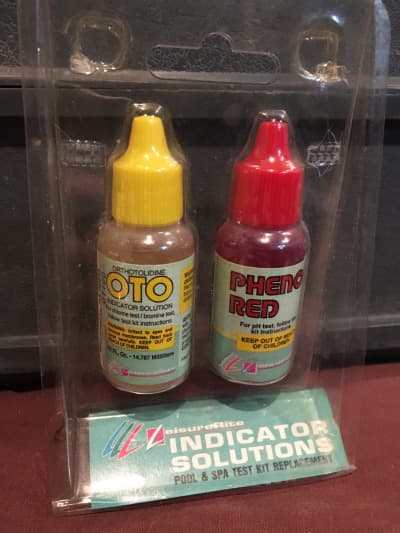
Balancing a pool means testing free chlorine, pH, total alkalinity and calcium hardness, then adjusting them in order. Virginia's standard for regulated pools keeps free chlorine at 1.0 to 3.0 ppm and pH at 7.2 to 7.8.[2] The Portsmouth Health Department's guide gives 80 to 120 ppm for alkalinity and 200 to 300 ppm for calcium hardness.[1] The method is in how to balance pool chemicals.
None of it is hard on a good week. The difficulty is the repetition and the stakes. pH can change rapidly,[1] and a missed week in July can turn clear water cloudy. The same guide says the Portsmouth City Pool Code requires pH and chlorine or bromine levels to be checked at least every two hours.[1] A home pool is not held to that, but it shows how fast the numbers move.
When hiring is worth it
You travel or have no time. A service tests and adjusts on a schedule, so the pool does not depend on you being home.
You are new to pools. Dosing errors are easy to make, and overcorrection is a common mistake: the guide warns that correcting pH before the other parameters are in range leads to overcorrection.[1]
The pool keeps going out of balance. Persistent problems, such as pH that bounces back above 8.0 after acid, often mean high alkalinity.[1] Someone who tests several parameters and keeps records finds the cause faster.
You do not want to store strong chemicals. Calcium hypochlorite reacts with moisture and many other substances and must be stored and handled with care.[1] Liquid chlorine must not touch any acid, because chlorine gas, which is highly poisonous, will be generated.[1] Pool companies handle and store these every day. If you have small children, a garage that gets hot or no safe place to keep them, that matters.
When doing it yourself makes sense
The pool is small, you have a decent test kit, and you can test weekly. You are willing to read labels, wear gloves and goggles, add one product at a time, and retest. The guide lists chemical-resistant gloves, an apron, goggles and a NIOSH-approved cartridge respirator as the protective clothing for handling chlorine.[1] You do not mind a little arithmetic: dosing is by pool volume, and the guide gives about 1.3 oz of chemical per 10,000 gallons for each 1.0 ppm of change.[1]
A middle path is a chemical-only service that tests and adds product but does not clean, or a monthly check with you doing the weekly maintenance in between.
How to hire well
- Write down what you want: testing, balancing, chlorine supply, algae treatment, opening and closing.
- Ask at least three companies for written quotes for the same scope.[3]
- Ask whether chemicals are included, billed at cost or marked up, and what a "chemicals extra" visit costs.
- Ask how often they visit, how they record readings, and what happens if the water goes green between visits.
- Limit what you pay ahead. The Virginia Board for Contractors suggests an initial deposit of no more than 10 percent of the total price or $1,000, whichever is less, on home improvement work.[3]
Chemical service is not construction. Virginia defines "swimming pool construction contracting" as the construction, repair, improvement or removal of in-ground swimming pools.[4] If a company also offers pump, liner, plumbing or surface repair, check its licence on the DPOR licence lookup before you sign. Also read what a pool service company does each visit.
Stop and call a pro if
- You smell chlorine gas, or products have been mixed. Leave, get fresh air and call 911 if anyone is coughing or has burning eyes.
- The water is green or cloudy and the numbers will not come into range. A pool company can test and treat it.
- Calcium hardness is very high. The only fix is to drain some water and refill with water of lower hardness,[1] which is a job to plan.
- You are about to pay for repairs. Work valued at $1,000 or more requires a valid Virginia contractor's licence for the licence category involved.[3]
Getting help in Virginia
See what pool chemicals cost per season to compare your own cost with a quote, and what weekly pool service costs in Virginia. Browse pool and spa services or more pool and spa answers.
When you are ready, describe your pool and local pool companies quote it.
Common questions
- Is a pool service cheaper than doing chemicals myself?
- Not usually on the chemical price alone. The case for a service is time, consistency and fewer dosing mistakes. No Virginia agency publishes a dated price for it, so compare written quotes against what you spend on products now.
- What should a chemical service quote include?
- The scope of each visit, how often, whether chemicals are included, billed at cost or marked up, how readings are recorded, and extra-visit fees. Virginia's Board for Contractors advises getting at least three written bids on the same specifications.
- Does a pool service need a contractor licence in Virginia?
- Routine testing and chemical balancing is not construction. Virginia defines swimming pool construction contracting as the construction, repair, improvement or removal of in-ground pools, so check a company's licence on the DPOR lookup if it also does repair work.
- How much should I pay up front?
- The Board for Contractors suggests an initial deposit of no more than 10 percent of the total price on home improvement work. For a seasonal contract, avoid paying months ahead.
- Is it safe to store pool chemicals myself?
- With care. Keep each product in its own closed container, never mix anything with chlorine except water, keep liquid chlorine away from acid, and keep calcium hypochlorite dry, since a small amount of water can cause a violent reaction.
Sources
- [1] Pool Operation and Maintenance Guide (compiled 2018), Portsmouth Health Department, Virginia Department of Health. Checked October 27, 2026.
- [2] 12VAC5-462-290. Water quality standards, Virginia Administrative Code, Virginia General Assembly. Checked October 27, 2026.
- [3] What You Should Know Before You Hire a Contractor, Virginia Board for Contractors, DPOR. Checked October 27, 2026.
- [4] 18VAC50-22-30. Definitions of specialty services, Virginia Administrative Code, Virginia General Assembly. Checked October 27, 2026.
Want a pro to handle it?
Describe the job once. Licensed local businesses send quotes, and you pay only when you book one.
Get a quote from a local pro