How much does a thermal imaging inspection cost in Virginia?
There is no set Virginia price, and we found no official source that publishes one. Cost follows what the scan is part of (an energy assessment, a home inspection add-on or a stand-alone scan), house size, hours on site and what the report includes. Utility programs such as Dominion Energy Virginia's offer audits through participating contractors, so check those, then get written quotes.
Free to ask. Local shops send quotes, and you pay only when you book one.
By Kasra Taheri, Founder, LoclisPublished
Researched and drafted with AI, then checked claim by claim against the sources listed below before it was published. Prices and rules change; the dates beside each source say when it was last checked.
Step by step
Read when to stop and call a pro, further down this page, before you start.
Step 1: Decide what the scan is for
Decide whether you need an energy assessment, a check of finished insulation, a moisture concern or a pre-purchase scan, because each is priced differently.
Step 2: Check utility programs first
Ask your electric utility whether it offers an energy assessment through participating contractors.[3]
Step 3: Ask each provider what tools they use
Ask whether they will use a blower door or conduct a thermographic inspection.[2]
Step 4: Get quotes in writing
Ask for the price, hours on site, the camera used, whether a blower door is included and what the report contains.
Step 5: Ask about credentials
Ask whether the person doing the scan holds an industry-recognized credential and which one.[2]
Step 6: Ask about timing
Ask what temperature difference they need and whether you must run the heat or air conditioner beforehand.[1]
Step 7: Compare like for like
Line up the quotes by what each includes, and call references before you book.
There is no set Virginia price for a thermal imaging inspection, and we found no official source that publishes one, so any number you see quoted without a date and a scope is a guess. What decides the cost is what the scan is part of, how long the visit takes and what you get at the end. The U.S. Department of Energy says many professional energy assessments will include a blower door test and a thermographic scan,[2] so for many homeowners the scan is not a separate purchase at all.
Three ways you might buy a scan
Inside an energy assessment. This is the usual route. Ask the energy auditor what tools they use in their assessments, for example if they will use a blower door to test air leakage or conduct a thermographic inspection.[2] Dominion Energy Virginia's program shows how visits are scaled: the program says "Contractor will provide a quick (30-60 min.) introductory assessment" or "Contractor will provide an in-depth (2-4 hr.) energy audit."[3] A longer visit usually costs more, so ask which visit includes the scan. Check with your own utility first, because a program may cover or reduce the fee; see whether there are free home energy audits in Virginia.
As an add-on to a home inspection. Some inspectors carry an infrared camera and offer a scan with the inspection. In Virginia, "It shall be unlawful for any individual who does not possess a license as a home inspector issued by the Board to perform a home inspection for compensation on a residential building."[5] The scan is an extra on top of that inspection. The inspection fee is its own price, covered in how much a home inspection costs.
As a stand-alone scan. A specialist comes only to scan, for example to check finished insulation or look into a moisture concern. Expect a quote based on the size of the house, the number of areas to scan and the report.
What drives the price
House size and layout. More walls, floors and attic area to scan means more time.
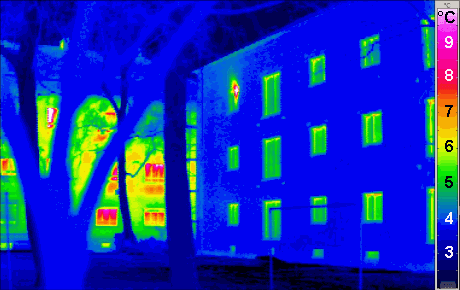
Interior or exterior survey. A thermographic inspection is either an interior or exterior survey.[1] Interior scans are more common, and interior surveys are generally more accurate because they benefit from reduced air movement.[1] An exterior scan or a scan on a windy day may give weaker results, so ask which will be done.
Blower door. Thermographic scans are also commonly used with a blower door test running.[1] That adds equipment and time.
The camera. The most accurate thermographic inspection device is a thermal imaging camera.[1] Spot radiometers and thermal line scanners do not provide the necessary detail for a complete home energy assessment.[1] A better camera and a more experienced operator usually cost more.
Weather and preparation. The scan needs a large temperature difference between inside and outside. In some cases the DOE says the homeowner may need to run the heat or air conditioner for up to four hours first.[1] Ask whether a day that does not work is rebooked for free.
The report. A set of annotated images with recommendations costs more than a verbal summary, and is worth more when you hand it to a contractor. The DOE adds that a thermographic scan performed by a certified technician is usually accurate enough to use as documentation in court proceedings.[1]
Who to hire
Selecting a certified home energy auditor assures you that the auditor is uniquely skilled and qualified to perform energy assessment work.[2] Ask for the credential and look it up. Dominion Energy tells customers who want more than a walk-through to contact a professional, noting that infrared cameras find air infiltration and missing insulation.[4]
Getting a quote you can compare
Ask each provider for the same things in writing: the price, the hours on site, the camera used, whether a blower door is included, what the report contains, and what happens if the weather does not work. Get several references and call them. Then read what a thermal imaging inspection can find and whether it is worth it before you decide.
Loclis lists DPOR-licensed businesses with their licence number and class. Browse inspection services or see more inspection answers.
To get prices for your own house, describe what you want checked once and local businesses quote it.
Stop and call a pro if
- You see scorch marks, smell burning, or a breaker keeps tripping. Do not investigate yourself; call a licensed electrician.
- A scan suggests water in a wall, ceiling or attic. Fix the source first, with a roofer or plumber, before paying for insulation work.
- A quote is very low and cannot say what equipment or report it includes. Ask for it in writing before you pay a deposit.
Common questions
- Is there a standard price for a thermal scan in Virginia?
- Not that we could find from an official source. Prices depend on whether the scan is stand-alone or part of an energy assessment or home inspection, on the size of the house, and on the hours and equipment involved. Ask for a written quote that states each of those.
- Is a thermal scan included in a home energy audit?
- Often. The Department of Energy says many professional energy assessments will include a blower door test and a thermographic scan, but it advises you to ask the auditor what tools they will use, so confirm it is in the quote.
- Does the weather affect the price?
- Indirectly. The scan needs a large indoor-outdoor temperature difference, and the Department of Energy says it may take up to four hours of heating or cooling beforehand. A provider may charge for the extra time, or reschedule if the day does not work, so ask how they handle it.
- Will Dominion Energy do a thermal scan?
- Dominion Energy Virginia's program offers a 30 to 60 minute introductory check-up and a 2 to 4 hour comprehensive audit through participating contractors. Whether a thermal camera is used is up to the contractor, so ask when you book.
- Is a cheap scan with a phone-attachment camera as good?
- It depends on the camera, the conditions and the person reading it. The Department of Energy calls a thermal imaging camera the most accurate device and says simpler tools lack the detail for a complete home energy assessment. Ask what equipment will be used and what the operator's training is.
Sources
- [1] Thermographic Inspections, U.S. Department of Energy, Energy Saver. Checked October 27, 2026.
- [2] Professional Home Energy Assessments, U.S. Department of Energy, Energy Saver. Checked October 27, 2026.
- [3] Home Energy Evaluation, Dominion Energy Virginia. Checked October 27, 2026.
- [4] Save Energy: Home Rebates & Programs (Virginia), Dominion Energy. Checked October 27, 2026.
- [5] Va. Code § 54.1-503, Licenses required, Code of Virginia, Legislative Information System. Checked October 27, 2026.
Want a pro to handle it?
Describe the job once. Licensed local businesses send quotes, and you pay only when you book one.
Get a quote from a local pro