Is a thermal imaging inspection worth it?
Often yes, in three cases: before you buy a house, after insulation or air sealing work to check it was done right, and when you suspect missing insulation or a moisture problem. The U.S. Department of Energy recommends a scan before buying, even a new house. It is least useful when weather, a poor camera or an unqualified operator limit what it can show.
Free to ask. Local shops send quotes, and you pay only when you book one.
By Kasra Taheri, Founder, LoclisPublished
Researched and drafted with AI, then checked claim by claim against the sources listed below before it was published. Prices and rules change; the dates beside each source say when it was last checked.
Step by step
Read when to stop and call a pro, further down this page, before you start.
Step 1: Name your reason
Write down what you want answered: a purchase, a check on new insulation, high energy bills, or a damp spot.
Step 2: Check the timing
Confirm you can book a day with a large indoor-outdoor temperature difference.[1]
Step 3: Ask what the scan will include
Ask whether it comes with a blower door test or is part of a wider assessment.[2]
Step 4: Check the credentials
Ask which certification the operator holds and look it up.[2]
Step 5: If buying, add it to the contract
Ask your agent or attorney about adding a clause that requires a scan before you commit.[1]
Step 6: Use the results
Ask for annotated images and a short list of what to fix and who should fix it.
For many homes a thermal imaging inspection is worth it, and it pays off most in three situations: before you buy, after insulation or air-sealing work, and when you suspect heat loss or a hidden moisture problem. It is a poor buy when conditions or equipment cannot give a clear picture. The U.S. Department of Energy goes further than most: "you should have a scan done before purchasing a house; even new houses can have defects in their thermal envelopes."[1]
When it is worth it
Before you buy. A scan can show missing insulation and air leaks that a walk-through will not. The DOE adds: "You may wish to include a clause in the contract requiring a thermographic scan of the house."[1] In Virginia, talk to your agent or attorney about how to word that and how it fits your inspection window.
After insulation or air sealing. The scan also serves as a quality control tool, to ensure that insulation has been installed correctly.[1] If you are paying a contractor to fill walls or the attic, a scan before the last payment lets you find voids and have them fixed.
When something looks wrong. High bills, a room that is always cold, or a damp ceiling are good reasons. Because wet insulation conducts heat faster than dry insulation, thermographic scans of roofs can often detect roof leaks.[1] The scan tells you where to look; a roofer, plumber or moisture meter finds out why.
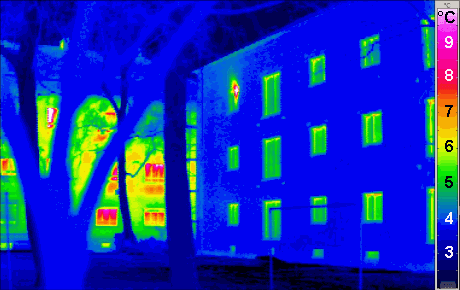
When it is not worth it
The weather is wrong. The most accurate thermographic images usually occur when there is a large temperature difference (at least 20°F [14°C]) between inside and outside air temperatures.[1] The DOE also notes that it is harder to detect temperature differences on the outside surface of the building during windy weather.[1] A scan on a mild, windy day can leave you with images nobody can read.
The tool is too basic. Spot radiometers and thermal line scanners do not provide the necessary detail for a complete home energy assessment.[1] Ask what camera will be used.
You need the whole building checked. A scan does not replace a home inspection. In Virginia a home inspection shall include a written evaluation of the readily accessible components of a residential building, including heating, cooling, plumbing, and electrical systems; structural components; foundation; roof; masonry structure; exterior and interior components; and other related residential housing components.[3] A scan is one clue among many.
How to hire well
Start with the person, not the camera. Selecting a certified home energy auditor assures you that the auditor is uniquely skilled and qualified to perform energy assessment work.[2] Ask which credential the operator holds, and look it up.
Ask whether the scan comes with a blower door test or is part of a wider visit: many professional energy assessments will include a blower door test and a thermographic scan.[2] A scan with a written report is more useful than a verbal summary; the DOE says a thermographic scan performed by a certified technician is usually accurate enough to use as documentation in court proceedings.[1]
If the scan is part of a home inspection you are paying for, check the licence. In Virginia, "It shall be unlawful for any individual who does not possess a license as a home inspector issued by the Board to perform a home inspection for compensation on a residential building."[4]
Stop and call a pro if
- The scan shows a hot spot at an outlet, switch or panel. Leave it alone and call a licensed electrician.
- You smell burning or see scorching. Do not wait for a second scan.
- The scan points to water. Find and fix the source with a roofer or plumber before insulation.
- A quote promises to diagnose mold, rot or termites from a thermal image alone. A scan does not name those. See what home inspectors most often find.
Getting help in Virginia
Read what a thermal imaging inspection can find and how much it costs in Virginia. Loclis lists DPOR-licensed businesses with their licence number and class: browse inspection services or see more inspection answers.
When you are ready, describe what you want checked once and local businesses quote it.
Common questions
- Should I get a thermal scan before buying a house?
- The Department of Energy says yes: you should have a scan done before purchasing a house, and even new houses can have defects in their thermal envelopes. It also suggests a contract clause requiring one. A scan does not replace a licensed home inspection.
- Does a thermal scan replace a home inspection?
- No. A home inspection in Virginia is a written evaluation of the readily accessible components of a residential building, from heating and cooling to structure, roof and electrical. A scan adds heat-loss and moisture clues; it does not cover the rest.
- Is it worth scanning after insulation work?
- Usually. The Department of Energy says the images serve as a quality control tool, to ensure that insulation has been installed correctly. Book it before you make the final payment so any gaps can be fixed under the contract.
- When is a thermal scan not worth it?
- When the weather will not give a large temperature difference, when the operator uses a basic tool, or when you already know the answer. A scan on a mild day or in wind can be hard to read, and the Department of Energy notes that spot radiometers do not provide enough detail.
- Can a thermal scan be used as evidence?
- The Department of Energy says a thermographic scan performed by a certified technician is usually accurate enough to use as documentation in court proceedings. Ask for the images, the operator's credentials and the conditions on the day in writing.
Sources
- [1] Thermographic Inspections, U.S. Department of Energy, Energy Saver. Checked October 27, 2026.
- [2] Professional Home Energy Assessments, U.S. Department of Energy, Energy Saver. Checked October 27, 2026.
- [3] Va. Code § 54.1-500, Definitions, Code of Virginia, Legislative Information System. Checked October 27, 2026.
- [4] Va. Code § 54.1-503, Licenses required, Code of Virginia, Legislative Information System. Checked October 27, 2026.
Want a pro to handle it?
Describe the job once. Licensed local businesses send quotes, and you pay only when you book one.
Get a quote from a local pro