What can a thermal imaging inspection find in a house?
A thermal imaging inspection shows where heat is moving through a house: missing or poorly installed insulation, air leaks, and some wet insulation and roof leaks, plus hot electrical or mechanical parts. The camera reads surface temperatures, not what is behind them, so a good operator confirms each finding another way. Results are best with a large indoor-outdoor temperature difference.
Free to ask. Local shops send quotes, and you pay only when you book one.
By Kasra Taheri, Founder, LoclisPublished
Researched and drafted with AI, then checked claim by claim against the sources listed below before it was published. Prices and rules change; the dates beside each source say when it was last checked.
Step by step
Read when to stop and call a pro, further down this page, before you start.
Step 1: Pick the right weather
Book the scan for a day with a big gap between indoor and outdoor air, ideally at least 20°F.[1]
Step 2: Ask about the camera
Ask for a thermal imaging camera and for the images to be included in your report.[1]
Step 3: Ask about conditions
Ask whether you will need to run the heat or air conditioner for up to four hours before the scan.[1]
Step 4: Clear the walls
Move furniture away from exterior walls and take down drapes before the visit.[1]
Step 5: Walk through with the assessor
Ask the assessor to show you each flagged area and what it might be, not only a final list.
Step 6: Get findings confirmed
Ask how each suspicious spot will be checked, for example with a blower door, a moisture meter or a small opening.
Step 7: Keep the images
Ask for the thermal images with notes on where and when they were taken, so you can show them to a contractor.
A thermal imaging inspection finds where heat is moving through a house in ways it should not: missing or poorly installed insulation, air leaks, some wet insulation and roof leaks, and hot spots in electrical and mechanical equipment. The camera does not see inside walls. It shows surface temperature differences, and a trained operator reads those as clues. The U.S. Department of Energy says: "Energy auditors may use thermography -- or infrared scanning -- to detect thermal defects and air leakage in building envelopes."[1]
How the camera works
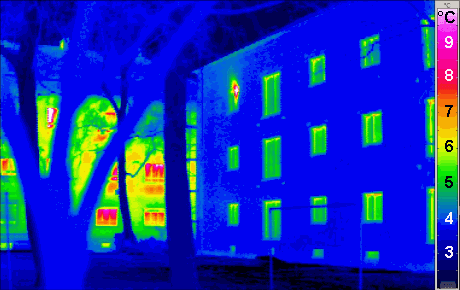
Thermography measures surface temperatures by using infrared video and still cameras.[1] The picture it makes, called a thermogram, shows warm and cool areas in different colors. A wall with good insulation behind it looks even. A wall with a gap shows a patch that is warmer or cooler than its neighbours.
What a scan can find
Insulation gaps. The Department of Energy says the resulting images help the auditor determine whether insulation is needed.[1] That is why a scan is a common part of an energy assessment. The same images also serve as a quality control tool, to ensure that insulation has been installed correctly.[1] That makes a scan useful after an insulation contractor leaves, not only before.
Air leaks. Dominion Energy says infrared cameras find air infiltration and missing insulation.[3] Scans are often done with a blower door running, which exaggerates air leaking through defects in the building shell. Such air leaks appear as black streaks in the infrared camera's viewfinder.[1] Common trouble spots are rim joists, attic hatches, recessed lights and the gaps around windows and doors.
Wet insulation and some roof leaks. Because wet insulation conducts heat faster than dry insulation, thermographic scans of roofs can often detect roof leaks.[1] A scan flags an area that looks wet. It does not prove there is water or say how it got there, so a moisture meter or a look from a roofer is the next step.
Hot electrical and mechanical parts. Thermograms of electrical systems can detect abnormally hot electrical connections or components.[1] Thermograms of mechanical systems can detect the heat created by excessive friction.[1] Those are specialist checks. A home energy scan is aimed at the building shell, so ask in advance if you want equipment looked at as well.
What a scan cannot do
It reads surfaces, so it can mislead. Heat loss detected in one area of the outside wall might originate at some other location on the inside of the wall.[1] Sun on a wall, a hot-water pipe, a recessed light or a heating duct can all light up an image for reasons that have nothing to do with insulation. A good operator confirms a finding another way, for example with a moisture meter, a blower door reading or a small inspection opening.
It does not name mold, rot, termites or structural damage either. Those need a licensed inspector or specialist; see what home inspectors most often find.
How to get a useful scan
Conditions matter as much as the camera. The most accurate thermographic images usually occur when there is a large temperature difference (at least 20°F [14°C]) between inside and outside air temperatures.[1] In Virginia that usually means a cold winter morning, or a hot afternoon with the air conditioner running. The assessor may also ask you to prepare the house by moving furniture away from exterior walls and removing drapes.[1] At some times of year the Department of Energy says it might be necessary for the homeowner to create and maintain a specific inside/outside temperature difference for a period of up to four hours before the test will be performed.[1] Ask about this when you book, so the day is not wasted.
The kind of camera matters too. Spot radiometers and thermal line scanners do not provide the necessary detail for a complete home energy assessment.[1] Ask for a thermal imaging camera, and for the images to be included in your report. The Department of Energy lists infrared cameras among the equipment assessors may use, such as blower doors, infrared cameras, furnace efficiency meters, and surface thermometers.[2]
Stop and call a pro if
- A scan shows a hot spot at an outlet, switch, breaker or the electrical panel. Do not open or probe anything yourself. A licensed electrician should look at it.
- You smell burning, see scorch marks, or a breaker keeps tripping. Leave the panel alone and call an electrician.
- The scan points to wet insulation, a damp ceiling or a stained wall. Water is the problem to fix, and it may need a roofer or plumber before anyone adds insulation.
- The scan suggests missing insulation inside walls or in the attic. Closing it up is a job for an insulation or general contractor, not a weekend fix.
- You want the scan as part of a home inspection. In Virginia, "It shall be unlawful for any individual who does not possess a license as a home inspector issued by the Board to perform a home inspection for compensation on a residential building."[4]
Getting help in Virginia
Read how much a thermal imaging inspection costs in Virginia and whether one is worth it before you book. For a whole-house review, see how much a home energy audit costs. Loclis lists DPOR-licensed businesses with their licence number and class: browse inspection services or see more inspection answers.
When you are ready, describe what you want checked once and local businesses quote it.
Common questions
- Can a thermal camera see through walls?
- No. It shows surface temperatures only. The Department of Energy notes that heat loss detected in one area of the outside wall might originate at some other location on the inside of the wall, so a trained operator reads the pattern and confirms it another way.
- Can it find a roof leak?
- Sometimes. The Department of Energy says that because wet insulation conducts heat faster than dry insulation, thermographic scans of roofs can often detect roof leaks. The scan shows where to look; a roofer or a moisture meter confirms it.
- Can it find electrical problems?
- It can. Thermograms of electrical systems can detect abnormally hot electrical connections or components. A whole-house energy scan is aimed at insulation and air leaks, so say in advance if you want the panel and connections included, and leave any repair to a licensed electrician.
- When is the best time to have a scan done?
- When there is a large temperature difference between inside and outside. The Department of Energy says the most accurate images usually occur with a difference of at least 20°F, so cold winter mornings or hot days with the air conditioner running tend to work best.
- Is a thermal scan the same as a home inspection?
- No. A thermal scan is one tool, often used in an energy assessment. A home inspection for compensation in Virginia must be done by a licensed home inspector, and it covers the whole building. A scan can be offered as an add-on to either.
Sources
- [1] Thermographic Inspections, U.S. Department of Energy, Energy Saver. Checked October 27, 2026.
- [2] Professional Home Energy Assessments, U.S. Department of Energy, Energy Saver. Checked October 27, 2026.
- [3] Save Energy: Home Rebates & Programs (Virginia), Dominion Energy. Checked October 27, 2026.
- [4] Va. Code § 54.1-503, Licenses required, Code of Virginia, Legislative Information System. Checked October 27, 2026.
Want a pro to handle it?
Describe the job once. Licensed local businesses send quotes, and you pay only when you book one.
Get a quote from a local pro