How often should I replace water filter cartridges?
Follow the rating for your exact cartridge, in months or gallons, whichever comes first, and change it sooner if the flow drops. For example, GE rates one whole-house carbon cartridge for 30,000 gallons or 3 months, Aquasana says to replace its whole-house iron filter cartridges every 6 months, and GE marks its under-sink RO filters for replacement six months after installation.
Free to ask. Local shops send quotes, and you pay only when you book one.
By Kasra Taheri, Founder, LoclisPublished
Researched and drafted with AI, then checked claim by claim against the sources listed below before it was published. Prices and rules change; the dates beside each source say when it was last checked.
Step by step
Read when to stop and call a pro, further down this page, before you start.
Step 1: List every filter
Make a list of each filter in the house: whole-house housings, under-sink and reverse osmosis units, the refrigerator, faucet filters and pitchers.
Step 2: Record the model numbers
Write down each cartridge's model number from its label or manual, since the rated life is set for that model.
Step 3: Look up the rated life
Find each cartridge's rating in months, gallons or both, and plan to change it at whichever limit comes first.[1]
Step 6: Read the gauges
If the housing has pressure gauges before and after it, note the difference with a fresh cartridge and change it when its manual says the gap is too wide.
Step 7: Change RO filters on schedule
On a reverse osmosis unit, change the prefilter and postfilter on their schedule and test the treated water as often as the manual says.[3]
Step 8: Schedule the UV lamp
Step 9: Keep a spare
Keep one spare cartridge of each type on hand so a change is never put off for want of a part.
Step 10: Retest the water
Test samples from before and after the equipment from time to time to confirm it is still doing its job.[5]
Replace each cartridge on the schedule for that exact cartridge, in months or gallons, whichever comes first, and sooner if your water flow drops. There is no single number for every filter, because a whole-house sediment cartridge, an under-sink carbon block and a reverse osmosis membrane do different jobs and wear out at different rates. The examples below show the range; your own cartridge's label is the one to follow.
Why the schedule matters
An overdue filter is not just a slower filter. The U.S. Environmental Protection Agency explains that activated carbon filters are designed to filter a certain amount of water; after that, the filters become clogged and ineffective.[7] Virginia Tech's well-water program says pitcher-style carbon filters must be changed according to directions or may actually become a source of contamination.[8]
Typical schedules by type
Whole-house carbon and sediment cartridges. GE's manual for its heavy-duty whole-house housing says to change the filter when the water flow is noticeably reduced or at least every 3 months, and rates its carbon cartridge for 30,000 gallons or 3 months.[1] Its reminder timer, once reset, has a light that flashes again after 90 days as a reminder.[1]
Whole-house iron filters. Aquasana's instructions for its three-stage iron filter system say to replace the cartridges every 6 months, sooner if there is a noticeable drop in flow, with the frequency varying with the iron and sediment in the water.[2] It also says the filter housings themselves must be replaced every 5 years.[2]
Under-sink reverse osmosis. GE's manual for its under-sink RO system says to mark the date for filter replacement six months from the installation date, and asks that the treated water be tested a minimum of every six months.[3] The membrane lasts longer: Virginia Cooperative Extension gives RO systems an average lifetime of 3-5 years, at which point the membrane must be replaced.[4] GE adds that the flow control should be replaced each time the reverse osmosis membrane is changed.[3] Do not let the prefilter run over. GE warns: "CHLORINE DESTROYS THE REVERSE OSMOSIS MEMBRANE".[3]
UV disinfection lamps. A. O. Smith's instructions say: "Replace the UV lamp annually (or biennially if seasonal home use) to ensure maximum disinfection."[6] They also explain that minerals slowly coat the quartz sleeve around the lamp, which cuts the UV light reaching the water, so the sleeve must be cleaned or replaced.[6]
Pitchers, faucet filters and refrigerator filters. Go by the box and the reminder light. For pitcher filters, Virginia Tech's well-water program advises: "Check the filter box to find out what is actually removed."[8] The same box gives the replacement interval.
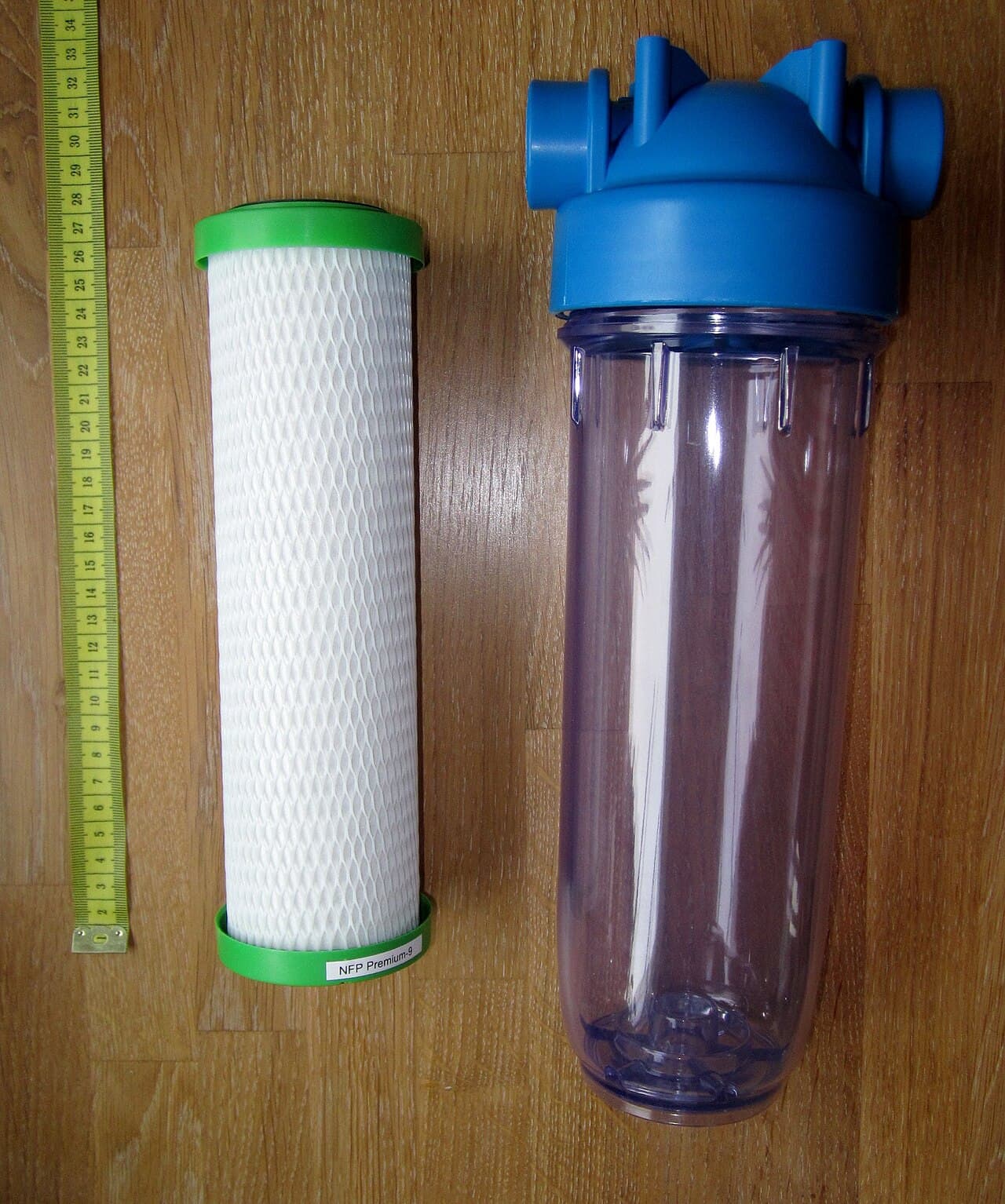
Signs a cartridge is due early
- Flow drops. A sediment or carbon cartridge that is loading up often shows it as weaker flow, and GE's and Aquasana's manuals both treat a noticeable drop in flow as a reason to change.[1][2]
- Pressure difference grows. With a gauge before and after the housing, the gap between them usually widens as the cartridge clogs.
- Taste or odor returns. On a reverse osmosis unit, worn filters are one cause among several. In GE's troubleshooting table for other tastes and odors, the prefilter and postfilter appear as a cause only after three others: RO water that simply tastes different from what you are used to, low water usage, and contamination in the storage tank. Its fix for the filters is to replace the prefilter and postfilter. If taste and odor persists, GE's next step is to replace the reverse osmosis cartridge, flow control and screen.[3]
- Cartridges clog far faster than rated. That can mean the water has changed or the cartridge is the wrong type, and it is time for a new water test.
Equipment without cartridges
Some treatment equipment is maintained, not replaced. Extension describes softeners as needing periodically adding sodium pellets to a brine tank,[5] media filters are backwashed rather than replaced,[5] and acid neutralizers need more neutralizing media added from time to time.[5] Whatever you have, Extension recommends periodic testing of samples collected before and after any treatment device[5] to confirm it is still working.
Stop and call a pro if
- The UV unit is hard-wired rather than plugged in, or is not on a GFCI. A. O. Smith says to disconnect power, shut off the water and release the pressure before servicing, and warns: "There may be more than one source of power. Only connect to a GFCI."[6] Wiring is a job for a licensed electrician.
- The lamp would have to be switched on or checked outside its chamber. UV light is a hazard in its own right. A. O. Smith's sheet says: "ALWAYS use UV protective gear, including gloves and UV safety glasses." It adds: "NEVER look directly at illuminated UV lamp, even when using protective gear." And: "NEVER illuminate UV lamp outside of the UV chamber."[6]
- You do not have the right gloves. The sheet says: "DO NOT handle UV lamps or quartz sleeves with bare hands." It calls for rubber or latex gloves for a used lamp or a soiled sleeve, and cotton gloves for a new lamp or a clean sleeve.[6]
- The quartz sleeve has to come out and you do not have the owner's manual. After cleaning or replacing the sleeve, A. O. Smith's sheet says to perform the disinfection procedure in the owner's manual once the service is complete.[6] Without that procedure, have a pro finish the job.
- A UV lamp or quartz sleeve breaks. "The UV lamp contains mercury."[6] A. O. Smith's sheet says to avoid breathing or swallowing the debris and keep it off your skin and eyes, never use a vacuum cleaner, which can scatter the mercury, and follow local rules for disposing of mercury waste.[6]
- You cannot confirm the UV chamber is depressurized, or you are not comfortable with the manual.
- A housing is cracked, past its service life, or leaks after you have reseated a clean O-ring.
- Your RO water tastes of chlorine after new filters. The membrane may be damaged.
- Cartridges clog within weeks. Have the water tested and the system reviewed; see how to know what water treatment system you need.
For the change itself, see how to change a whole-house water filter.
Getting help in Virginia
Loclis lists DPOR-licensed plumbing businesses with their licence number and class. Look up plumbers in Blacksburg, browse water treatment services, or read more plumbing answers.
If a fresh cartridge has not brought the flow back, describe the problem once and licensed local plumbers quote it.
Common questions
- What happens if I do not change a water filter cartridge?
- It stops doing its job and can make things worse. The EPA says carbon filters become clogged and ineffective once they have treated the water they were designed for, and Virginia Tech's well-water program warns that pitcher-style carbon filters not changed according to directions may become a source of contamination.
- Should I go by months or by gallons?
- Whichever limit comes first. Many cartridges carry both: GE rates its whole-house carbon cartridge for 30,000 gallons or 3 months. A large household uses up the gallons sooner, and a cartridge in a vacation home still ages by the calendar.
- How often does a reverse osmosis membrane need replacing?
- Far less often than its filters. Virginia Cooperative Extension gives reverse osmosis systems an average lifetime of 3-5 years before the membrane must be replaced, while GE marks the prefilter and postfilter on its under-sink unit for replacement six months after installation. A chlorine taste in RO water is a warning sign, because chlorine destroys the membrane.
- Does a water softener have a cartridge to change?
- Usually not. A softener is maintained by adding salt to the brine tank, and the brine regenerates its resin. Media filters are backwashed, and acid neutralizers need more media added over time, all on schedules that depend on your water.
- How often should a UV lamp be replaced?
- Follow your unit's manual. A. O. Smith's instructions for its UV systems say to replace the lamp annually, or every two years in a seasonal home. The lamp contains mercury, the unit must be powered off and depressurized first, and the sheet calls for gloves and UV safety glasses. A hard-wired unit, a broken lamp or sleeve, or a sleeve that needs cleaning and disinfection without the owner's manual at hand is a job for a pro.
Sources
- [1] Installation Instructions: Heavy-Duty Water Filtration System GXWH40L (49-50220-4), GE Appliances. Checked October 26, 2026.
- [2] Replacement Whole House Iron Filter Owner's Manual (EQ-PRE-204-R, EQ-FE20-R and EQ-PFC.35), Aquasana. Checked October 26, 2026.
- [3] Reverse Osmosis Filtration System GXRV10ABL: Owner's Manual and Installation Instructions, GE Appliances. Checked October 26, 2026.
- [4] Virginia Household Water Quality Program: Sulfate and Hydrogen Sulfide in Household Water (442-658), Virginia Cooperative Extension, Virginia Tech. Checked October 26, 2026.
- [5] Virginia Household Water Quality Program: Household Water Treatment (442-670), Virginia Cooperative Extension, Virginia Tech. Checked October 26, 2026.
- [6] UV Lamp and Quartz Sleeve Replacement/Maintenance (Instruction Sheet 520183-R), A. O. Smith. Checked October 26, 2026.
- [7] Water Health Series: Filtration Facts, U.S. Environmental Protection Agency. Checked October 26, 2026.
- [8] Virginia Household Water Quality Program: Frequently Asked Questions, Virginia Cooperative Extension, Virginia Tech. Checked October 26, 2026.
Want a pro to handle it?
Describe the job once. Licensed local businesses send quotes, and you pay only when you book one.
Get a quote for Plumbing Repair