How do I change a whole-house water filter?
Shut off the water to the filter or set its bypass, relieve the pressure with the release button or valve on the housing, and unscrew the housing with its wrench. Fit the same size and type of cartridge, clean and lightly grease the O-ring, snug the housing without overtightening, turn the water on slowly, bleed the air, check for leaks and flush the new cartridge.
Free to ask. Local shops send quotes, and you pay only when you book one.
By Kasra Taheri, Founder, LoclisPublished
Researched and drafted with AI, then checked claim by claim against the sources listed below before it was published. Prices and rules change; the dates beside each source say when it was last checked.
Step by step
Read when to stop and call a pro, further down this page, before you start.
Step 1: Get the right cartridge
Match the new cartridge to the housing's length, diameter and type, and keep the housing's manual at hand, since the order of steps differs between models.
Step 2: Shut off the water
Close the shutoff valve ahead of the filter, or turn the filter head's control handle to BYPASS or OFF if it has one.[1]
Step 4: Get a bucket under it
Set a bucket and towels under the housing, which is full of water, heavy, and likely to crack if dropped.[2]
Step 5: Unscrew the housing
Loosen the housing with the wrench that came with the system, lower it carefully and discard the used cartridge.[1]
Step 6: Clean the housing
Wash the inside of the housing with mild soap and water, not harsh cleaners or hot water.[1]
Step 8: Seat the new cartridge
Set the new cartridge in the housing so it is centered and fully seated on the bottom seal.[1]
Step 10: Turn the water back on
Open the shutoff slowly or turn the handle back to FILTER, then press the release button to let trapped air out.[1]
Step 11: Check for leaks
Once the system is fully pressurized, look over the housing and its fittings for drips.[2]
Step 12: Flush the new cartridge
Run a faucet downstream for as long as the manual says to flush the new cartridge before you drink the water.[1]
Step 13: Record the date
Write the change date on the housing or reset the reminder timer if your system has one, so you know when the next change is due.[1]
Changing a whole-house filter cartridge is a short job once you know your housing: water off, pressure off, housing off, new cartridge in, then back the way it came. The two things that usually cause trouble are opening a housing that is still under pressure and a dry or twisted O-ring that leaks when the water comes back on. Models differ in the details, so keep your housing's manual at hand.
Before you start
Find how water gets shut off to the filter, and how the housing lets its pressure out.
- A head with a bypass. On GE's heavy-duty housing, for example, you turn the control handle on the filter head to BYPASS or OFF, then press the red pressure-release button on the head.[1] In BYPASS, water keeps flowing to the house around the filter, so the release button is what empties the pressure from the housing.[1]
- Shutoff valves or the main. Other systems have a shutoff valve on each side of the filter, or none, so you close the valves or the main shutoff. On Aquasana's whole-house system you then unscrew the pressure-relief valve on the sump cap, and with the main closed you can also drain the lines by opening a faucet inside the house; in bypass mode the lines do not need draining.[2]
Have these ready:
- the replacement cartridge, matched to your housing's size and type
- the housing wrench that came with the system
- a bucket and a couple of towels
- food-grade silicone grease for the O-ring, and a spare O-ring if yours is old
Aquasana warns that its filter housings are heavy and will likely crack if dropped,[2] so lower the housing with both hands.
Leave any copper wire clamped across the filter in place. GE warns: "A copper or galvanized cold water pipe may be used to ground electrical outlets in the home." GE adds that the filter housing may have broken this ground path, so where the pipe carries the electrical ground, the installer should have bridged the filter with a copper ground wire.[1] Aquasana gives the same warning for copper pipes: leave the grounding clamps installed while you change the filter.[2]
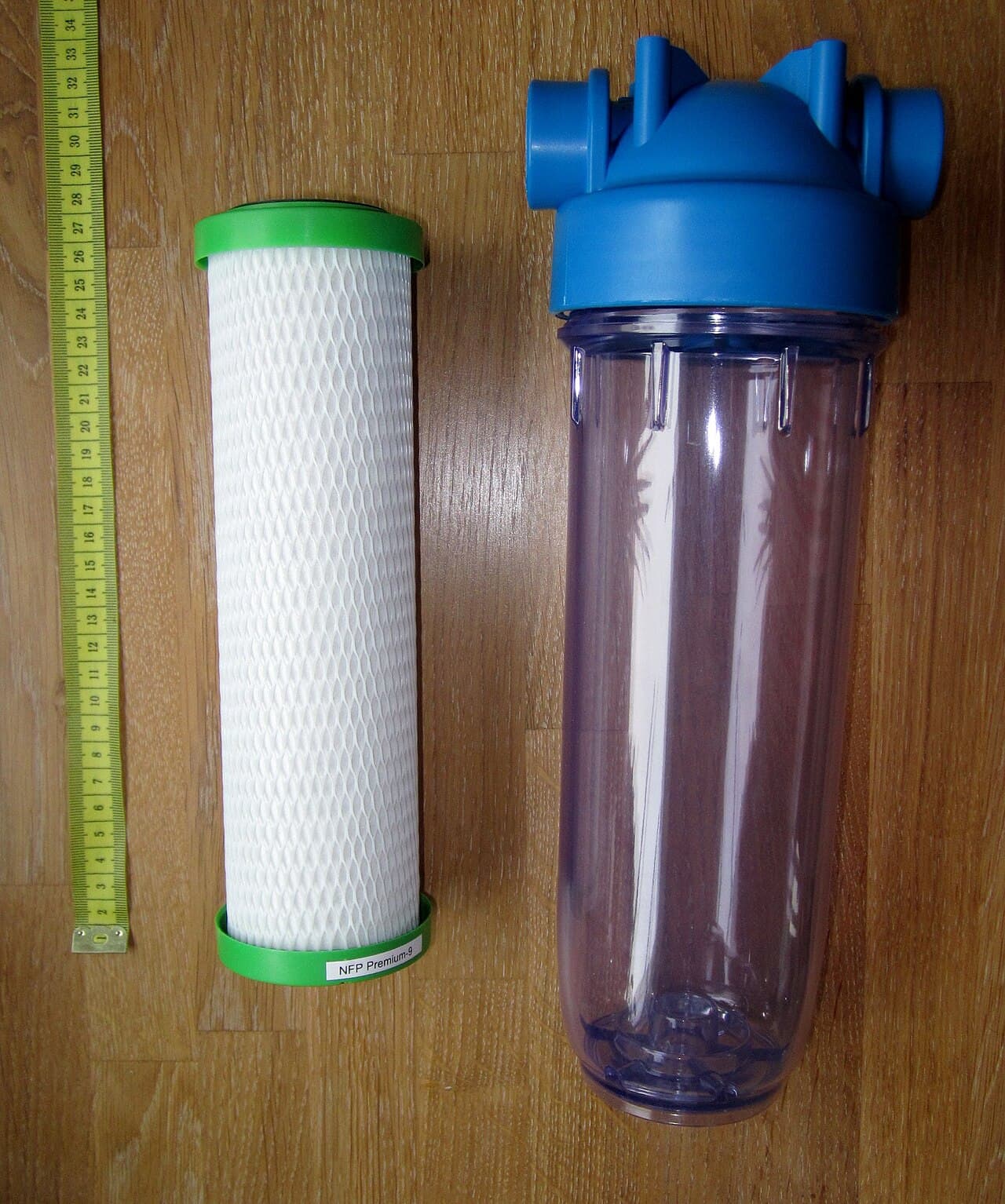
Cleaning, the O-ring and putting it back
With the old cartridge out, rinse the housing. Wash the inside of the housing with mild soap and water, not harsh cleaners or hot water.[1]
The O-ring is what keeps the housing from leaking. Clean it, coat it lightly with food-grade silicone grease rather than petroleum jelly, and press it evenly into its groove.[1][2] A flattened, cracked or stretched O-ring is often the cause of a drip after a filter change, so replace one that looks worn.
Set the new cartridge in the center of the housing, screw the housing on by hand, and snug it with the wrench. Both manuals say not to overtighten, and Aquasana notes the wrench should only need an eighth to a quarter of a turn.[1][2]
Turn the water back on slowly, bleed the air with the release button, and look for drips. Then flush the cartridge before anyone drinks the water. GE's instructions are to flush the cartridge for 10 minutes (40 gallons), wait one hour, then flush again for 10 minutes before using the water.[1] A carbon cartridge often sends out some black dust at first; that is what the flush is for.
How often to change it
Go by the schedule for your exact cartridge, not a general rule. GE's manual says to change the cartridge when the water flow is noticeably reduced or at least every 3 months, and its carbon cartridge is rated for 30,000 gallons or 3 months.[1] Aquasana's whole-house iron filter cartridges are replaced every 6 months, sooner if the flow drops.[2]
Overdue cartridges are not harmless. Virginia Cooperative Extension says activated carbon filters must be changed according to the manufacturer's recommendation to work properly,[3] and Virginia Tech's well-water program warns that pitcher-style carbon filters that are not changed according to directions may actually become a source of contamination.[4] There is more on schedules in how often to replace water filter cartridges.
Picking the right replacement
A sediment cartridge and a carbon cartridge can look alike and do different jobs. According to Virginia Cooperative Extension, sediment filters are rated by the smallest particle they can trap, such as 20 microns, and carbon filters treat taste, odor and chlorine.[3] Buy the same type and rating unless you are deliberately changing what the filter does, and look for certification by an independent third party, like NSF International.[3]
Know what a cartridge filter cannot do. GE's housing is meant for a potable, safe-to-drink cold water supply only, and in GE's words, "The filter cartridge will not purify water or make unsafe water safe to drink."[1] If you are on a well and have not had the water tested, read how to know what water treatment system you need before buying anything more.
Stop and call a pro if
- The housing or head is cracked, or it still leaks after you have reseated a clean, greased O-ring.
- The leak is at the pipe fittings, not the housing. That is plumbing work on the supply line.
- There is no way to isolate the filter. Adding shutoff valves or a bypass means cutting into the supply line, and the Virginia Uniform Statewide Building Code requires a permit for installations or alterations involving the water supply and distribution system.[5]
- The ground wire across the filter is missing or loose on copper or galvanized pipe. Have an electrician or plumber restore it.
- Your water pressure is high. GE's heavy-duty housing is rated up to 100 psi and calls for a pressure-reducing valve ahead of it if house pressure runs higher than 80 psi during the day.[1]
- The housing is old. Aquasana says its housings must be replaced every 5 years.[2] Check your own manual for the housing's service life.
Getting help in Virginia
Loclis lists DPOR-licensed plumbing businesses with their licence number and class. Look up plumbers in Blacksburg or another town, browse water treatment services, or find more plumbing answers.
If the flow is still weak after a fresh cartridge, describe the problem once and licensed local plumbers quote it.
Common questions
- Do I need to turn off the water to the whole house to change the filter?
- Often not. Many whole-house housings sit between two shutoff valves, or have a head with a bypass setting that keeps water flowing to the house while the cartridge is out. If yours has neither, you will need to close the main shutoff, and adding valves around the filter is a job for a plumber.
- The housing will not come loose. What should I do?
- Make sure the pressure is fully released first, since a pressurized housing is much harder to turn. Then use the housing wrench made for it rather than pipe wrenches or force, which can crack the plastic. If it still will not move, stop before you break the head and call a plumber.
- Why is there air and cloudy water after I change the filter?
- Air gets trapped when the housing is open, and fine carbon dust washes out of a new carbon cartridge. Press the release button to bleed air, then flush for as long as the manual says. GE's instructions for its heavy-duty housing call for 10 minutes, an hour's wait, then 10 more minutes.
- Can I use any brand of cartridge in my housing?
- Only one that matches the housing's size and that you know does the job you need. A cartridge that fits loosely can let water bypass it. Look for one certified by an independent body such as NSF International for the claim on the box, such as chlorine taste and odor or sediment.
- My housing leaks after I put it back on. Is it broken?
- Usually the O-ring is twisted, dry or out of its groove. Shut the water off, relieve the pressure, take the housing off, clean and lightly grease the O-ring, seat it and try again. If it still leaks, or the leak is at the pipe fittings rather than the housing, call a plumber.
Sources
- [1] Installation Instructions: Heavy-Duty Water Filtration System GXWH40L (49-50220-4), GE Appliances. Checked October 26, 2026.
- [2] Replacement Whole House Iron Filter Owner's Manual (EQ-PRE-204-R, EQ-FE20-R and EQ-PFC.35), Aquasana. Checked October 26, 2026.
- [3] Virginia Household Water Quality Program: Household Water Treatment (442-670), Virginia Cooperative Extension, Virginia Tech. Checked October 26, 2026.
- [4] Virginia Household Water Quality Program: Frequently Asked Questions, Virginia Cooperative Extension, Virginia Tech. Checked October 26, 2026.
- [5] 13VAC5-63-80, Virginia Uniform Statewide Building Code: Section 108 Application for permit, Virginia Administrative Code, Legislative Information System. Checked October 26, 2026.
Want a pro to handle it?
Describe the job once. Licensed local businesses send quotes, and you pay only when you book one.
Get a quote for Plumbing Repair