How do I know what water treatment system I need?
Test the water first, then buy only what the results call for. On a well, have a certified lab or a Virginia Household Water Quality Program clinic test for bacteria, nitrate, hardness, iron, manganese, pH, lead and more; on city water, start with the utility's annual water quality report. Each problem has its own fix, and no single device treats them all.
Free to ask. Local shops send quotes, and you pay only when you book one.
By Kasra Taheri, Founder, LoclisPublished
Researched and drafted with AI, then checked claim by claim against the sources listed below before it was published. Prices and rules change; the dates beside each source say when it was last checked.
Step by step
Read when to stop and call a pro, further down this page, before you start.
Step 1: Write down the symptoms
Note what you see, taste or smell and where: stains, scale, soap that will not lather, an odd taste or odor, or cloudy, frothy or colored water.[7]
Step 2: Know your water source
Find out whether your water comes from a public utility or from a private well, spring or cistern, since that decides who tests it.
Step 3: Read the utility's report
On public water, read the utility's annual water quality report, sometimes called a consumer confidence report.[9]
Step 4: Test a private well
Have a certified lab test a well at least for total coliform bacteria, nitrate, total dissolved solids and pH, plus whatever your symptoms point to.[7]
Step 5: Compare with EPA levels
Compare each result with EPA's drinking water standards, including the secondary levels for taste, odor and staining.[8]
Step 6: Match problems to treatments
List each problem the test found and the treatment that fits its concentration, since one device rarely fixes everything.[1]
Step 7: Choose whole-house or one tap
Decide whether each problem needs treating at every tap or only at the faucet used for drinking and cooking.[9]
Step 8: Get two or three opinions
Ask two or three suppliers to propose equipment from the same test results before you buy.[1]
Step 10: Retest after it is installed
Test water before and after the new equipment to confirm it is doing what it was sold to do.[1]
You find out what treatment you need by testing the water and treating what the test shows, in that order. In Virginia Cooperative Extension's words, "It is critical to have a water sample analyzed by an independent, certified lab and to consult a professional before purchasing any water treatment equipment."[1] It also notes that no single water treatment device treats all problems, and all devices have limitations,[1] so a system sold before anyone has seen a lab report is a guess.
Start with a test, not a sales pitch
On a private well, spring or cistern, testing is your job. The U.S. Environmental Protection Agency's advice is: "Test your private well annually for total coliform bacteria, nitrates, total dissolved solids, and pH levels."[7] For a broader picture, Virginia Tech runs drinking water clinics in around 70 Virginia counties every year through local Extension offices, covering 28 chemical and bacteriological constituents for $70 a kit when we checked on October 26, 2026.[6] A clinic kit includes bacteria, nitrate, hardness, iron, manganese, lead, copper, pH and more,[6] which covers most of what drives treatment decisions.
On public water, the utility already tests. The EPA's advice is to contact your supplier and ask for the annual water quality report (sometimes called a consumer confidence report).[9] Treat at home only for something specific, such as lead from your own plumbing or hardness that scales fixtures.
Your symptoms tell the lab what else to look for. The EPA's table for well owners says scaly residues and soap that will not lather point to hardness, stained fixtures and laundry point to iron, copper or manganese, and an objectionable taste or smell points to hydrogen sulfide, corrosion or metals.[7]
Matching the result to the equipment
Each finding has its own treatment, and often the amount decides which one:
- Hard water (scale, poor lather). Extension says hardness below 7.0 grains per gallon (120 mg/L) generally does not need treatment, and that when hardness is causing a problem the most common fix is an ion exchange water softener.[2] Be wary of magnetic or electronic descalers: no recognized agency in the United States has established protocol to assess the effectiveness of physical water treatment devices.[2]
- Iron and manganese (orange or black stains). EPA's secondary, or nuisance, levels are 0.3 mg/L for iron and 0.05 mg/L for manganese.[8][3] The fix depends on the amount. An ion exchange softener can usually remove iron and manganese at combined levels of 5 mg/L or less, aeration followed by filtration handles 5 to 10 mg/L, and an oxidizing filter handles up to 15 mg/L.[3]
- Rotten-egg smell. This is hydrogen sulfide, and again the dose decides. Trace amounts, up to a few tenths of a milligram per liter, can be removed with an activated carbon filter; a manganese greensand oxidizing filter handles up to 6 mg/L; above that, an oxidizing agent such as chlorine or potassium permanganate is injected ahead of a holding tank and a filter.[4] See why water smells like rotten eggs for the checks to make first.
- Low pH (acidic, corrosive water). The EPA-recommended pH range for public drinking water supplies is between 6.5 and 8.5.[1] Below that, acidic water can dissolve copper and lead from household plumbing.[1] An acid water neutralizing filter raises the pH, but it will likely increase the hardness of the water,[1] sometimes enough to add a softener. Virginia Tech lists the warning signs of corrosive water as pitting, pinhole leaks, a metallic taste or blue-green staining.[5]
- Lead. Besides correcting low pH, Virginia Tech suggests an activated carbon filtration or reverse osmosis unit designed to remove lead at the faucet where drinking and cooking water is obtained.[5]
- Bacteria. Common in wells: Virginia Tech's program finds coliform bacteria in about 40% of the well samples it tests and E. coli in about 8-10%.[5] If E. coli turns up, it recommends boiling water for at least a minute or using another source of water until the problem is fixed, and having the well checked.[5] Long-term treatment options for bacteria are a UV light or a chlorination system,[5] but Extension says UV is not the right choice where the water has more than 1,000 total coliforms per 100 milliliters or more than 100 fecal coliforms per 100 milliliters.[1]
- Nitrate. The EPA lists the removal methods as "Nitrates - distillation, reverse osmosis or ion exchange".[9]
Softening has a side effect worth knowing about: "Water softeners add sodium (salt) to water. Individuals on restricted-sodium diets should consult a physician before consuming softened water."[1]
Whole house, or one faucet
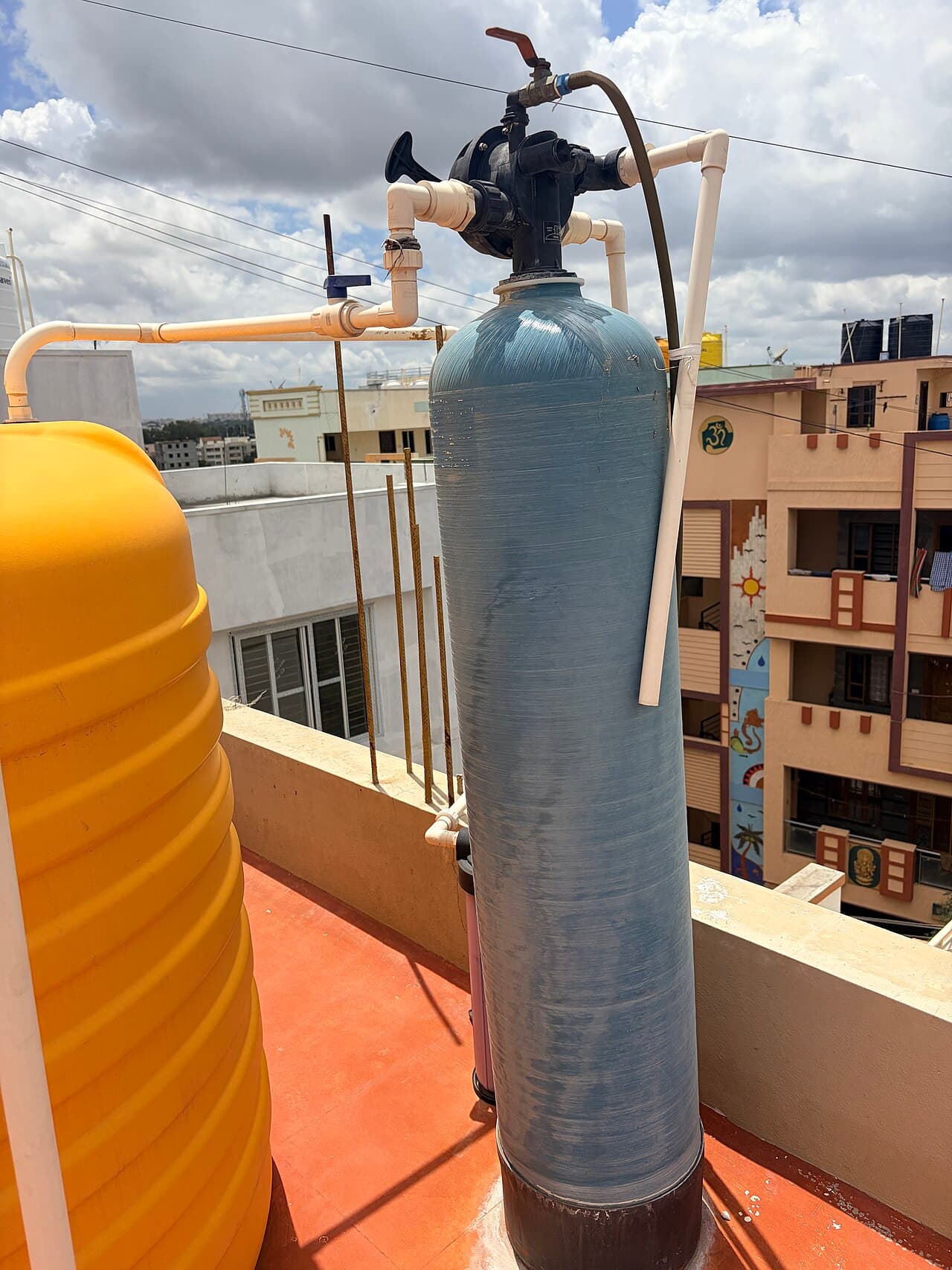
Not every problem needs whole-house equipment. According to the EPA, for most contaminants a point-of-use device is effective for treating only the water that is consumed, so a unit at the drinking-water tap can be enough for a concern such as lead or nitrate. The exceptions are contaminants such as radon, disinfection byproducts and some organic chemicals, which turn into gases easily and may pose a risk when inhaled, such as when showering; those call for point-of-entry treatment of all the water entering the house.[9] Whole-house equipment also makes sense for problems you notice everywhere: staining, scale, sediment and odor. When several problems show up together, the order matters, and a good supplier will explain why each tank sits where it does. What a whole-house filter costs covers the running costs of each type.
Choosing who designs and installs it
- The designer. For water treatment specialists, Virginia Tech says to look for those who have a Water Quality Association certification.[5]
- The equipment. Extension recommends equipment certified by an independent third party, like NSF International.[1]
- Comparing offers. Get two or three opinions from different suppliers,[1] based on the same lab report.
- The installer's licence. Plumbing a system into the supply line is plumbing work. Under the Code of Virginia, the Board for Contractors requires "a master tradesmen license as a condition of licensure for electrical, plumbing, and heating, ventilation, and air conditioning contractors,"[10] and the Board's home improvement (HIC) specialty "does not provide for electrical, plumbing, HVAC, or gas fitting functions."[11] On Loclis, plumbing work needs a licence at any job size. Check any business on DPOR's License Lookup.[12]
- The well itself. If the fix is a cracked casing or a missing well cap rather than a filter, hire a licensed well driller. Virginia Tech's well-water program says: "Do not allow anyone who is not a licensed well driller to work on your well".[5] See who can work on a private well in Virginia.
Once the system is in, Extension recommends periodic testing of samples collected before and after any treatment device[1] to show it is working.
Stop and call a pro if
- The test shows E. coli or other bacteria. Use boiled or other water for drinking and cooking, and have a licensed well driller find out how the bacteria get in.
- Lead or nitrate is above EPA's limits. Get the fix designed by a professional. The EPA also advises testing more frequently if small children or elderly adults live in your house or if someone in your house is pregnant or nursing.[7]
- The odor smells like sewage or the well is shallow and near a septic drainfield. Extension says hydrogen sulfide can signal sewage contamination, and that if it is suspected you should test your water for coliform bacteria and nitrate.[4] Have the well inspected too.
Finding help in Virginia
Loclis lists DPOR-licensed plumbing businesses with their licence number and class. Look up plumbers in Blacksburg, browse well water testing and water treatment services, or read more plumbing answers.
When you have the lab report, describe the job once and licensed local plumbers quote it.
Common questions
- Can a water treatment company test my water for me?
- Many will, but a sales test is not a substitute for a certified lab. Virginia Cooperative Extension says it is critical to have a sample analyzed by an independent, certified lab before buying equipment. A lab report gives you numbers every supplier can quote against.
- I am on city water. Do I need a treatment system at all?
- Often not. The EPA sets and enforces national standards for tap water from public water systems. Read your utility's annual water quality report first, and treat only for a specific concern it, or your own test, shows, such as lead from old plumbing or hardness that leaves scale.
- Do magnetic or electronic descalers work?
- Unproven. Virginia Cooperative Extension notes that the hardness of the water is not changed by these devices and that no recognized U.S. agency has set a protocol to assess them, while ion exchange softeners have a test standard, NSF/ANSI 44.
- Should a softener treat my drinking water too?
- It does not have to. Extension says water for drinking and cooking does not necessarily need to be softened, and that softening adds sodium, so people on restricted-sodium diets should consult a physician. A softener can be set up to treat only the hot water, or to bypass the kitchen cold tap.
- Who should I hire for well water treatment in Virginia?
- For the equipment, Virginia Tech's well-water program suggests a water treatment specialist with a Water Quality Association certification. The plumbing itself is contractor work, so check the installer's licence with DPOR. For anything in the well itself, it says to use only a licensed well driller.
Sources
- [1] Virginia Household Water Quality Program: Household Water Treatment (442-670), Virginia Cooperative Extension, Virginia Tech. Checked October 26, 2026.
- [2] Virginia Household Water Quality Program: Hardness in Household Water (442-664), Virginia Cooperative Extension, Virginia Tech. Checked October 26, 2026.
- [3] Virginia Household Water Quality Program: Iron and Manganese in Household Water (442-656), Virginia Cooperative Extension, Virginia Tech. Checked October 26, 2026.
- [4] Virginia Household Water Quality Program: Sulfate and Hydrogen Sulfide in Household Water (442-658), Virginia Cooperative Extension, Virginia Tech. Checked October 26, 2026.
- [5] Virginia Household Water Quality Program: Frequently Asked Questions, Virginia Cooperative Extension, Virginia Tech. Checked October 26, 2026.
- [6] Virginia Household Water Quality Program: drinking water clinics, Virginia Cooperative Extension, Virginia Tech. Checked October 26, 2026.
- [7] Protect Your Home's Water, U.S. Environmental Protection Agency. Checked October 26, 2026.
- [8] Secondary Drinking Water Standards: Guidance for Nuisance Chemicals, U.S. Environmental Protection Agency. Checked October 26, 2026.
- [9] Water Health Series: Filtration Facts, U.S. Environmental Protection Agency. Checked October 26, 2026.
- [10] Code of Virginia § 54.1-1100, Contractors: Definitions, Code of Virginia, Legislative Information System. Checked October 26, 2026.
- [11] 18VAC50-22-30, Board for Contractors Regulations: Definitions of specialty services, Virginia Administrative Code, Legislative Information System. Checked October 26, 2026.
- [12] License Lookup, Virginia Department of Professional and Occupational Regulation. Checked October 26, 2026.
Want a pro to handle it?
Describe the job once. Licensed local businesses send quotes, and you pay only when you book one.
Get a quote for Plumbing Repair