What are the signs of bad shocks or struts?
The usual signs are a bouncy or floaty ride, the front end diving when you brake, the body leaning in turns, clunks over bumps, oily fluid on the shock body and uneven tire wear. Virginia's inspection rules reject shocks and struts that are broken, bent, loose, disconnected or leaking in a way that stops them working. A shop must confirm which part is at fault.
Free to ask. Local shops send quotes, and you pay only when you book one.
By Kasra Taheri, Founder, LoclisPublished
Researched and drafted with AI, then checked claim by claim against the sources listed below before it was published. Prices and rules change; the dates beside each source say when it was last checked.
This is a job for a licensed pro in Virginia
This page explains what the work involves, the permits, what a licensed pro does and what drives the cost. It does not give step-by-step instructions, because this work needs a licence, a permit or both, and doing it wrong can injure someone. Before you hire, check the licence on Virginia's DPOR record.
The most common signs of worn shocks or struts are a bouncy or floaty ride, the nose dipping hard when you brake, the body leaning in corners, clunks or rattles over bumps, oily fluid on the damper and tires that wear unevenly. None of these proves a shock or strut is the cause, because worn bushings, ball joints and springs feel similar. A shop has to look at the car to say which part has failed.
What bad shocks and struts feel like
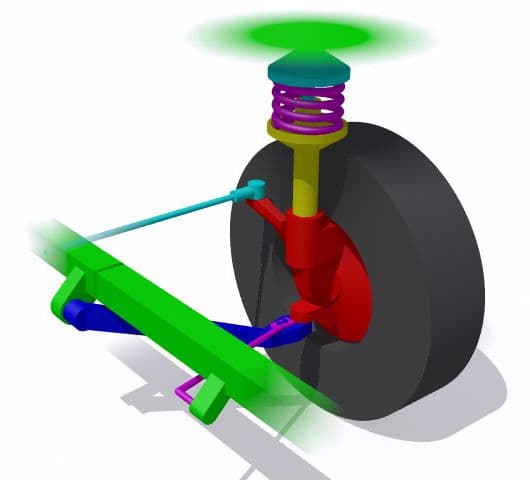
Shocks and struts are dampers: they stop the springs from bouncing the car up and down after a bump. When they wear out, the car loses that control, and you tend to notice it in a few ways:
- A bouncy or floaty ride. The car keeps moving after a dip or bump instead of settling at once.
- Nose dive and squat. The front end drops noticeably when you brake, or the rear squats when you accelerate.
- Body lean. The car rolls more than it used to in turns or crosswinds.
- Clunks and rattles. A knock over bumps from one corner can be a worn mount, a loose damper or a worn link, not only a dead shock.
- A harsh or wandering feel. Virginia's inspection rules reject a vehicle that shimmies or wanders at normal operating speeds.[1]
What a shop looks for
Leaks matter, but only up to a point. The inspection rules tell inspectors not to reject a shock absorber or MacPherson strut unless there is evidence of leakage that causes the device not to function properly.[1] Damp is not the same as failed. Fluid streaming down the body, combined with a bouncy ride, is a much stronger sign than a thin film of oil.
The rules also describe damage that is plainly a failure. They reject shock absorbers or cross stabilizer links that are disconnected, broken, bent, loose, or do not function properly,[1] and a MacPherson strut that is broken, bent, loose or does not function properly.[1] If a shop says your strut is bad, ask what it found: a leak, a bent rod, a loose mount or play when the part is moved.
Related parts show up in the same inspection. A spring fails inspection when a spring is broken, sagging or misaligned.[1] A control arm or other suspension part that uses bushings is rejected when the bushing is missing, or worn to the extent that the component can be moved by hand along the axis of the component.[1] A car that sits low on one corner, or one that clunks, may need one of these rather than a new damper.
Tire wear is a clue, not a verdict
Dampers that no longer control the wheel can let a tire bounce on the road, which often leaves patchy or scalloped wear. The same pattern can come from a bad alignment, worn joints or a tire out of balance. Tires also have their own inspection limit: a tire is rejected when the tread depth is less than 2/32 of an inch in two adjacent tread grooves at each of the measured spots around it.[2] If your tires are wearing oddly, mention it when you ask for a suspension check.
Getting a fair diagnosis
Describe what you notice and when: over bumps, under braking, at highway speed, on one side. Ask the shop to show you the worn part on the car, or the leak or play it found, rather than accept a list of parts. Shops often recommend replacing dampers in pairs on the same axle, so ask why and whether the other side was inspected.
Ask for a written estimate. On request, in Virginia, the shop cannot charge more than 10 percent over the written estimate, or 20 percent for a vehicle at least 25 model years old, unless you authorize the extra work or time.[3] For price drivers, read how much suspension repair costs in Virginia, and for another wear-item symptom guide, see why brakes squeal.
When to call a licensed pro
For the repair itself, and for confirming the diagnosis. Suspension parts hold the wheels in place, and replacing them means lifting the vehicle, releasing spring force and measuring against the manufacturer's specifications, so a mistake is a safety problem. Take the car to a qualified repair shop, and stop driving it if the steering feels loose, the car pulls hard to one side, a wheel wobbles or you hear metal knocking from a corner. Your protection is the written estimate under Virginia's Automobile Repair Facilities Act, at law.lis.virginia.gov.
Loclis lists Virginia businesses by trade and area. Browse automotive repair services or read more automotive repair answers.
To get quotes for your own car, describe the problem once.
Common questions
- Does a leaking shock always need replacing?
- Not always. Virginia's inspection rules say not to reject a shock absorber or MacPherson strut unless there is evidence of leakage that causes the device not to function properly. A light film of oil can be harmless, while fluid running down the body with a bouncy ride points to a worn part.
- Can bad shocks make my tires wear unevenly?
- They can contribute. A damper that no longer controls the wheel lets the tire bounce on the road, and that often shows up as patchy or cupped wear. Worn bushings, ball joints and a bad alignment cause similar wear, so have the whole front end checked.
- Is it safe to keep driving with a bad shock or strut?
- For a short trip to a shop, often yes, but braking distances and handling get worse as the part wears. Stop driving if the steering feels loose, the car pulls hard to one side, a wheel wobbles or you hear metal knocking from a corner.
- Do worn shocks fail the Virginia safety inspection?
- They can. The rules reject shocks and struts that are disconnected, broken, bent, loose or do not function properly, and a broken spring or a spring that sags is also a rejection item. Ordinary wear that does not affect function is a judgment call for the inspector.
- What is the difference between a shock and a strut?
- Both are dampers that control bounce. A strut also carries the coil spring and is part of the steering and suspension geometry on many cars, which is why a failing strut can affect alignment and why it is a bigger job than a simple shock.
Sources
- [1] 19VAC30-70-110, Steering and suspension, Virginia Administrative Code, Department of State Police. Checked October 28, 2026.
- [2] 19VAC30-70-130, Tires; wheels; rims, Virginia Administrative Code, Department of State Police. Checked October 28, 2026.
- [3] Va. Code § 59.1-207.3, Written estimate for repair work required upon request, Code of Virginia, Virginia General Assembly. Checked October 28, 2026.
Want a pro to handle it?
Describe the job once. Licensed local businesses send quotes, and you pay only when you book one.
Get a quote for Automotive